What Is Defensive Driving? 10 Habits Every Driver Can Use
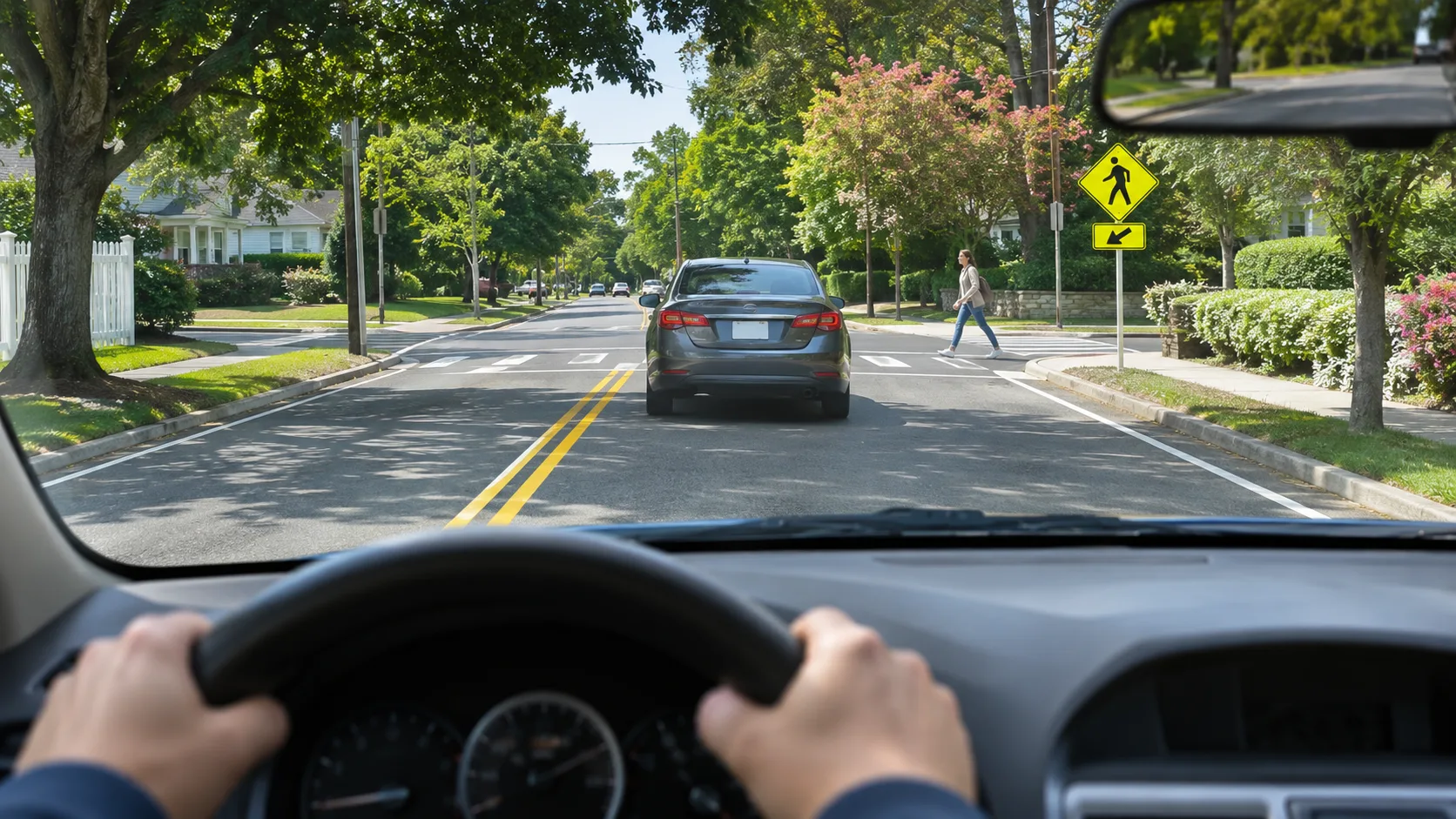
Driver leaving room behind another car near a pedestrian crossing on a suburban street.
Quick Answer & Key Takeaways
Defensive driving means looking ahead, leaving space, staying focused, and preparing for other road users to make mistakes. The goal is to spot a hazard early enough to slow, steer, or stop smoothly.
- Scan far ahead and check mirrors regularly.
- Leave a following gap you can increase in rain, darkness, or heavy traffic.
- Keep a safe escape option and never assume another driver sees you.
The 10 core principles
1. Look far ahead
Watch the roadway well beyond the car directly in front of you. A brake light several vehicles ahead or a person approaching a crosswalk gives you time to ease off the accelerator before you need to brake hard.
2. Scan the sides and mirrors
Check sidewalks, driveways, side streets, and mirrors as part of a steady scan. Do not stare at a single hazard so long that you miss a new one elsewhere.
3. Keep space in front
Pick a fixed roadside object and count the seconds from when the vehicle ahead passes it until you do. Use a generous gap and add more time when visibility or traction is poor. Following too closely removes your time to respond.
4. Protect an escape route
Avoid staying boxed in beside another vehicle. When practical, keep open space to at least one side so you have room to respond if the vehicle ahead stops suddenly.
5. Expect mistakes
A turn signal is a clue, not a promise. A driver may turn without signaling, a pedestrian may step into the road, or a parked car door may open. Slow and leave room when a mistake is possible.
6. Make yourself visible
Use required lights in low visibility, signal early, and avoid lingering in another vehicle’s blind spot. Position your car where others have a reasonable chance to see it.
7. Manage speed for conditions
The posted limit does not guarantee a safe speed in rain, fog, darkness, or congestion. Reduce speed until you can see and stop within the clear road ahead.
8. Eliminate distractions
Set navigation before moving, silence avoidable alerts, and pull over safely if a task needs your eyes or hands. Even a short glance away can hide a changing traffic scene.
9. Stay rested and calm
Fatigue and anger narrow attention. If you are sleepy, stop somewhere safe and rest or arrange another driver. When someone drives aggressively, give them space instead of competing for position.
10. Buckle up and drive sober
Every trip starts with an appropriate seat belt or child restraint. Never drive after drinking or using impairing drugs. Planning a safe ride is part of defensive driving, not an afterthought.
A real-world example
Approaching a busy crosswalk
You see a car stopped in the next lane near a marked crosswalk. Do not pass it just because your lane looks clear. Ease off the gas, cover the brake, and look for a pedestrian hidden by that vehicle. This is defensive driving: noticing an incomplete view and creating time to react.
Practice without overthinking
Use a simple scan routine
Look well ahead, check the immediate path, glance at mirrors, then repeat. At every intersection ask: What could enter my path, and where would I go if it did? A calm, repeatable routine is more useful than trying to predict every possibility.
Putting this into practice
Why defensive driving feels slower at first
A new driver often spends most of their attention keeping the car centered. Adding a scan of mirrors, sidewalks, and intersections can feel like too much. Start on familiar, quiet roads with a qualified supervisor. Say aloud what you see: a brake light ahead, a driveway, a cyclist, or a traffic signal changing. The exercise makes your observations deliberate. As the routine becomes familiar, you can do it silently and with less effort.
Make room before you need it
Many close calls begin when a driver waits for proof that a problem is real. If a ball rolls toward the street, a child may follow. If a bus stops, someone may cross in front of it. You do not need to panic or make an abrupt move. Ease off the accelerator early, cover the brake when appropriate, and keep looking for the missing part of the scene. Small early adjustments are usually smoother than a last-second reaction.
Remember the limits of your view
At night, around a curve, or beside a tall truck, you cannot react to what you cannot see. Increase your margin by slowing down and leaving more space. If you cannot see past a parked vehicle near a crosswalk, treat the hidden area as a possible conflict point. That does not mean assuming danger at every moment; it means matching your speed and attention to how much of the road you can actually observe.
Use the habit on ordinary trips
Defensive driving is most valuable on routine journeys when it is easy to drift into autopilot. Before moving, put the phone away and set the route. During the trip, check your gap, mirrors, and the next likely conflict point. After a difficult moment, ask what early clue you noticed and what you could do sooner next time. That quick reflection builds judgment without turning every drive into a stressful test.
Frequently asked questions
Is defensive driving only for new drivers?
No. Experienced drivers benefit because familiar routes can encourage autopilot. The same scanning and space habits work on every trip.
Does a defensive driving course replace practice?
No. A course can explain habits, but supervised practice and feedback are how you apply them on real roads.
How much following space is enough?
There is no single distance that works at every speed and in every condition. Count time, not car lengths: choose a fixed point, watch the vehicle ahead pass it, and count until you reach it. If you catch up before you finish your chosen count, ease off the accelerator. Add more time when the road is wet, the view is blocked, or you are following a large vehicle. Never use a counting rule as permission to drive faster than conditions allow.
What should you watch at intersections?
Look for the full conflict area, including sidewalks and crosswalks. A green light tells you when you may proceed, but it does not prove that cross traffic has stopped. Scan left, ahead, and right as you approach, and be ready for a turning vehicle or someone crossing late. If another car blocks your view, slow enough to give yourself time to see what is behind it.
How do you handle a tailgater?
Avoid braking suddenly to punish the driver behind you. Keep a steady speed, increase the space ahead of your own car, and change lanes or pull over at a safe place when possible. More room in front lets you brake gradually if traffic slows. If the driver acts threateningly, head toward a public place and seek help instead of engaging.
What does an escape route mean?
An escape route is an open area that may let you avoid a hazard. It could be a clear adjacent lane or extra room beside your vehicle. It is not an instruction to swerve onto a sidewalk or into oncoming traffic. Keep checking where nearby vehicles are so a safe option is available if you need one.
Can technology do the scanning for you?
Driver-assistance features can warn or help in some situations, but cameras and sensors can miss objects or struggle in poor weather. Keep your eyes on the road and follow the instructions for your vehicle. Treat a warning as extra information, not proof that the system will prevent a crash.
Build your road knowledge with a free DMV practice test, and review the guidance in your state driver handbook.
Authoritative Sources & Regulatory References
Content and statutory guidelines in this guide are verified against official state vehicle codes, federal transportation standards, and authoritative regulatory documentation: