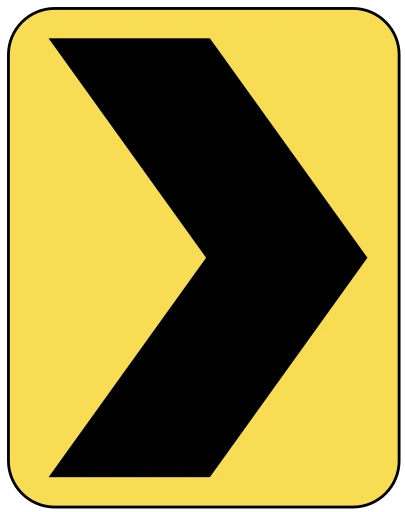
Warning Road Sign (W1-8)
Chevron Alignment Sign Sign Meaning & Driving Rules
Provides continuous visual guidance along the outer edge of a sharp curve to delineate the exact path of the roadway.
Required Driver Action & Right-of-Way Protocol
Follow the arc delineated by the chevron signs. Keep your speed within the posted advisory limit.
Detailed Overview & Purpose
Chevron Alignment signs (W1-8) are installed in groups of three or more along the outside perimeter of sharp curves and interchange ramps. They act as visual guideposts, illuminating the curve's radius as vehicle headlights sweep across them.
Chevrons are spaced according to road speed and curve radius: tighter curves have chevrons positioned closer together to provide unbroken visual guidance.
Always steer so your vehicle stays inside the boundary defined by the chevron sequence.
Key Standard & Origin: Chevrons are among the most retroreflective devices on highways. They are designed to reflect headlight beams directly back to the driver's eyes from extreme angles.
Where You'll Find This Sign
Mounted sequentially around the outer circumference of sharp highway ramps, mountain curves, and rural bends.
Common Driver Mistakes to Avoid
Fixating directly on the chevron sign rather than looking ahead through the curve to the road's exit point.
How This Sign Appears on the DMV Knowledge & Road Test
Tests understanding of nighttime road delineation and curve alignment markers.
Legal Penalties and Moving Violations
Striking chevron markers due to speed-induced understeer carries property damage and moving violation fines.
Sign Variations & Related Types
Left Chevron (W1-8L)
Chevron points left for curves bending left.
Right Chevron (W1-8R)
Chevron points right for curves bending right.
When you encounter the official Chevron Alignment Sign (W1-8) on a roadway, what is your legal duty?
Prepare for Your State Permit Exam
Take full 2026 practice tests covering mandatory road signs, traffic laws, and state-specific driving rules.