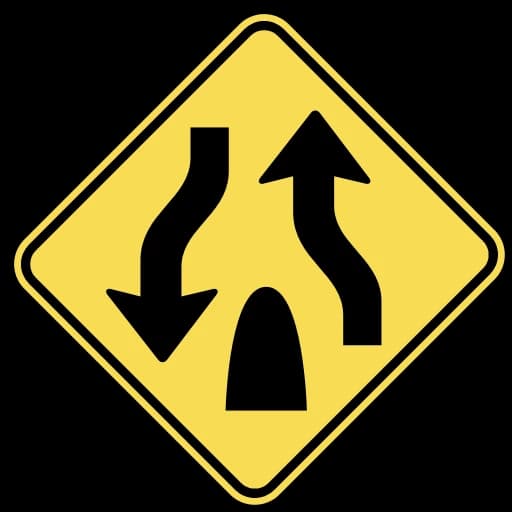
Warning Road Sign (W6-2)
Divided Highway Ends Sign Meaning & Driving Rules
The Divided Highway Ends sign (MUTCD W6-2) warns drivers that the physical median divider is ending and the roadway is transitioning back to a two-way undivided road.
Required Driver Action & Right-of-Way Protocol
Keep to the right of the yellow centerline. Be aware that oncoming vehicles will now be sharing the same paved roadway.
Detailed Overview & Purpose
The Divided Highway Ends sign alerts drivers that opposing traffic will no longer be separated by a physical median island or concrete barrier. The sign shows two opposing arrows with the median barrier graphic positioned at the bottom of the diamond.
Beyond this point, opposing traffic travels on the same undivided pavement separated only by painted yellow centerlines. Drivers must exercise heightened caution and keep firmly to the right.
Key Standard & Origin: Memorization tip: If the median divider is at the TOP, the divided highway begins; if the divider is at the BOTTOM, the divided highway ends.
Where You'll Find This Sign
Installed 200 to 750 feet in advance of the termination of a divided median highway.
Common Driver Mistakes to Avoid
Continuing to treat the left lane as a one-way highway lane after the median ends, risking head-on collisions.
How This Sign Appears on the DMV Knowledge & Road Test
Top-frequency DMV graphic sign question comparing W6-1 (Begins) vs. W6-2 (Ends).
Legal Penalties and Moving Violations
Crossing the centerline into opposing traffic carries severe moving violation citations.
Sign Variations & Related Types
Two-Way Traffic (W6-3)
Reinforces that two-way opposing traffic is now present on the undivided roadway.
When you encounter the official Divided Highway Ends (W6-2) on a roadway, what is your legal duty?
Prepare for Your State Permit Exam
Take full 2026 practice tests covering mandatory road signs, traffic laws, and state-specific driving rules.