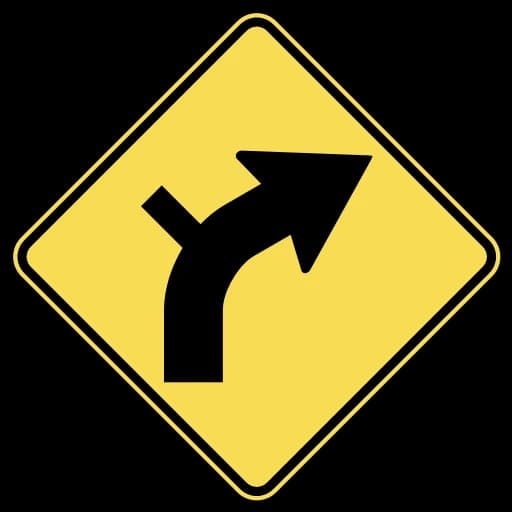
Warning Road Sign (W1-10)
Intersection in Curve Ahead Sign Meaning & Driving Rules
Warns that a side street or crossroad enters the roadway along the arc of an upcoming curve where sight distance is limited.
Required Driver Action & Right-of-Way Protocol
Reduce speed before entering the curve and scan the side-road junction carefully for entering vehicles or pedestrians.
Detailed Overview & Purpose
The Intersection in Curve sign (W1-10) alerts drivers that a side road joins the main road directly within a curve. This creates a double hazard: managing the physical curve while watching for vehicles entering or turning from the side street with obstructed sightlines.
Drivers on the side road often cannot see oncoming curve traffic until they have already pulled into the lane. Through-drivers must be prepared for entering vehicles.
Key Standard & Origin: Intersections located on curves have significantly higher collision rates because centrifugal force reduces braking efficiency at the exact location where conflict points exist.
Where You'll Find This Sign
Rural curves where secondary roads, farm lanes, or residential streets intersect within the arc of the curve.
Common Driver Mistakes to Avoid
Assuming the curve is clear without scanning the side road intersection for vehicles edging into the roadway.
How This Sign Appears on the DMV Knowledge & Road Test
Tests defensive driving at blind curve intersections.
Legal Penalties and Moving Violations
Failure to yield or failure to maintain safe speed in curve intersections results in moving violation citations.
Sign Variations & Related Types
Side Road Inside Curve
Side road joins from the inner radius of the curve.
Side Road Outside Curve
Side road joins from the outer radius of the curve.
When you encounter the official Intersection in Curve Ahead (W1-10) on a roadway, what is your legal duty?
Prepare for Your State Permit Exam
Take full 2026 practice tests covering mandatory road signs, traffic laws, and state-specific driving rules.