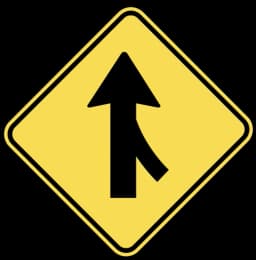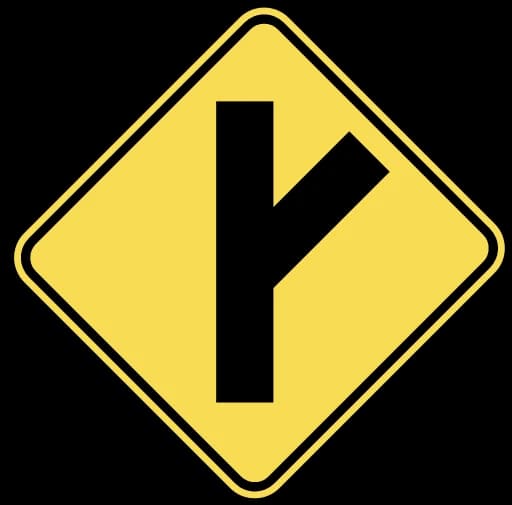
Warning Road Sign (W2-3)
Side Road at an Angle Sign Meaning & Driving Rules
Warns of a side road entering the highway at an acute or obtuse angle rather than a 90-degree perpendicular intersection.
Required Driver Action & Right-of-Way Protocol
Slow down slightly and cover the brake. Watch for vehicles pulling into your lane from the angled entrance.
Detailed Overview & Purpose
The Side Road at an Angle sign (W2-3) indicates an upcoming intersection where the crossing road meets the highway at an angle. Angled intersections create severe blind spots for drivers on the side road who must look over their shoulders at awkward angles to see oncoming traffic.
Through-drivers should exercise extra caution because entering drivers have restricted field of view.
Key Standard & Origin: Angled intersections have higher collision rates because drivers must turn their heads up to 135 degrees to see oncoming traffic before pulling out.
Where You'll Find This Sign
Skewed rural crossroads, railroad-adjacent roads, and historic diagonal street connections.
Common Driver Mistakes to Avoid
Not recognizing that side-street drivers have acute blind spots and may pull out directly in front of you.
How This Sign Appears on the DMV Knowledge & Road Test
Tests awareness of blind spots caused by non-perpendicular road geometry.
Legal Penalties and Moving Violations
Moving violation points apply for failing to take reasonable care at skewed junctions.
Sign Variations & Related Types
Angled Road Right (W2-3R)
Angled branch joins from the right.
Angled Road Left (W2-3L)
Angled branch joins from the left.
When you encounter the official Side Road at an Angle (W2-3) on a roadway, what is your legal duty?
Prepare for Your State Permit Exam
Take full 2026 practice tests covering mandatory road signs, traffic laws, and state-specific driving rules.