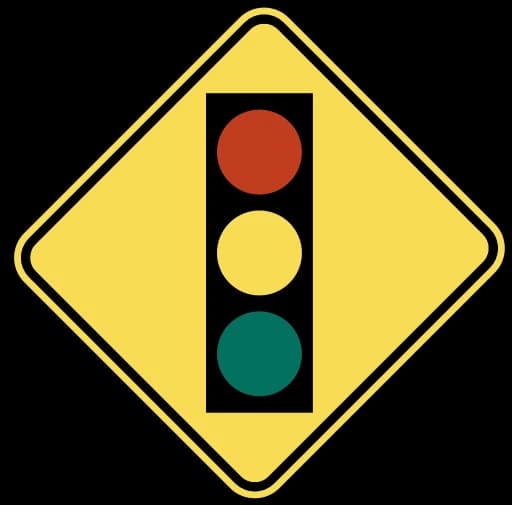
Warning Road Sign (W3-3)
Traffic Signal Ahead Sign Meaning & Driving Rules
The Traffic Signal Ahead sign (MUTCD W3-3) alerts drivers that a traffic control signal is operating ahead at an intersection, prompting preparation for potential red light stops.
Required Driver Action & Right-of-Way Protocol
Scan ahead for the signal lenses, monitor traffic queues, and modulate speed to allow for a safe, gradual stop if the light turns yellow or red.
Detailed Overview & Purpose
Traffic signals installed around blind curves, over hilltops, or on high-speed rural expressways present significant rear-end crash risks if approaching drivers are caught off guard. The Traffic Signal Ahead sign displays a bold pictorial graphic of a three-lens traffic light (red, yellow, green) inside a yellow diamond.
When equipped with advance flashing yellow beacons, the flashing lights indicate that the upcoming signal is currently red or about to change, requiring immediate deceleration.
Key Standard & Origin: When paired with 'PREPARED TO STOP WHEN FLASHING' strobe plaques, the sign communicates with the signal controller to warn drivers miles in advance.
Where You'll Find This Sign
Installed on high-speed highway corridors and visual-obstruction approaches 300 to 1,000 feet before signalized intersections.
Common Driver Mistakes to Avoid
Maintaining full cruising speed over hill crests assuming the signal will be green upon arrival.
How This Sign Appears on the DMV Knowledge & Road Test
Frequently tested in intersection safety and defensive driving modules.
Legal Penalties and Moving Violations
Running the red light at the upcoming signal results in heavy moving violation citations ($250–$500).
Sign Variations & Related Types
Signal Ahead with Flashing Beacons
Equipped with synchronized flashing lights activated when the signal turns yellow or red.
When you encounter the official Traffic Signal Ahead (W3-3) on a roadway, what is your legal duty?
Prepare for Your State Permit Exam
Take full 2026 practice tests covering mandatory road signs, traffic laws, and state-specific driving rules.