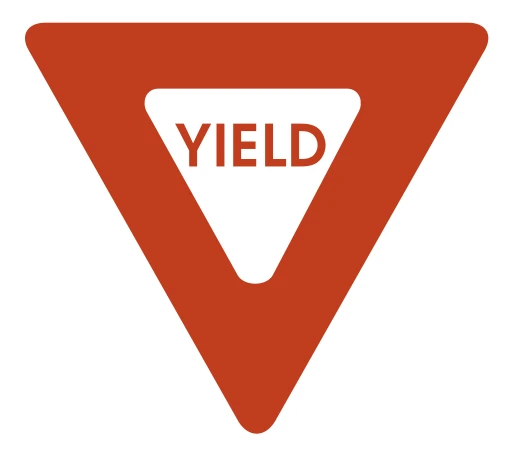
Regulatory Road Sign (R1-2)
Yield Sign Sign Meaning & Driving Rules
The Yield sign (MUTCD R1-2) is a fundamental regulatory sign instructing drivers to slow down to a safe, reasonable speed and yield the right-of-way to any vehicle, bicyclist, or pedestrian in the roadway they are about to cross or merge into.
Required Driver Action & Right-of-Way Protocol
Slow down significantly as you approach the intersection or merge point. Check mirrors and scan for oncoming traffic, circulating vehicles, and crossing pedestrians. If traffic is present, stop smoothly behind the yield line and wait for a safe gap. If the roadway is completely clear, proceed smoothly without stopping.
Detailed Overview & Purpose
Unlike a Stop sign, the Yield sign does not mandate a complete stationary halt if the roadway is clear and merging can be executed safely without impeding other traffic. However, the legal obligation to yield is absolute: if any vehicle, cyclist, or pedestrian is approaching close enough to constitute an immediate hazard, the driver facing the yield sign must come to a full stop and wait until the roadway is clear.
Yield signs are the primary regulatory mechanism at modern roundabouts, where entering motorists must yield right-of-way to vehicles already circulating inside the circular roadway. They are also standard at freeway on-ramps without acceleration lanes, channelized right-turn slip lanes, and secondary rural road junctions entering multi-lane divided highways.
The inverted triangular geometry was adopted by international convention and incorporated into the MUTCD to ensure immediate recognizability under adverse weather, faded paint, or back-lit lighting conditions.
Key Standard & Origin: The downward-pointing equilateral triangle is exclusive to Yield signs in the United States. No other traffic sign uses this inverted triangular shape, allowing drivers to recognize the yielding command from hundreds of feet away even if the red and white surface text is faded or obscured.
Where You'll Find This Sign
Positioned at roundabout entry points, channelized intersection right-turn bypass lanes, freeway entrance ramp merge points, bicycle boulevard crossings, and minor street intersections where full stops are unnecessary for traffic flow.
Common Driver Mistakes to Avoid
Treating a yield sign as a stop sign when the road is completely clear, causing rear-end collisions with trailing motorists. Conversely, failing to slow down adequately and aggressively forcing entry ahead of circulating roundabout traffic or oncoming highway vehicles. Drivers also frequently fail to yield to pedestrians in channelized right-turn crosswalks.
How This Sign Appears on the DMV Knowledge & Road Test
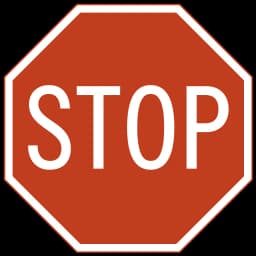
DMV written tests frequently test the core difference between Stop and Yield: a Stop sign requires a full halt every time, whereas a Yield sign requires slowing down and stopping only when necessary to yield right-of-way. Roundabout yielding rules are also among the most common questions on modern 2026 permit exams.
Legal Penalties and Moving Violations
Failure to yield right-of-way carries moving violation citations ($100 to $300), 2 driving record points, and establishes full civil fault liability in the event of an intersection collision.
Sign Variations & Related Types
Yield Here to Pedestrians (R1-5 / R1-5a)
Mounted alongside mid-block crosswalks accompanied by white yield triangles painted on the pavement to protect pedestrians.
Yield to Oncoming Traffic (R1-4)
Posted at single-lane bridges and traffic-calming chicanes where opposing traffic shares a single travel lane.
Roundabout Yield (R1-2a)
A Yield sign paired with a circular roundabout symbol plaque indicating circulating traffic has right-of-way.
When you encounter the official Yield Sign (R1-2) on a roadway, what is your legal duty?
Prepare for Your State Permit Exam
Take full 2026 practice tests covering mandatory road signs, traffic laws, and state-specific driving rules.