New York DMV Permit Test: Requirements, 5-Hour Course & Study Guide
Mastering statutory driver licensing regulations and highway laws ensures first-time test success.
Quick Answer & Key Takeaways
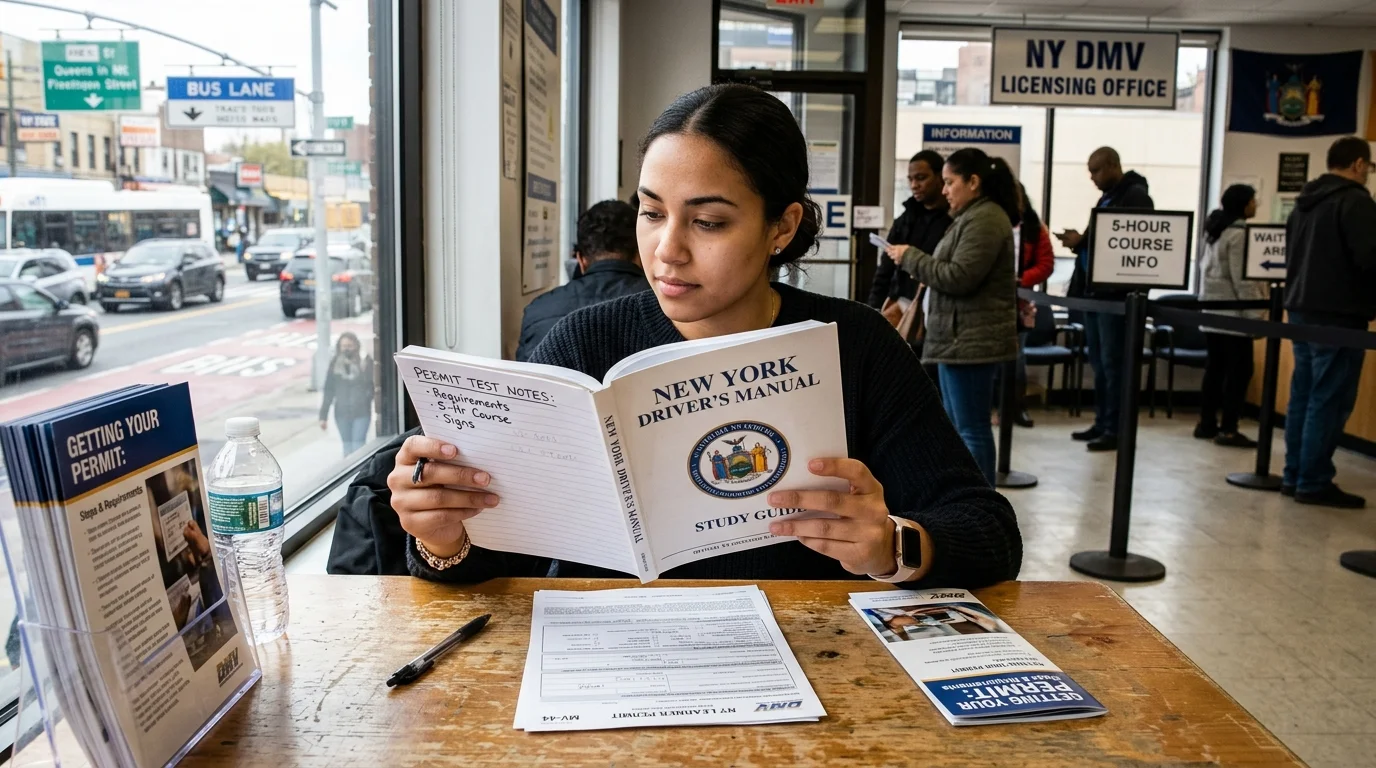
New York State DMV learner permit requirements and testing format: 1) TEST FORMAT: 20 multiple-choice questions; you must answer at least 14 correctly (70% overall), BUT YOU MUST GET AT LEAST 2 OUT OF 4 ROAD SIGN QUESTIONS CORRECT. Failing the road sign section causes an automatic failure regardless of total score. 2) 5-HOUR PRE-LICENSING COURSE: Mandatory 5-hour classroom or online course (Form MV-278) required before scheduling a road test. 3) NYC DRIVING BAN: Permit holders are STRICTLY PROHIBITED from driving in the 5 boroughs of New York City, on state parkways, or in bridge/tunnel zones.
- 20 Questions (14 correct to pass): 70% passing threshold.
- Mandatory Road Sign Section: Must get at least 2 of 4 road sign questions correct.
- Mandatory 5-Hour Course: Required to receive the MV-278 road test certificate.
- NYC Permit Ban: Permit holders cannot legally drive anywhere inside New York City.
I remember taking my New York permit test back in 2019, and honestly, I underestimated it. I grew up in Buffalo and thought I knew everything about driving because I'd been watching my parents drive for years. Turns out, there are a lot of New York-specific rules that you absolutely need to memorize, and common sense won't get you through all 20 questions.
What Makes the NY Permit Test Different
The New York DMV knowledge test is shorter than most states, with only 20 questions instead of the usual 30 or 40. You need to get 14 correct to pass, which is a 70% passing score. But here's the catch that trips people up: out of those 20 questions, 4 are specifically about road signs, and you must get at least 2 of those road sign questions correct. If you miss 3 out of 4 sign questions, you fail automatically, even if you ace everything else.
- Statutory Compliance: Obeying exact vehicle code thresholds rather than informal habits ensures zero penalty points on exam day.
- Defensive Safety Standard: Maintaining safe following distances and active visual scanning eliminates collision risks under Basic Speed Law principles.
- Hazard Recognition: Anticipating changing traffic patterns and road conditions allows proactive rather than reactive braking.
The test is based on the New York State Driver's Manual, which you can download for free from the NY DMV website. I'd recommend focusing on Chapters 4 through 11, which cover the rules of the road, traffic control, and safe driving practices.
New York City Has Different Rules
If you're taking the test in New York City or plan to drive there, you need to know this: turning right on red is illegal throughout all five boroughs unless there's a sign that specifically permits it. This is the opposite of what most Americans learn. In the rest of the country, you can turn right on red after stopping, unless there's a sign prohibiting it. In NYC, it's banned by default.
- Statutory Compliance: Obeying exact vehicle code thresholds rather than informal habits ensures zero penalty points on exam day.
- Defensive Safety Standard: Maintaining safe following distances and active visual scanning eliminates collision risks under Basic Speed Law principles.
- Hazard Recognition: Anticipating changing traffic patterns and road conditions allows proactive rather than reactive braking.
This rule catches a lot of people, especially those moving to New York from other states. The NYC Department of Transportation explains that this rule has been in effect since 1989 due to the high volume of pedestrian traffic.
Cell Phone Laws Are Stricter Here
New York has some of the toughest distracted driving laws in the country. You cannot hold a phone for any reason while driving, even if you're stopped at a red light. The law requires full hands-free operation. That means no texting, no holding the phone to your ear, and no scrolling through Spotify at a stoplight.
- Statutory Compliance: Obeying exact vehicle code thresholds rather than informal habits ensures zero penalty points on exam day.
- Defensive Safety Standard: Maintaining safe following distances and active visual scanning eliminates collision risks under Basic Speed Law principles.
- Hazard Recognition: Anticipating changing traffic patterns and road conditions allows proactive rather than reactive braking.
I've seen people get pulled over for checking their phone while stuck in traffic on the LIE. The fine starts at $50 for a first offense and goes up from there, plus you get points on your license. If you're under 18 with a junior license or learner's permit, you can't use a phone at all, not even hands-free. The New York DMV's safe driving chapter covers all of this in detail.
Winter Driving Questions Are Common
Living in New York means dealing with winter, and the DMV test reflects that. You'll probably see at least one or two questions about driving in snow, ice, or reduced visibility conditions. Black ice is a big topic because it's invisible and extremely dangerous. The test wants to make sure you know to reduce your speed and avoid sudden braking or steering when roads might be icy.
- Statutory Compliance: Obeying exact vehicle code thresholds rather than informal habits ensures zero penalty points on exam day.
- Defensive Safety Standard: Maintaining safe following distances and active visual scanning eliminates collision risks under Basic Speed Law principles.
- Hazard Recognition: Anticipating changing traffic patterns and road conditions allows proactive rather than reactive braking.
Hydroplaning is another common question. A lot of people think hydroplaning happens during heavy rainstorms, but it's actually most dangerous during the first few minutes of light rain. That's when the water mixes with oil and dirt on the road surface, creating a slippery film. Once it rains harder, the road gets washed clean. This is counterintuitive, which is why the DMV loves to test it.
The Six Points of ID Requirement
Before you can even take the test, you need to prove your identity with documents that add up to at least six points. This is probably the most frustrating part of the process because a lot of people show up to the DMV without the right documents and get turned away.
- Statutory Compliance: Obeying exact vehicle code thresholds rather than informal habits ensures zero penalty points on exam day.
- Defensive Safety Standard: Maintaining safe following distances and active visual scanning eliminates collision risks under Basic Speed Law principles.
- Hazard Recognition: Anticipating changing traffic patterns and road conditions allows proactive rather than reactive braking.
A US passport is worth 4 points, and a Social Security card is worth 2 points, so that combination works for most people. Your birth certificate is also worth 4 points if it's an original or certified copy. You can find the full list of acceptable documents on the NY DMV's ID Requirements guide. I'd recommend checking that page before you go to avoid wasting a trip.
Interactive Knowledge Check
Question: On the New York State DMV written permit test, what special requirement must be met in addition to answering 14 of 20 total questions correctly?
Authoritative Sources & Regulatory References
Content and statutory guidelines in this guide are verified against official state vehicle codes, federal transportation standards, and authoritative regulatory documentation:
- AAMVAOfficial State Driver Handbooks & Licensing Examination Criteria (2026)(American Association of Motor Vehicle Administrators)
- NHTSANational Highway Traffic Safety Administration (NHTSA) Uniform Guidelines for State Highway Safety(National Highway Traffic Safety Administration)
- FHWAFederal Highway Administration (FHWA) Manual on Uniform Traffic Control Devices (MUTCD)(Federal Highway Administration)
88% of people found this article helpful.
Click a star to add your vote
278 votes • average 4.44 out of 5
Official 2026 DMV Practice Tests by State
Select your state to practice real exam questions based on the latest 2026 driver handbook.
Ready to Pass the DMV Test on Your First Try?
Practice real 2026 DMV questions with instant answer explanations, simulated timers, and pass-guarantee study guides.
Start Free Practice Test