How to Pass the DMV Permit Test on Your First Try: 7 Habits
Mastering statutory driver licensing regulations and highway laws ensures first-time test success.
Quick Answer & Key Takeaways
7 proven habits to pass your DMV knowledge test on the first try: 1) TAKE 10+ MOCK TESTS: Focus on question-based learning through spaced repetition. 2) MASTER STATUTORY NUMBERS: Memorize speed limits, parking distances, and BAC limits. 3) LEARN SIGN SHAPES: Know warning diamonds, regulatory rectangles, and octagons by silhouette. 4) ELIMINATE 2 WRONG ANSWERS: Every DMV question has 2 obviously incorrect options. 5) USE THE SKIP BUTTON: Pass hard questions first to bank easy points. 6) DEFENSIVE BIAS: Pick the safest answer when torn. 7) PREPARE DOCUMENTS & SLEEP: Arrive with original paperwork and 8 hours of rest.
- Spaced Repetition: Study 30 minutes a day for 5 days rather than cramming overnight.
- Process of Elimination: Cross out extreme answers ('always', 'never') to find the safest choice.
- Skip Function on Touchscreens: Bank 30+ correct answers before tackling tricky questions.
- Defensive Answer Bias: When uncertain, select the option that maximizes pedestrian and collision safety.
Spaced Repetition Mock Testing (Not Overnight Cramming)
The most common reason for DMV exam failure is cramming the driver handbook for 6 continuous hours the night before the test. Cognitive science demonstrates that passive reading leads to rapid memory decay.
- Active Retrieval Testing: Taking full-length practice tests forces your brain to retrieve rules under timed exam conditions, cementing neural recall under spaced repetition study strategies.
- Daily 30-Minute Micro-Sessions: Studying 25 to 30 minutes per day over five consecutive days yields over 85% higher retention than a single marathon study night.
- Review Explanations on Mistakes: Don't just memorize the correct letter—read why the other three choices were legally incorrect.
Memorize Non-Negotiable Statutory Numbers (Distances & Limits)
General intelligence cannot deduce arbitrary statutory numbers. Over 35% of missed questions on state DMV written exams involve exact numerical thresholds:
- Parking Distance Thresholds: 15 feet from a fire hydrant, 20 feet from an unmarked crosswalk at an intersection, and 50 feet from a railroad crossing.
- Curb Proximity: When parallel parking, your right-side tires must be within 18 inches (or 12 inches in select states) of the curb under standard parking laws.
- Turn Signaling Distance: You must activate your turn signal continuously for at least 100 feet prior to making a turn or lane change.
- Blind Intersections & Alleys: The speed limit is 15 MPH at blind intersections where visibility is under 100 feet in the last 100 feet of approach.
Master Road Signs by Silhouette Shape and Color
State knowledge exams frequently test road signs with the text blanked out, requiring you to identify the sign's mandatory action purely by shape and color palette:
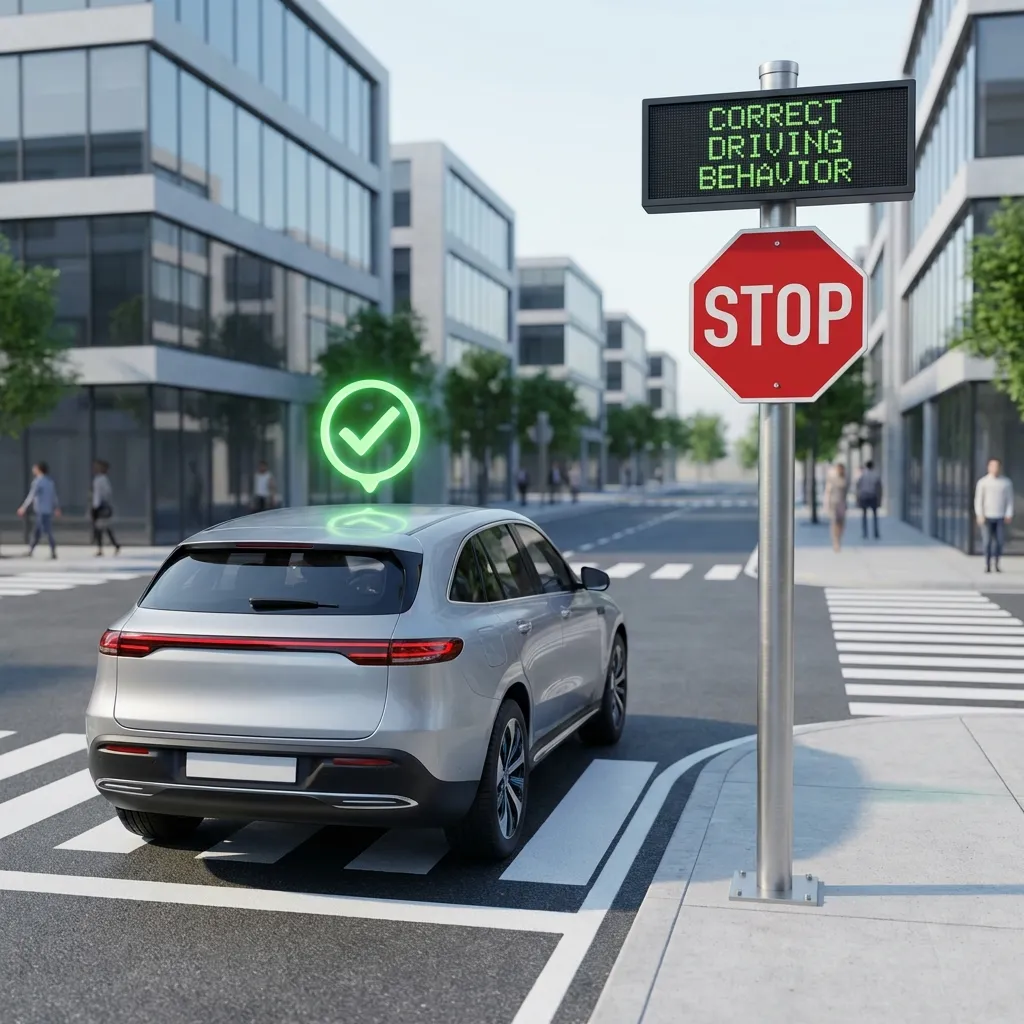
- Octagon (8 Sides): Exclusively reserved for STOP signs. Requires a complete 0.0 MPH halt behind the limit line.
- Inverted Equilateral Triangle: Exclusively reserved for YIELD signs. Requires slowing down and surrendering right-of-way.
- Pennant (Sideways Triangle): Posted exclusively on the LEFT side of the highway to mark NO PASSING ZONES under MUTCD traffic sign standards.
- Fluorescent Pentagon: Indicates School Zones and school crosswalks.
Eliminate the Two Obvious Distractor Options
Almost every multiple-choice question on a DMV written exam is structured with four options:
- Two Obvious Distractors: One is blatantly illegal (e.g., "Speed up to beat the train") and one is overly passive or irrelevant (e.g., "Turn off your engine in the travel lane").
- Cross Out the Extremes: Eliminate choices containing absolute words like "Always", "Never", or "Immediately honk your horn".
- Focus on the Final Two: Eliminating the two distractors instantly boosts your odds from a 25% blind guess to a 50/50 probability.
Default to the Most Defensive Safety Choice When in Doubt
When you are genuinely stuck between two plausible answers on a knowledge exam, remember the primary mission of the Department of Motor Vehicles: collision reduction and pedestrian protection.
- Yield to Pedestrians: Pedestrians in marked or unmarked crosswalks always have the statutory right-of-way.
- Slow Down for Conditions: Under the Basic Speed Law, reducing speed and widening your following distance to 4+ seconds is virtually always the legally correct response.
- Never Insist on Right-of-Way: If another driver fails to yield at a 4-way stop, the correct legal answer is to yield and let them proceed safely to avoid a crash.
Organize Original Documents & Rest Before Exam Day
Test performance is directly tied to physiological preparation and administrative calm:
- 8 Hours of Sleep: Sleep deprivation slows cognitive processing and leads to misreading trickily worded questions (e.g., missing words like "EXCEPT" or "NOT").
- Organize Certified Paperwork: Prepare your original certified birth certificate, Social Security proof, two residency utility bills, and application confirmation number in a folder the evening before.
- Arrive 30 Minutes Early: Rushing to an appointment spikes cortisol and anxiety, triggering test panic.
The 7 Habits First-Time Passing Benchmark Matrix
The following matrix summarizes the 7 essential preparation habits and their concrete exam impact:
| Habit # | Core Preparation Habit | Primary Test Advantage |
|---|---|---|
| Habit 1 | Spaced Repetition Mock Tests | Builds active recall memory under timed conditions |
| Habit 2 | Memorize Statutory Numbers | Secures points on arbitrary distance/speed thresholds |
| Habit 3 | Learn Sign Shapes & Colors | Enables instant recognition on blanked-out sign questions |
| Habit 4 | Eliminate 2 Distractor Answers | Elevates guessing odds to a 50/50 probability |
| Habit 5 | Use Touchscreen "Skip" | Banks passing score before facing complex questions |
| Habit 6 | Defensive Safety Bias | Aligns choices with DMV collision-prevention principles |
| Habit 7 | Document Prep & 8 Hours Rest | Eliminates intake stress and prevents misreading errors |
Interactive Knowledge Check
Question: When taking a state DMV written knowledge test on a computer terminal, how should you utilize the "Skip" button when encountering a difficult question?
Authoritative Sources & Regulatory References
Content and statutory guidelines in this guide are verified against official state vehicle codes, federal transportation standards, and authoritative regulatory documentation:
- AAMVAOfficial State Driver Handbooks & Licensing Examination Criteria (2026)(American Association of Motor Vehicle Administrators)
- NHTSANational Highway Traffic Safety Administration (NHTSA) Uniform Guidelines for State Highway Safety(National Highway Traffic Safety Administration)
- FHWAFederal Highway Administration (FHWA) Manual on Uniform Traffic Control Devices (MUTCD)(Federal Highway Administration)
89% of people found this article helpful.
Click a star to add your vote
284 votes • average 4.50 out of 5
Official 2026 DMV Practice Tests by State
Select your state to practice real exam questions based on the latest 2026 driver handbook.
Ready to Pass the DMV Test on Your First Try?
Practice real 2026 DMV questions with instant answer explanations, simulated timers, and pass-guarantee study guides.
Start Free Practice Test