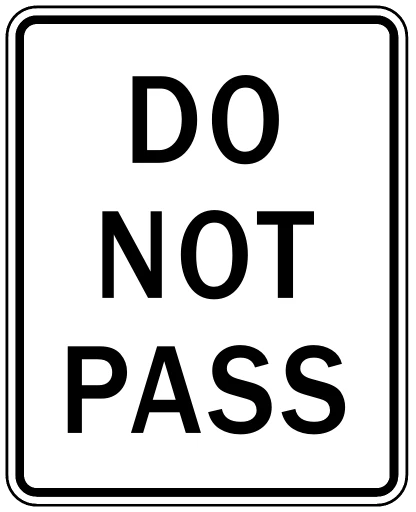
Regulatory Road Sign (R4-1)
Do Not Pass Sign Meaning & Driving Rules
The Do Not Pass sign (MUTCD R4-1) establishes a legally binding no-passing zone, prohibiting drivers from crossing into opposing lanes to overtake vehicles.
Required Driver Action & Right-of-Way Protocol
Stay firmly in your lane behind the vehicle ahead. Maintain a safe following distance and do not cross the center yellow line.
Detailed Overview & Purpose
The Do Not Pass sign is installed on two-lane undivided highways where sight distance is restricted by horizontal curves, vertical hills, bridges, or intersections. It is positioned on the right side of the roadway and reinforced by a solid yellow centerline on your side of the road.
You must not cross the center yellow line to overtake any vehicle while in this zone, regardless of how slowly the vehicle ahead is traveling.
Key Standard & Origin: On the opposite (left) side of the road, this sign is paired with the yellow pennant-shaped 'NO PASSING ZONE' warning sign.
Where You'll Find This Sign
Installed on the right shoulder before blind curves, hill crests, railroad crossings, and bridges on two-lane highways.
Common Driver Mistakes to Avoid
Attempting to pass slow agricultural machinery, postal delivery trucks, or cyclists inside a posted no-passing zone.
How This Sign Appears on the DMV Knowledge & Road Test
Passing laws and centerline markings (solid yellow vs. broken yellow) are tested on every state permit exam.
Legal Penalties and Moving Violations
Passing in a no-passing zone carries 3 to 4 license points, heavy fines, and immediate road test failure.
Sign Variations & Related Types
Pass With Care (R4-2)
Marks the formal conclusion of the no-passing zone where passing is once again permitted when safe.
When you encounter the official Do Not Pass (R4-1) on a roadway, what is your legal duty?
Prepare for Your State Permit Exam
Take full 2026 practice tests covering mandatory road signs, traffic laws, and state-specific driving rules.