Double Solid White Lines: Can You Ever Cross Them Legally?
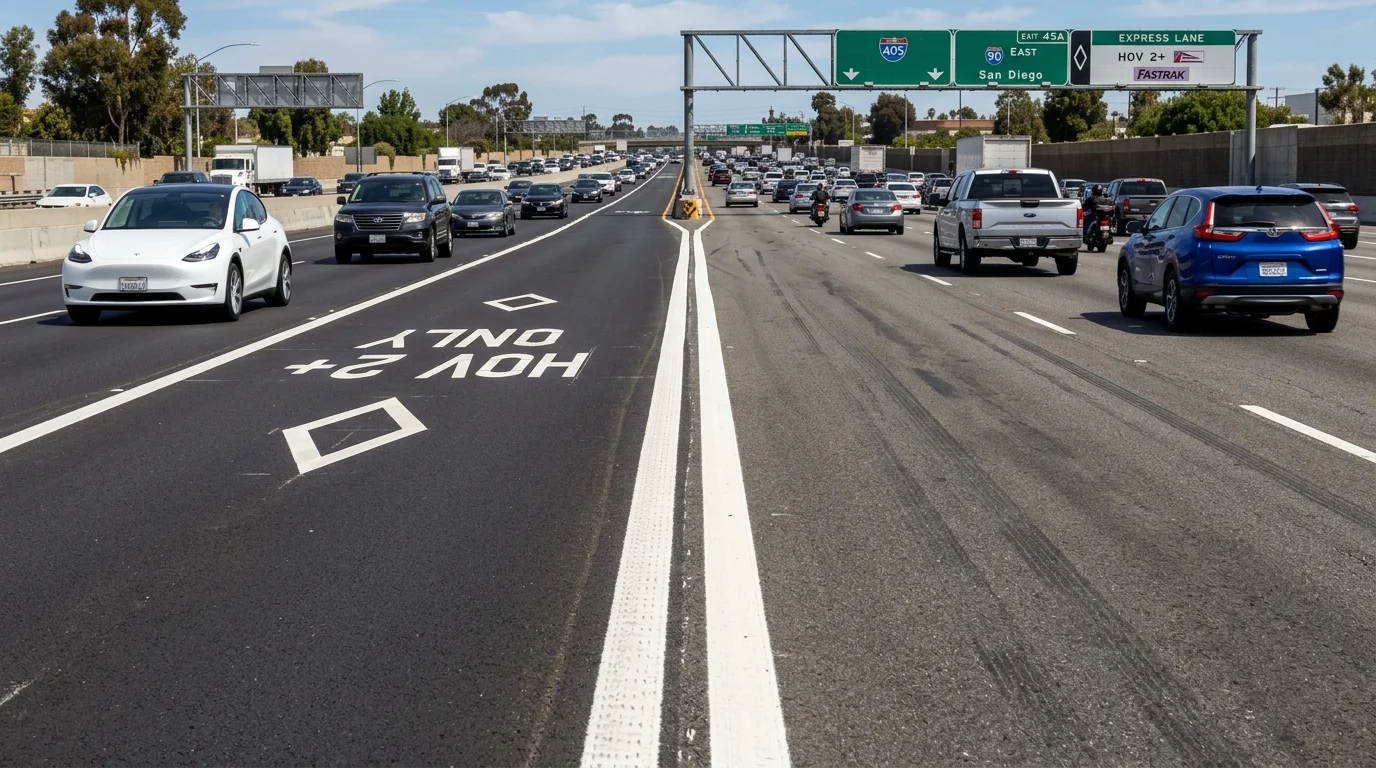
Double solid white lines indicate that lane changes are strictly prohibited between lanes of traffic moving in the same direction.
Quick Answer & Key Takeaways
Under US federal highway standards, DOUBLE SOLID WHITE LINES indicate that lane changes are strictly prohibited. You may NEVER cross double solid white lines to change lanes, enter/exit carpool lanes, or pass vehicles moving in the same direction. You must maintain your lane until the markings transition into broken dashed white lines. The only narrow exception is when directed by a police officer or emergency responder around an active crash.
- Absolute Prohibition: Crossing double solid white lines is illegal under all routine driving conditions.
- Separates same-direction traffic: White lines separate traffic moving in the same direction; double solid lines act as a legal barrier.
- Common in HOV/HOT buffer zones: Used to prevent high-speed weaving between express lanes and general traffic lanes.
- Automatic Road Test Fail: Crossing a double solid white line during a DMV driving test is an immediate critical safety disqualification.
The Absolute Prohibition Against Crossing Double Solid White Lines
While most drivers understand that double solid yellow lines prohibit crossing into oncoming traffic to pass, many motorists are confused about the meaning of double solid white lines.
Under FHWA MUTCD Section 3B.04 standards, white lines delineate traffic lanes traveling in the same direction.
When painted as double solid lines, they establish an absolute statutory mandate: LANE CHANGES ARE STRICTLY PROHIBITED. You must remain centered within your current travel lane. Crossing double solid white lines is a moving violation subject to heavy citations and points under state vehicle codes.
Single Solid White vs. Double Solid White: Key Legal Differences
Drivers frequently confuse single and double solid white pavement markings:
- Single Solid White Line: Indicates that lane changes are discouraged due to safety hazards, but not strictly illegal unless accompanied by regulatory signage. Commonly used on intersection approaches, toll plazas, and highway merge tapers.
- Double Solid White Line: Indicates that lane changes are STRICTLY PROHIBITED BY LAW. Crossing them is an enforceable moving violation under California Vehicle Code § 21655.8.
The 4 Common Locations Where You Encounter Double Solid White Lines
Traffic engineers deploy double solid white lines in four high-risk roadway environments:
Express Toll (HOT) & Carpool (HOV) Buffer Zones
As explained in our guide on HOV and Carpool Lane rules, double solid white lines separate 65+ mph express lanes from congested stop-and-go general purpose lanes. They prevent sudden speed differential collisions caused by drivers swerving unpredictably into high-speed carpool traffic.
Tunnels, Bridges, and Elevated Viaducts
In underwater tunnels (e.g., Lincoln Tunnel, Bay Bridge) and narrow bridge spans with zero emergency shoulders, double white lines prevent sideswipes that could cause gridlock or multi-car pileups in confined spaces.
Freeway Exit Ramp "Gore Points"
The triangular paved zone separating an exit ramp from the highway through lanes is bordered by double white lines (the gore area). Attempting to dive across the gore point at the last second to catch a missed exit is one of the leading causes of fatal highway rollover crashes under NHTSA crash research.
Dedicated Bike Lanes & Transit-Only Corridors
Double solid white lines buffer dedicated bicycle lanes and BRT (Bus Rapid Transit) lanes, prohibiting passenger cars from using them for driving or parking under curb parking rules.
Are There Any Legal Exceptions to Crossing Double White Lines?
There are virtually no routine exceptions for civilian motorists.
The only lawful circumstances under which you may cross double solid white lines are:
- Directed by an Emergency Officer: A police officer, highway patrol trooper, or Caltrans flagger explicitly waving you across to clear a blocked lane.
- Avoiding an Imminent Catastrophic Collision: Swerving across to avoid striking a pedestrian, rollover crash, or large fallen tree trunk blocking your lane.
Fines up to $490, DMV Points, and Road Test Disqualification
Enforcement is stringent:
- Traffic Fines: Crossing double white lines into an HOV or Express lane carries statutory fines of $490 or more.
- DMV Road Test Evaluation: Crossing a solid or double solid white line during your behind-the-wheel exam is scored as an immediate Automatic Failure for "Improper Lane Change / Violation of Road Markings" under DMV exam criteria.
Interactive Knowledge Check
Question: While driving on a freeway, you are traveling alongside a carpool lane separated by double solid white lines. Traffic in the general lanes slows to 20 mph, while the carpool lane is moving at 65 mph. Can you change lanes into the carpool lane?
Authoritative Sources & Regulatory References
Content and statutory guidelines in this guide are verified against official state vehicle codes, federal transportation standards, and authoritative regulatory documentation:
- FHWAWhite Lane Line Markings and Channelizing Lines (MUTCD Section 3B.04)(Federal Highway Administration)
- California LegislatureCalifornia Vehicle Code § 21655.8: Preferential Lane Line Crossing(State of California Vehicle Code)
- NHTSAFreeway Weaving Sections and High-Speed Sideswipe Mitigation(National Highway Traffic Safety Administration)
86% of people found this article helpful.
Click a star to add your vote
112 votes • average 4.32 out of 5
Official 2026 DMV Practice Tests by State
Select your state to practice real exam questions based on the latest 2026 driver handbook.
Ready to Pass the DMV Test on Your First Try?
Practice real 2026 DMV questions with instant answer explanations, simulated timers, and pass-guarantee study guides.
Start Free Practice TestRecommended Driver Guides

Solid Yellow Lines vs. Broken Yellow Lines: Passing Rules Decoded

HOV and Carpool Lane Rules: Occupancy Limits, Hours, and Clean Air Decals
