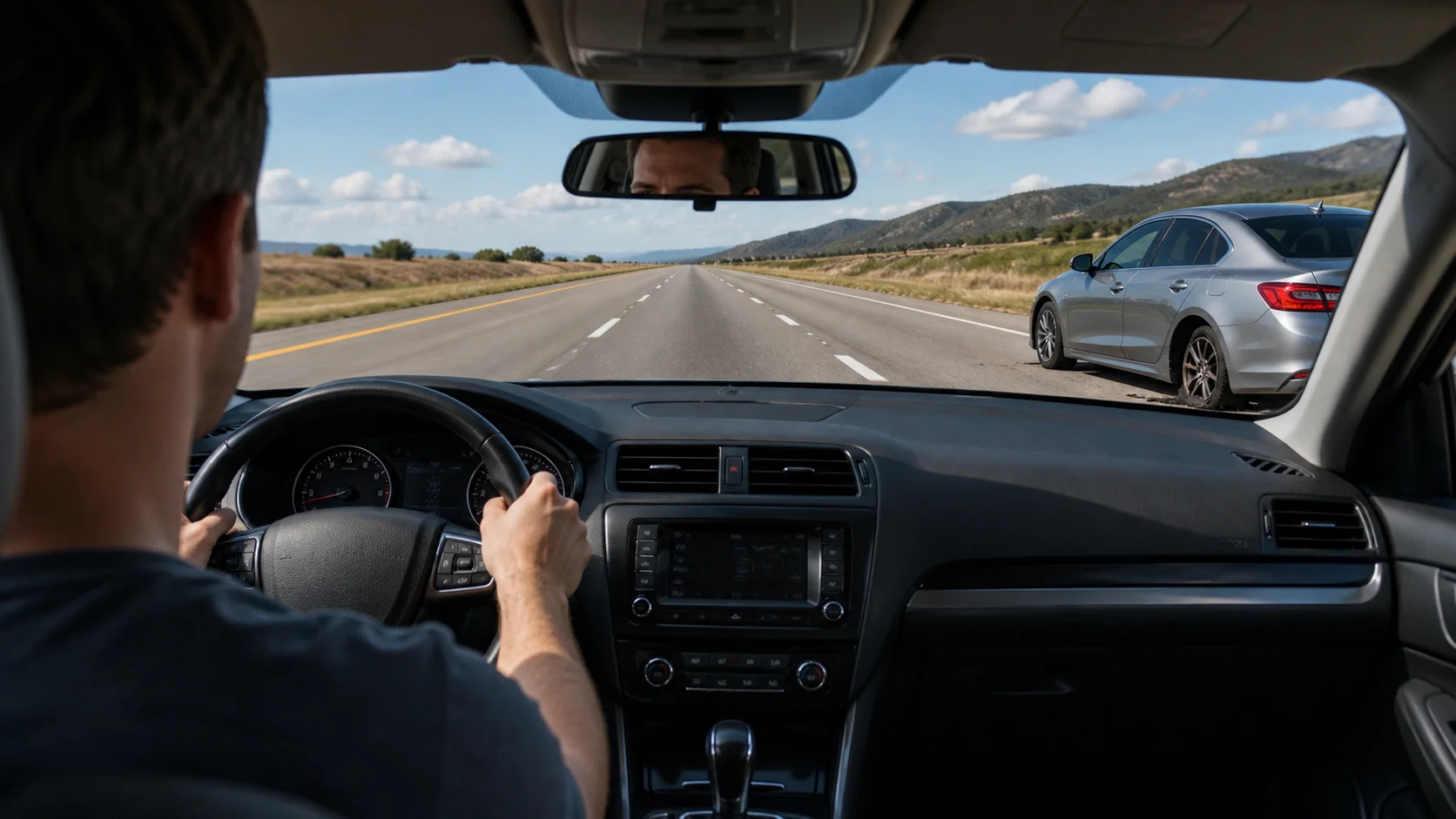
Downshifting & Engine Braking: Decelerate Without Cooking Brakes

Downshifting into a lower gear harnesses engine vacuum resistance to control descent speed without boiling brake fluid.
Quick Answer & Key Takeaways
Engine braking is the practice of decelerating a motor vehicle by shifting into a lower mechanical gear and releasing the accelerator pedal: 1) HOW IT WORKS: When the throttle plate closes at high engine RPM, engine pistons must pull against a strong intake manifold vacuum, creating mechanical resistance that slows the drive wheels without touching the brake pads. 2) PREVENTS BRAKE FADE: On steep mountain descents, riding the foot brake generates temperatures exceeding 600°F (315°C), boiling brake fluid and causing complete, catastrophic loss of hydraulic braking power (brake fade). 3) IN AUTOMATICS: Shift the gear lever from 'D' to '3', '2', 'L', or use steering wheel paddle shifters (-) to lock in a lower gear. 4) COASTING IS ILLEGAL: Coasting downhill in Neutral or with the clutch depressed is strictly prohibited under California CVC § 21708.
- Engine Vacuum Creates Retardation: Piston pumping resistance slows the vehicle naturally.
- Prevents 600°F Brake Boil: Engine braking preserves friction pads for sudden emergency stops.
- Automatics Have Low Gears: Use 'L', '2', or '-' paddle shifters to force transmission engine braking.
- Coasting in Neutral Is Illegal: Rolling in Neutral eliminates vehicle control and is a traffic violation.
The Thermodynamics of Brake Fade: Why Mechanical Brakes Fail on Hills
When descending a 6% or 8% mountain grade over several miles, a 3,500-pound passenger car converts massive amounts of kinetic energy into thermal friction.
According to SAE thermal braking research, holding continuous pressure on the brake pedal causes brake rotor and pad temperatures to exceed 600°F to 900°F (315°C to 480°C).
At these extreme temperatures, two fatal mechanical failures occur:
- Pad Glazing: Friction resins melt into a glass-smooth surface, creating zero grip against the steel rotor.
- Brake Fluid Vapor Lock: DOT 3 and DOT 4 hydraulic brake fluid boils inside the caliper lines, turning fluid into compressible gas bubbles—causing the brake pedal to drop straight to the floorboard with zero stopping force.
How Engine Braking Works: Manifold Vacuum & Piston Compression
Engine braking harnesses the internal combustion engine as an air compressor:
- When you lift your foot off the gas pedal, the engine throttle body closes.
- Because the transmission is locked to the drive wheels in a lower gear, the car's forward momentum forces the pistons to pump rapidly against a closed throttle intake valve.
- This creates a powerful manifold vacuum resistance (pumping loss) that acts as a natural mechanical retarder, holding vehicle speed steady without generating heat at the wheels.
Downshifting in Manuals: Rev-Matching & Smooth Gear Engagement
In a manual transmission vehicle, downshift before entering the steep descent:
- Brake straight to the target descent speed (e.g., 35 MPH).
- Depress the clutch pedal and move the shifter from 4th down to 3rd (or 2nd for steep switchbacks).
- Rev-Match (Throttle Blip): Tap the accelerator briefly with the clutch in to raise engine RPM to match the higher rotational speed of the lower gear (e.g., blip from 1,800 to 3,200 RPM).
- Release the clutch smoothly. The engine RPM will rise, and the car will hold steady speed down the grade.
Engine Braking in Automatics: D3, 2, L, Paddle Shifters & Grade Logic
Automatic transmissions are fully capable of engine braking:
- Shifter Gate (3, 2, 1 / L): Move the shifter out of "Drive" (D) into "3" or "2" or "L" (Low). This prevents the transmission from upshifting into high overdrive gears.
- Paddle Shifters (M-Mode): Pull the left steering wheel paddle shifter marked with a minus symbol (-) to downshift one or two gears.
- Electronic Grade Logic: Modern automatic transmissions automatically downshift when they detect continuous footbrake application while traveling downhill.
Steep Mountain Descents: The "Snub Braking" Protocol
Commercial truck drivers and mountain experts use the Snub Braking Method:
- Select a low transmission gear where the vehicle naturally cruises at 35 MPH.
- If speed creeps up to 40 MPH, apply firm, steady brake pressure for 3 to 5 seconds to reduce speed back down to 30 MPH (the "snub").
- Release the brake pedal completely for 15 to 20 seconds. This allows circulating ambient air to cool the rotors between braking cycles.
Engine Braking vs. Friction Brake Deceleration Table
| Deceleration Method | Thermal Load on Brakes | Brake Fade Risk | Ideal Application |
|---|---|---|---|
| Engine Braking (Lower Gear) | Zero Rotor Heat (Piston Vacuum) | 0% Fade Risk | Long mountain descents & steep hills |
| Snub Braking (Firm pulse + Cool) | Low to Moderate Heat Dissipation | Minimal | Trimming speed during engine braking |
| Continuous Brake Dragging | Extreme Heat (600°F–900°F+) | Catastrophic Brake Failure | Dangerous driving habit |
| Coasting Downhill in Neutral | 100% Load on Brakes | Extremely High | ILLEGAL under CVC § 21708 |
Interactive Knowledge Check
Question: Why is shifting into a lower gear (engine braking) rather than riding the foot brake recommended when driving down a steep, long mountain grade?
Authoritative Sources & Regulatory References
Content and statutory guidelines in this guide are verified against official state vehicle codes, federal transportation standards, and authoritative regulatory documentation:
- NHTSACommercial and Passenger Vehicle Mountain Grade Safety & Brake Thermal Fade Studies (DOT HS 810 933)(National Highway Traffic Safety Administration)
- SAE InternationalSAE Technical Standard J2807: Braking and Thermal Dissipation Under Heavy Load(SAE International Automotive Engineering)
- California LegislatureCalifornia Vehicle Code § 21708: Coasting Prohibited (Mandatory Gear Engagement)(California Vehicle Code)
90% of people found this article helpful.
Click a star to add your vote
39 votes • average 4.47 out of 5
Official 2026 DMV Practice Tests by State
Select your state to practice real exam questions based on the latest 2026 driver handbook.
Ready to Pass the DMV Test on Your First Try?
Practice real 2026 DMV questions with instant answer explanations, simulated timers, and pass-guarantee study guides.
Start Free Practice Test