How to Change Lanes Safely on Multi-Lane Highways (SMOG Guide)
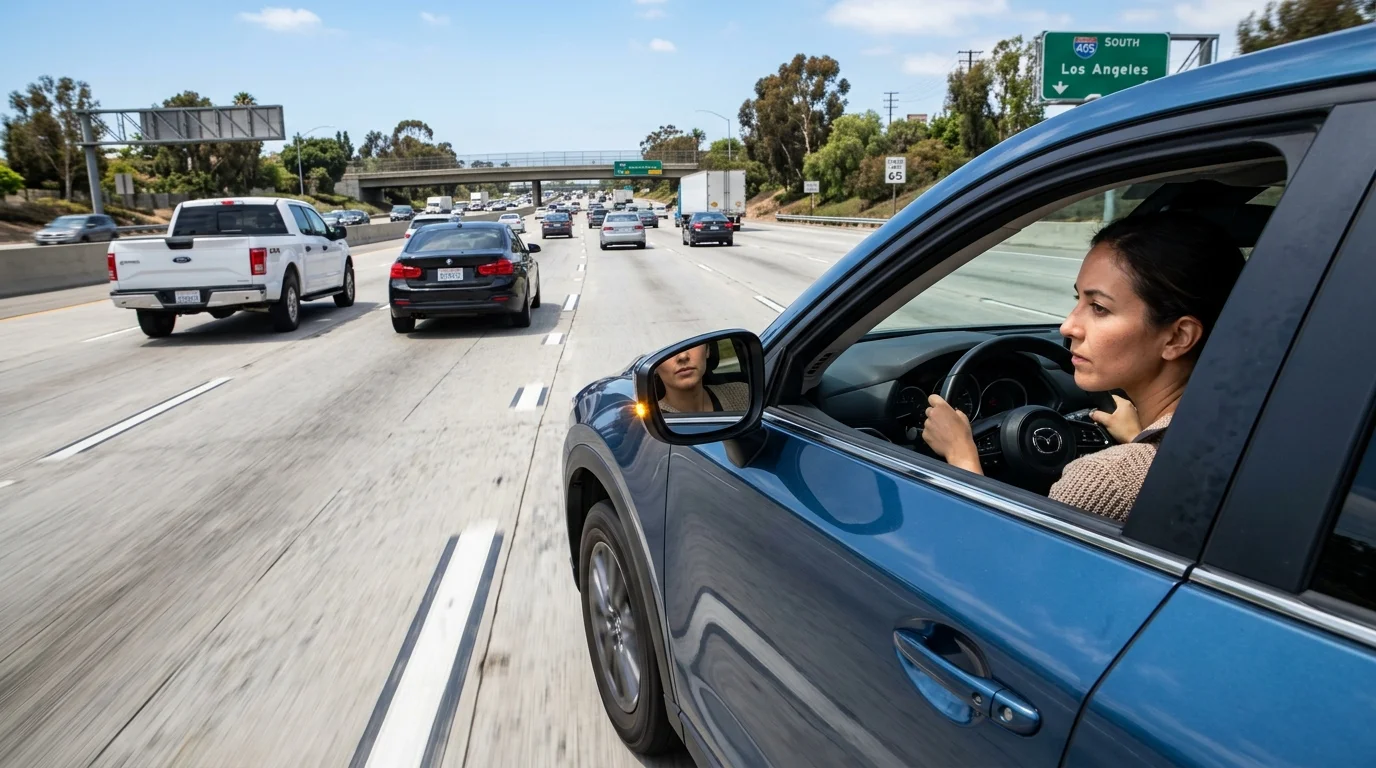
Executing SMOG with smooth speed matching prevents high-speed highway sideswipes.
Quick Answer & Key Takeaways
Executing a high-speed lane change on a multi-lane highway requires the 4-step SMOG sequence: 1) SIGNAL (100 feet or 3 seconds in advance). 2) MIRRORS (Check rearview mirror for trailing tailgaters, then side mirror for adjacent traffic). 3) OVER-THE-SHOULDER BLIND SPOT CHECK (Turn your chin 90 degrees to check the blind spot triangle next to your rear B-pillar). 4) GO (Glide smoothly across the dashed line into the adjacent lane over a 3-to-4-second span at matching traffic speed). NEVER SLOW DOWN while changing lanes; decelerating creates a dangerous closing speed differential for trailing vehicles.
- Never Tap the Brakes: Maintain current cruising speed or accelerate slightly into the open gap.
- The 90-Degree Head Check: Side mirrors leave a blind spot large enough to hide an entire full-size SUV.
- Watch for Center Lane Clashes: On 3+ lane freeways, ensure a car two lanes over isn't merging into the same middle space.
- Cancel Signal Immediately: Turn off your indicator within 2 seconds of centering your vehicle in the new lane.
Highway Lane Changes: Sideswipe Crash Mechanics & Speed Deltas
According to NHTSA traffic safety data, lane-change collisions account for over 530,000 crashes and 220,000 injuries annually in the United States.
At 65 to 70 MPH, a vehicle travels approximately 100 feet per second. A mere 2-second glance away from forward roadway traffic or a failure to detect a vehicle tucked in your quarter-panel blind spot results in an instant high-speed sideswipe collision.
The SMOG Framework: Signal, Mirrors, Over-the-Shoulder & Go
Professional driving academies standardize every lane change through the SMOG protocol:
- S — Signal: Activate your turn indicator at least 100 feet (or 3 to 5 full flashes) before initiating steering movement under CVC § 22107.
- M — Mirrors: Check your center rearview mirror to establish trailing traffic speed, then glance into your side mirror to identify open gaps.
- O — Over-the-Shoulder: Perform a rapid 90-degree head turn past the B-pillar to verify your blind spot is completely clear.
- G — Go: Steer with smooth, progressive inputs, angling your vehicle gently across the line over a 3-to-5-second duration.
Gap Selection & Speed Matching: The 4-Second Cushion
Never force your way into a tight gap:
- Identify a 4-Second Opening: Ensure there is at least a 2-second buffer ahead of your car and a 2-second buffer behind you in the target lane.
- Match Target Lane Speed: If the target lane is moving at 68 MPH, accelerate to 68 MPH before entering. Decelerating into a faster lane forces trailing drivers to slam their brakes, causing chain-reaction rear-end crashes.
The Dual Lane Change Trap: Resolving Center Lane Collisions
On 3-lane and 4-lane freeways, a dangerous collision scenario occurs when two vehicles attempt to merge into the same middle lane simultaneously:
- A vehicle in Lane 1 moves right toward Lane 2 at the exact same moment a vehicle in Lane 3 moves left toward Lane 2.
- Always scan two lanes across before moving into a center travel lane.
- If both drivers signal for the same space simultaneously, yield the center lane to the vehicle coming from the faster left-hand passing lane.
Blind Spot Mechanics: The 90-Degree Chin-to-Shoulder Head Check
To check your blind spot properly without swerving:
- Keep your hands steady at 9-and-3 on the steering wheel.
- Rotate only your neck and chin 90 degrees toward the side window for no more than 0.5 to 1.0 second.
- Never lean your entire torso forward, which causes involuntary tugging on the steering wheel and lane drift.
DMV Road Test Lane Change Scoring & Deduction Table
| Lane Change Fault | Examiner Observation | Safety Risk | Scoring Penalty |
|---|---|---|---|
| No Blind Spot Head Check | Relied solely on mirrors | Sideswipe collision with adjacent car | Critical Error (Auto-Fail if traffic near) |
| Unsignaled Lane Change | Turned wheel without 100-ft signal | Surprise cut-off of trailing driver | 1-Point Minor Deduction |
| Braking During Lane Change | Slowed down 10 MPH while crossing line | Trailing vehicle rear-end risk | 1-Point Minor Deduction (Improper speed) |
| Cutting Off Adjacent Car | Forced adjacent driver to brake | Near-miss collision | AUTOMATIC TEST FAILURE |
Interactive Knowledge Check
Question: Why should a driver NEVER step on the brake pedal while executing a lane change on a high-speed multi-lane highway?
Authoritative Sources & Regulatory References
Content and statutory guidelines in this guide are verified against official state vehicle codes, federal transportation standards, and authoritative regulatory documentation:
- NHTSANHTSA Analysis of Lane Change Crashes and Blind Spot Collision Countermeasures (DOT HS 810 779)(National Highway Traffic Safety Administration)
- California LegislatureCalifornia Vehicle Code § 22107: Unsafe Lane Changes and Signal Requirements(California Vehicle Code)
- FHWAHuman Factors in Lane Change Maneuvers: Glancing Behavior and Speed Judgment(Federal Highway Administration)
85% of people found this article helpful.
Click a star to add your vote
120 votes • average 4.29 out of 5
Official 2026 DMV Practice Tests by State
Select your state to practice real exam questions based on the latest 2026 driver handbook.
Ready to Pass the DMV Test on Your First Try?
Practice real 2026 DMV questions with instant answer explanations, simulated timers, and pass-guarantee study guides.
Start Free Practice Test