Blind Spot Driving Rules: How to Adjust Mirrors to Completely Eliminate Blind Spots
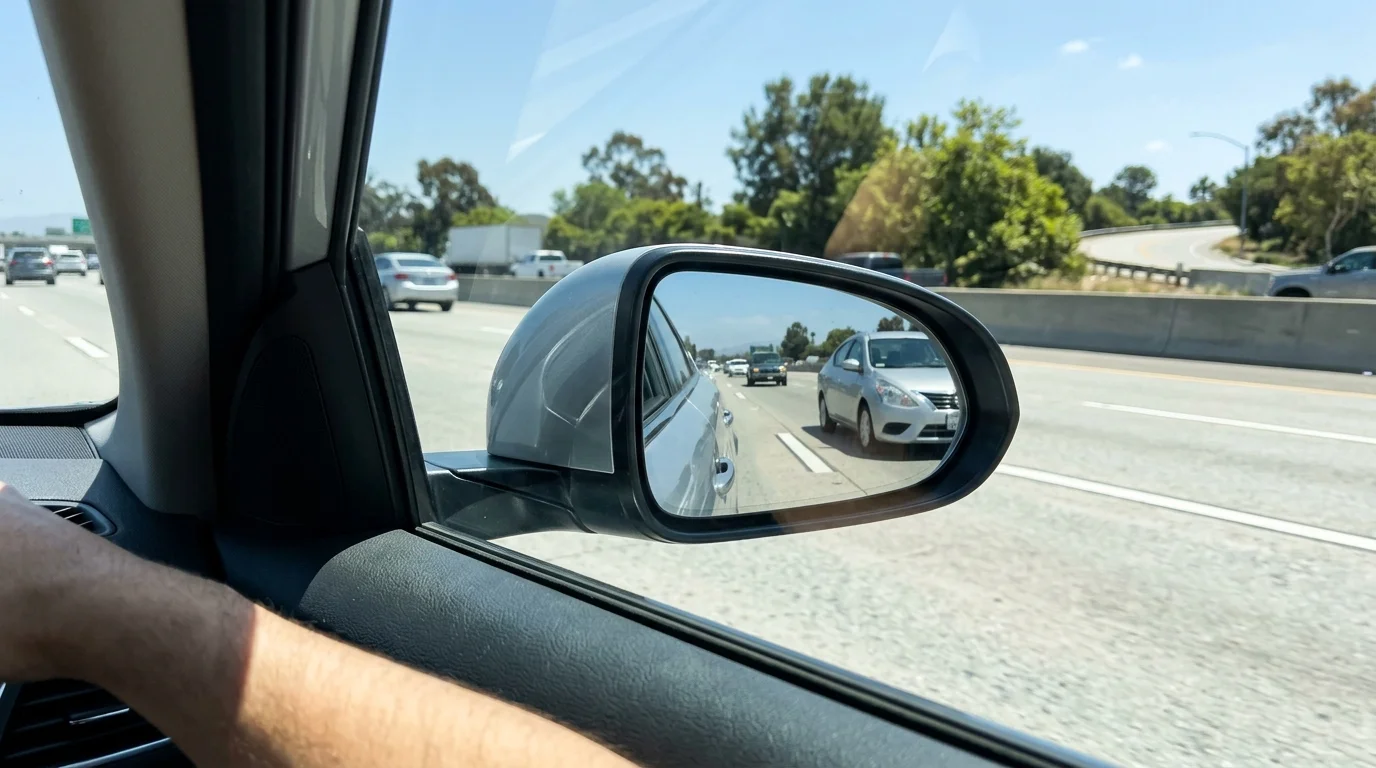
The SAE Blindzone & Glare Elimination method angles side mirrors outward to track vehicles continuously from rear mirror to peripheral view.
Quick Answer & Key Takeaways
Blind spots occur alongside your rear quarter panels where adjacent cars are hidden behind your vehicle's B-pillars. To eliminate blind spots using the SAE (Society of Automotive Engineers) method: 1) LEAN your head left until it touches the driver's side window glass, then adjust your driver's mirror so you can barely see the side of your car. 2) LEAN your head right toward the center console, then adjust your passenger mirror so you can barely see the right side. When driving, an overtaking car will transition smoothly from your center rearview mirror directly into your side mirror, and then into your peripheral vision—with ZERO blind spot gaps.
- The Flaw of Old Mirror Habits: If you can see your own car's side panels in your mirrors while sitting upright, your mirrors are angled too far inward, creating massive blind spots.
- The SAE BGE Method: Angling mirrors outward creates a seamless 180-degree panoramic field of rear vision.
- Eliminates Night Glare: Outward mirrors reflect high-beam headlights from trailing cars away from your eyes.
- DMV Exam Mandate: Even with perfect mirrors, you MUST physically turn your head and look over your shoulder during the driving test or fail automatically.
The Anatomy of a Vehicle Blind Spot: The Dangerous B-Pillars
Every year in the United States, over 840,000 side-impact and sideswipe collisions occur during routine lane changes, resulting in more than 300 fatalities, according to data from the National Highway Traffic Safety Administration (NHTSA).
The vast majority of these crashes stem from blind spots: triangular areas flanking both sides of the vehicle where adjacent passenger cars, motorcycles, and cyclists are completely hidden from standard mirror views behind the car’s roof pillars (B-pillars and C-pillars).
The Traditional Flawed Mirror Setup (Why Seeing Your Own Car Fails)
Most drivers adjust their mirrors incorrectly because they were taught the outdated "rear fender" method:
- The Mistake: Sitting upright and adjusting both side mirrors until the rear flanks of your own car occupy the inner 30% of the mirror glass.
- Why It Fails: Your car's body panels never move; they do not need to be monitored. Angling side mirrors inward merely duplicates the view already provided by your center rearview mirror, while leaving the critical 45-degree blind zone alongside your rear doors completely invisible.
The SAE "Blindzone & Glare Elimination" (BGE) Setup (Step-by-Step)
Published by automotive engineer George Platzer in SAE Technical Paper 950601 and endorsed by the American Automobile Association (AAA), the BGE (Blindzone & Glare Elimination) method angles mirrors outward to create a seamless panoramic field of view:
Frame the Entire Rear Window in the Center Mirror
Sit in your normal driving posture as practiced in your pre-drive inspection. Adjust the center rearview mirror so that it squares and frames the entire back window glass. The center mirror is your dedicated tool for viewing traffic directly behind your bumper.
The Driver-Side "Glass Lean" Technique
Lean your head to the left until your temple gently touches the driver’s side window glass. From this tilted position, adjust the left side mirror so that the rear edge of your vehicle’s body is just barely visible in the inside edge of the mirror glass. When you return your head to normal upright center, you will no longer see your own car, but will instead view the active traffic lane directly in your blind spot.
The Center Console Lean for the Passenger Mirror
Lean your head to the right so your head is positioned directly over the center console (between the driver and front passenger seats). From this position, adjust the right side mirror so the rear right edge of your vehicle is just barely visible. Return to normal upright posture.
The Seamless Panoramic "Hand-Off" Visual Test
When configured correctly, passing vehicles experience a flawless visual hand-off:
- Far Behind: A trailing car appears centered in your inside rearview mirror.
- Approaching: As they pull out to pass you, their front bumper glides into your side mirror before their car leaves your center rearview mirror.
- Alongside: As they pull alongside your door, their vehicle appears in your peripheral vision before their bumper leaves your side mirror.
Why Examiners Still Require Over-the-Shoulder Head Checks
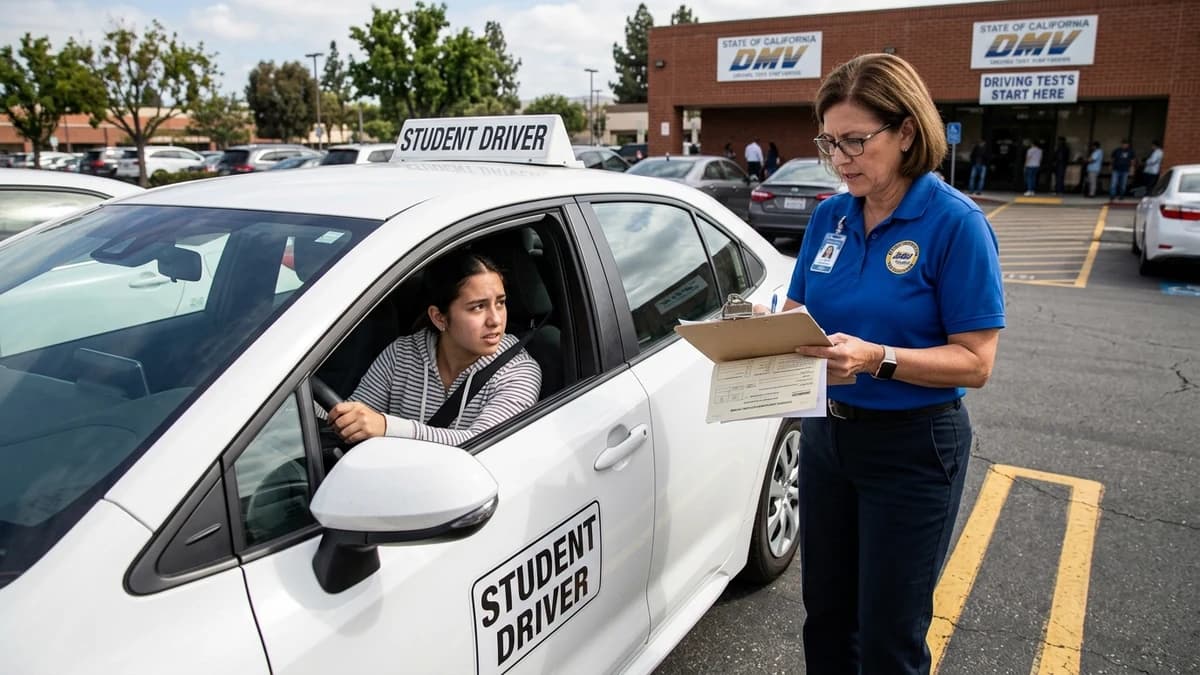
While the SAE mirror setup drastically reduces highway sideswipes, it does not replace the physical head check on the DMV road test.
During your behind-the-wheel exam, performing the full S.M.O.G. procedure (Signal, Mirror, Over-the-shoulder, Go) is mandatory. Failing to physically turn your chin to your shoulder to verify blind spots before merging or changing lanes is scored as an Automatic Failure for "Unsafe Lane Change" under DMV road test rubrics.
Interactive Knowledge Check
Question: Under the SAE Blindzone and Glare Elimination method, how should you position your head when adjusting the driver-side exterior mirror?
Authoritative Sources & Regulatory References
Content and statutory guidelines in this guide are verified against official state vehicle codes, federal transportation standards, and authoritative regulatory documentation:
- SAE InternationalSAE Paper 950601: The Geometry of Automotive Rearview Mirrors(Society of Automotive Engineers)
- NHTSALane Change Crash Avoidance and Field of View Evaluations(National Highway Traffic Safety Administration)
- AAAHow to Correctly Adjust Your Side Mirrors(American Automobile Association)
84% of people found this article helpful.
Click a star to add your vote
144 votes • average 4.26 out of 5
Official 2026 DMV Practice Tests by State
Select your state to practice real exam questions based on the latest 2026 driver handbook.
Ready to Pass the DMV Test on Your First Try?
Practice real 2026 DMV questions with instant answer explanations, simulated timers, and pass-guarantee study guides.
Start Free Practice TestRecommended Driver Guides

S.M.O.G. Driving Technique: Signal, Mirror, Over-Shoulder, Go Explained

The "No-Zone": Semi-Truck Blind Spots and How to Share the Road Safely