How to Check and Top Off Engine Oil Step-by-Step: Reading the Dipstick
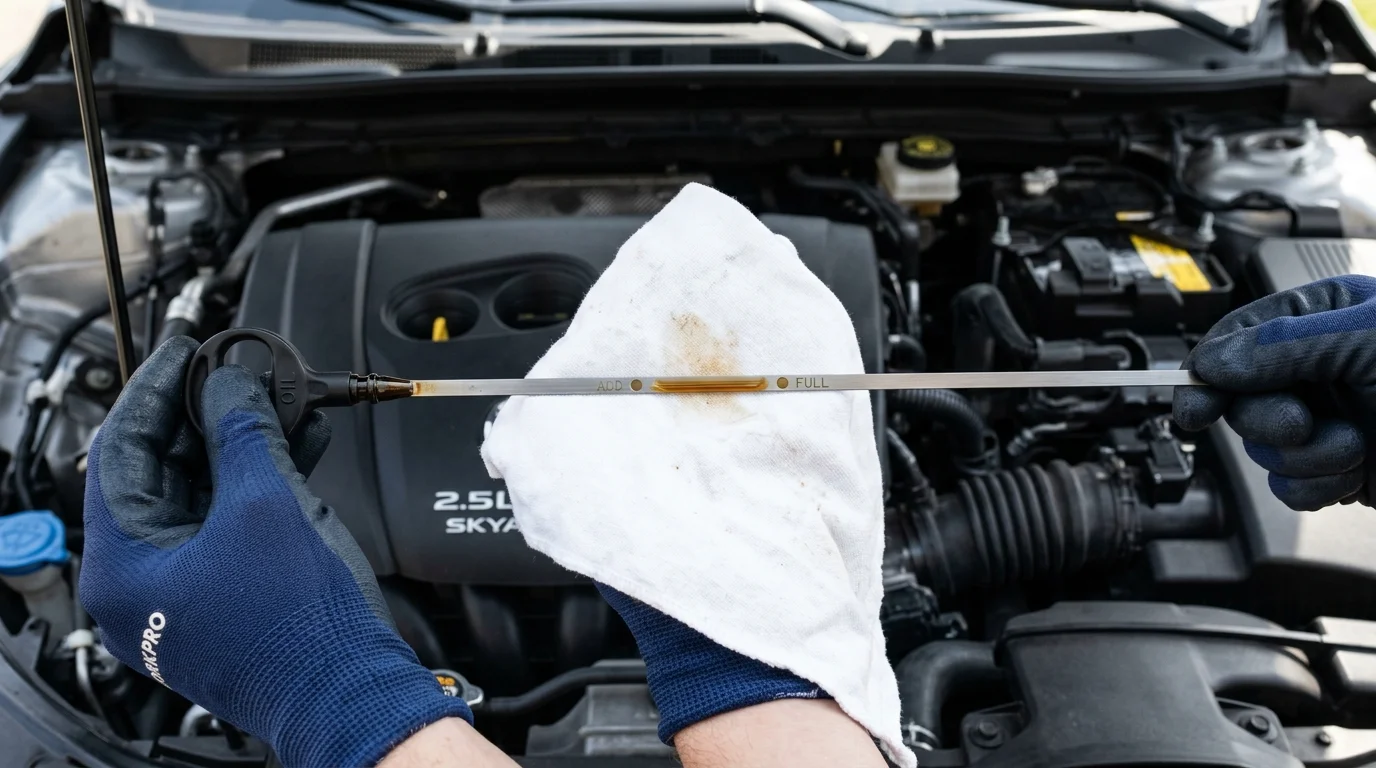
Regularly checking oil level on the dipstick prevents metal-on-metal internal engine friction and catastrophic motor seizure.
Quick Answer & Key Takeaways
To check engine oil: 1) Park on level ground, shut off the engine, and wait 5 minutes for oil to settle in the pan. 2) Pop the hood and locate the yellow or orange loop dipstick handle. 3) Pull the dipstick out and WIPE IT CLEAN with a paper towel (the first reading is always inaccurate due to engine oil splash). 4) Re-insert the dipstick all the way in until fully seated, then pull it back out to inspect the oil level. The oil film should sit between the 'MIN' (or lower dot) and 'MAX' (or upper dot) crosshatch lines. 5) If below MIN, add 1/2 quart of the manufacturer's recommended viscosity (e.g. 0W-20) using a funnel. The gap between MIN and MAX represents exactly 1 QUART of oil.
- The 1-Quart Rule: The distance between the 'MIN' (lower hole) and 'MAX' (upper hole) marks on virtually all car dipsticks equals exactly 1 US quart of oil.
- Always Wipe First: Never read a dipstick on the first pull; oil sloshes up the tube while driving and will give a false high reading.
- Check Every Month: Check oil level once a month and before every long road trip.
- Beware of Overfilling: Adding too much oil causes the crankshaft to whip the oil into aerated froth, starving engine bearings of lubrication.
Why Engine Oil Is the Lifeblood of Your Vehicle (Friction & Heat)
Inside an internal combustion engine, thousands of precision metal components (pistons, connecting rods, camshafts, crankshaft bearings) move at up to 6,000 revolutions per minute.
Engine oil creates a microscopic lubricating boundary layer (just a few microns thick) between metal surfaces, dissipates heat away from combustion chambers, and suspends dirt particles.
Running an engine low on oil causes metal-on-metal friction that will weld engine components together (a seized engine) within minutes, resulting in a catastrophic $5,000 to $10,000 replacement bill.
When to Check Your Oil: Monthly & Pre-Road Trip Intervals
Modern car manufacturers state that burning up to 1 quart of oil every 1,500 to 2,000 miles is normal operation due to high engine compression and low-viscosity oils.
Do not wait for the red oil pressure light on your dashboard to illuminate; that light indicates total loss of oil pressure, at which point internal engine damage is already occurring. Check your oil level:
- Once every month during routine gas station stops.
- Before every long-distance highway road trip as part of your pre-drive safety inspection.
The Foolproof 5-Step Dipstick Reading Method
Follow these five engineering steps to get an accurate reading:
Park on Level Ground & Wait 5 Minutes
Park the car on flat, level asphalt. Parking on an incline tilts the oil pool inside the bottom oil pan, resulting in an inaccurate reading. Shut down the engine and wait 3 to 5 minutes to allow hot oil circulating throughout the upper cylinder head to drain back down into the oil pan.
Locate and Pull the Bright Dipstick Handle
Pop the vehicle hood. Look for a bright yellow, orange, or white circular loop handle protruding from the engine block, often stamped with an oil can icon.
The First Wipe Rule (Clean with Rag or Paper Towel)
Never read the dipstick on the initial pull!
While driving, oil splashes up the dipstick tube, coating the steel blade and giving a false full reading. Pull the dipstick out smoothly and wipe the metal tip completely clean with a paper towel or shop rag.
Re-insert Fully & Read the Crosshatch Level Marks
Slide the clean dipstick all the way back down the tube until the handle seats firmly against the rubber seal. Pull it back out and hold it horizontally.
- Between MIN and MAX: If the amber oil film covers the crosshatch area between the lower and upper holes, your oil level is perfect.
- Below the MIN Mark: Your engine is dangerously low on oil and requires immediate top-off.
How to Top Off Oil (The 1-Quart Rule Between Min & Max)
On virtually all passenger cars, the distance between the MIN and MAX mark represents exactly 1 US Quart (approx. 1 Liter) of oil.
- If the oil is at the MIN mark: Add exactly 1 full quart.
- If the oil is halfway between MIN and MAX: Add 1/2 quart.
- How to Add: Unscrew the oil filler cap on top of the valve cover (marked with oil viscosity like 0W-20 or 5W-30), place a clean funnel in the opening, pour in the oil slowly, wait 2 minutes, and re-check with the dipstick.
How to Read Oil Color: Golden Honey vs. Jet Black vs. Milky Brown
Wiping the dipstick on a white paper towel tells you about your engine’s health:
- Golden Amber / Honey: Fresh oil in peak condition.
- Dark Brown / Jet Black: Normal heat cycling and suspended carbon soot; change according to manufacturer mileage intervals (e.g. 5,000–10,000 miles for full synthetic).
- Milky Frothy Light Brown ("Chocolate Milkshake"): DANGER! Coolant is leaking into the engine oil via a blown head gasket; do NOT start the engine.
Interactive Knowledge Check
Question: On an automotive engine oil dipstick, how much oil is represented by the gap between the "MIN" (lower) mark and the "MAX" (upper) mark?
Authoritative Sources & Regulatory References
Content and statutory guidelines in this guide are verified against official state vehicle codes, federal transportation standards, and authoritative regulatory documentation:
- APIMotor Oil Guide and Lubrication Standards(American Petroleum Institute)
- NHTSAVehicle Maintenance Schedules and Fluid Health(National Highway Traffic Safety Administration)
- AAAHow to Check Engine Oil and Prevent Engine Seizure(American Automobile Association)
87% of people found this article helpful.
Click a star to add your vote
289 votes • average 4.40 out of 5
Official 2026 DMV Practice Tests by State
Select your state to practice real exam questions based on the latest 2026 driver handbook.
Ready to Pass the DMV Test on Your First Try?
Practice real 2026 DMV questions with instant answer explanations, simulated timers, and pass-guarantee study guides.
Start Free Practice TestRecommended Driver Guides

How to Jumpstart a Dead Car Battery Safely: Red to Positive, Black to Ground
How to Change a Flat Tire Step-by-Step: Jack Placement, Lug Nuts, Spare Donut