How to Check Blind Spots Correctly Without Swerving the Wheel
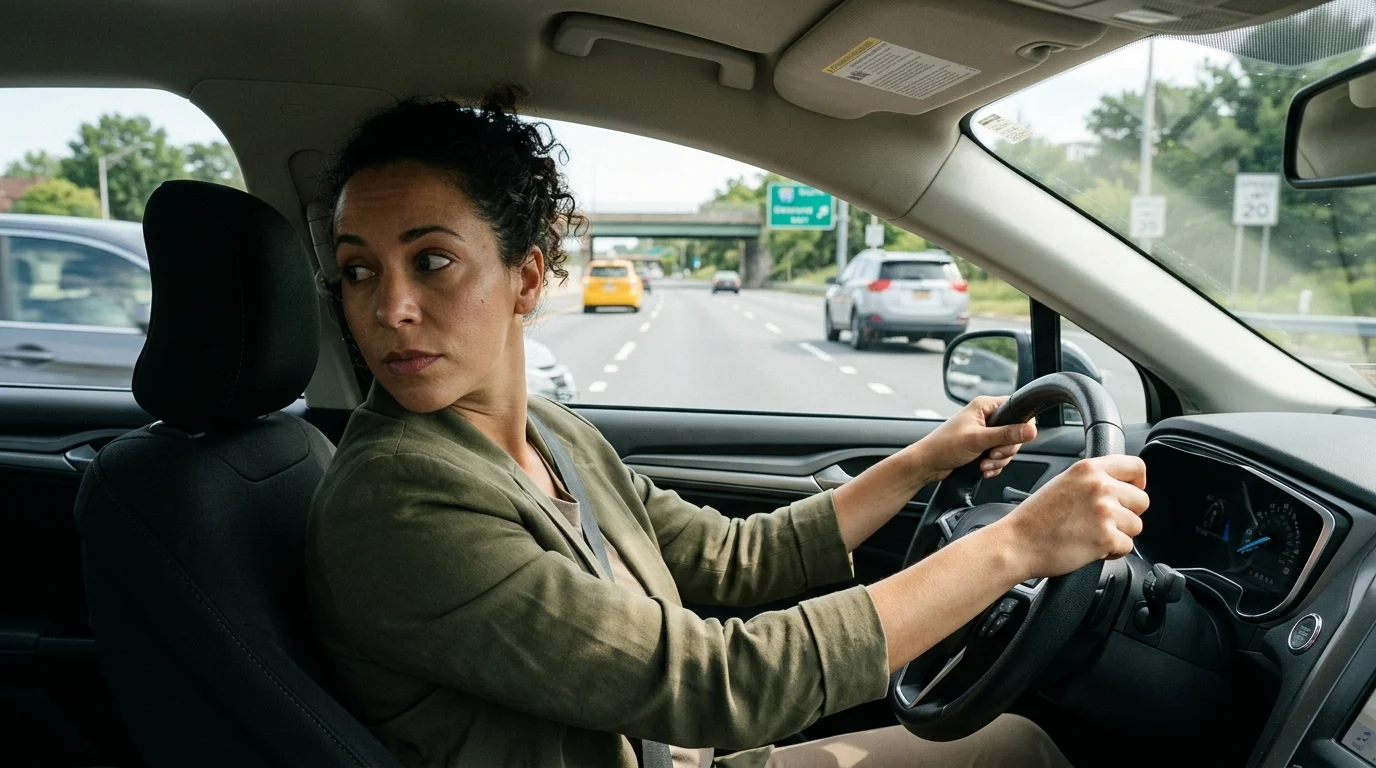
Isolating neck rotation while keeping hands relaxed at 9-and-3 prevents lane drift during blind spot checks.
Quick Answer & Key Takeaways
A common danger among beginner drivers is 'the blind spot drift': when turning your head to check over your shoulder, your shoulders rotate and your arms involuntarily pull the steering wheel, causing the vehicle to drift into oncoming traffic or side swipe adjacent cars. 1) ISOLATE YOUR NECK: Keep your shoulders flat against the seatback and rotate ONLY your chin 90 degrees to the side window. 2) THE 1-SECOND GLANCE: The head check should last exactly 0.5 to 1.0 second. Staring back longer causes forward collisions. 3) RELAX HAND PRESSURE: Maintain light grip at 9-and-3. 4) COMBINE WITH SAE MIRRORS: Adjust side mirrors outward 15 degrees so your car's flank is invisible, eliminating 80% of the blind zone.
- Isolate Neck Muscles: Never twist your torso or shoulders; rotate only your neck and chin.
- The 1-Second Rule: A quick 0.5-second snap check is all that is required to confirm no vehicle is beside your B-pillar.
- Anchored Hands at 9-and-3: Keep elbows slightly bent to prevent shoulder movement from transmitting into the steering column.
- Never Check Mid-Braking: Complete your speed adjustment before performing your over-the-shoulder check.
The Biomechanics of the Blind Spot Swerve: Shoulder-Arm Tugging
When humans rotate their upper bodies to look backward, the musculoskeletal system naturally pivots the entire thoracic spine.
According to NHTSA driver biomechanics research, when a novice driver turns around to look over their left shoulder, their left arm naturally retracts while the right arm pushes forward. This involuntary motion pulls the steering wheel counter-clockwise, causing the vehicle to swerve 1 to 2 feet to the left into adjacent traffic lanes.
Mastering isolated cervical neck rotation is essential to maintaining laser-straight lane tracking.
The 90° Chin-to-Shoulder Method: Isolating Neck Muscle Rotation
Follow the professional driving instructor's "Chin-to-Shoulder" technique:
- Press Back Against the Seat: Keep both shoulder blades firmly planted against the seatback.
- Rotate Only the Neck: Turn your head 90 degrees to point your chin directly at your left or right shoulder.
- Look Out the Side Rear Glass: Your eyes should look through the rear side window right past the B-pillar (the roof pillar behind your head).
- Snap Back Forward: Immediately snap your eyes back to forward road traffic.
Hand Anchoring at 9-and-3: Preventing Involuntary Steering Drift
Your hand position on the steering wheel dictates steering stability:
- Hold the steering wheel at the 9-and-3 position with relaxed fingers (no white-knuckle gripping).
- Keep your elbows bent slightly (approx. 120-degree angle). Relaxed, bent elbows act as shock absorbers, absorbing minor shoulder twitches without moving the steering wheel.
The 1-Second Rule: Why Staring at Your Blind Spot Causes Head-On Crashes
At 65 MPH, your vehicle travels 95 feet every single second.
If you turn your head to look over your shoulder for 2 or 3 seconds, your car travels nearly the length of a football field completely blind to forward brake lights, stopped traffic, or lane departures.
The blind spot check is a 0.5-to-1.0-second confirmation snapshot: you are simply verifying that the large space next to your rear door is empty.
The SAE Mirror Adjustment: Eliminating the Blind Spot Triangle
In 1995, the Society of Automotive Engineers published SAE Paper 950601, proving that standard mirror setups leave massive blind spots:
- Traditional Setup (Wrong): Adjusting side mirrors so you see the side flank of your own car. This creates a redundant overlap with your center rearview mirror and creates large blind spots.
- The SAE Setup (Correct): Lean your head against the driver's side window glass, then adjust your driver's mirror outward until your car's rear flank just disappears. Lean toward the center console and adjust the passenger mirror the same way.
- Under the SAE mirror method, as a passing car leaves your center mirror, its front bumper instantly appears in your side mirror—virtually eliminating blind spots.
Blind Spot Scanning Faults, Crash Risks & Corrections Table
| Scanning Error | Biomechanic Cause | Safety Risk | Correct Technique |
|---|---|---|---|
| Steering Wheel Swerve / Drift | Twisting torso & locked elbows | Sideswiping adjacent vehicle | Keep shoulders back, rotate neck only |
| Prolonged Stare (>2 sec) | Hesitation and poor confidence | Rear-ending lead vehicle | 0.5-second snap check |
| Mirror-Only Reliance | Skipping physical head turn | Blind spot sideswipe crash | Full 90° chin-to-shoulder check |
Interactive Knowledge Check
Question: What is the proper biomechanical technique to check your blind spot over your shoulder without causing the vehicle to swerve out of its lane?
Authoritative Sources & Regulatory References
Content and statutory guidelines in this guide are verified against official state vehicle codes, federal transportation standards, and authoritative regulatory documentation:
- SAE InternationalSAE Paper 950601: The Geometry of Automotive Rearview Mirrors and Blind Spot Elimination(SAE International Automotive Engineering)
- NHTSANHTSA Driver Head Turning and Involuntary Lane Deviation Studies (DOT HS 810 847)(National Highway Traffic Safety Administration)
- California DMVCalifornia DMV Driving Performance Evaluation: Lane Change and Traffic Check Standards(California Department of Motor Vehicles)
84% of people found this article helpful.
Click a star to add your vote
76 votes • average 4.26 out of 5
Official 2026 DMV Practice Tests by State
Select your state to practice real exam questions based on the latest 2026 driver handbook.
Ready to Pass the DMV Test on Your First Try?
Practice real 2026 DMV questions with instant answer explanations, simulated timers, and pass-guarantee study guides.
Start Free Practice Test