How to Get a Motorcycle License (Class M): Permit Test vs. MSF Waiver
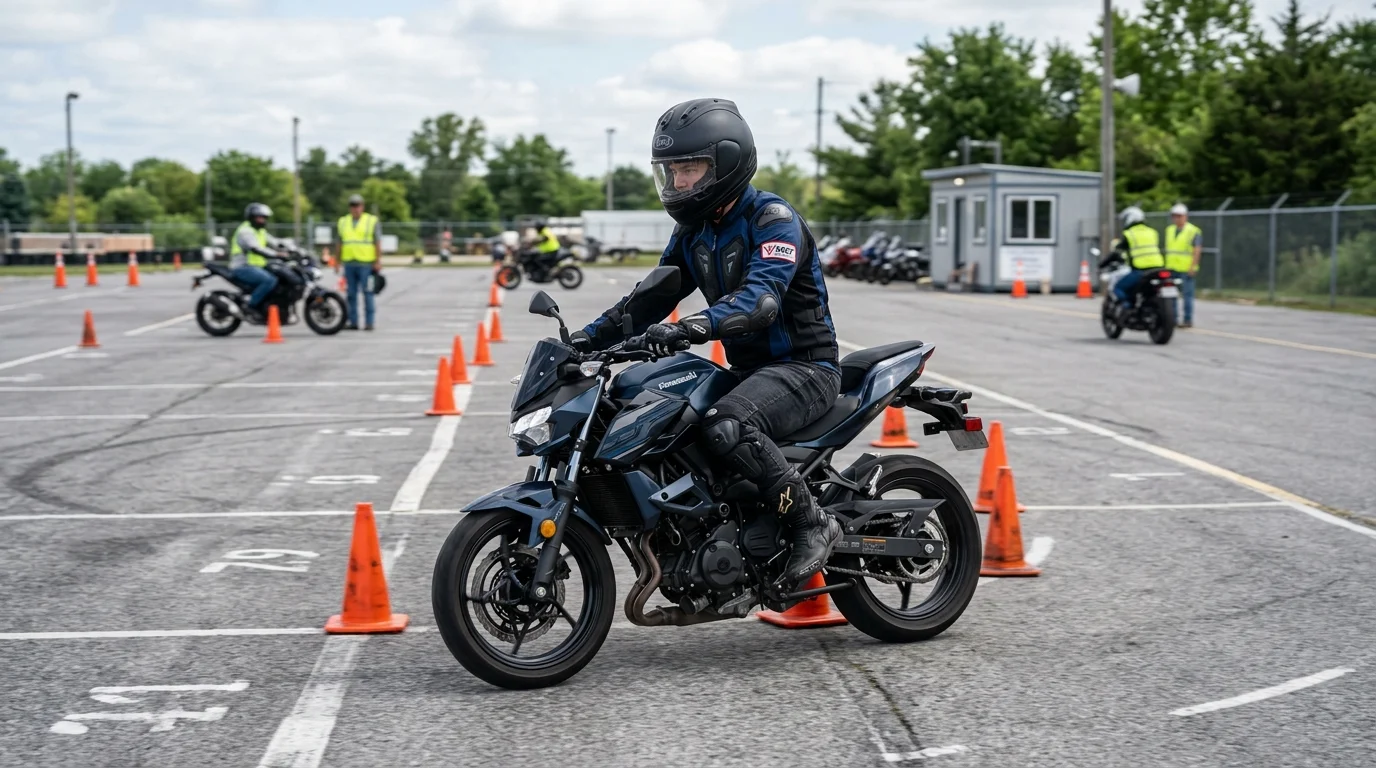
Graduating from an approved Motorcycle Safety Foundation course waives the difficult DMV parking lot skills test in over 40 states.
Quick Answer & Key Takeaways
To obtain a Class M Motorcycle License, riders have two primary pathways: 1) THE MSF COURSE WAIVER PATHWAY (RECOMMENDED): Complete a 2-day Motorcycle Safety Foundation (MSF) Basic RiderCourse (or state equivalent like California CMSP). Upon graduation, you receive a Skills Test Waiver (e.g. DL 389 certificate), allowing you to walk into the DMV, take the written knowledge exam, and receive your full Class M license WITHOUT ever taking the DMV parking lot riding test. 2) THE DIRECT DMV PATHWAY: Pass the written motorcycle knowledge test to get a motorcycle permit, practice on your own, and then schedule the DMV practical skills exam (the notorious low-speed 'Lollipop' circle weave test). NOTE: In most states, riders under age 21 are legally required to complete an MSF course.
- MSF Waives DMV Riding Test: Passing the 2-day MSF course grants an official riding test waiver in 40+ states.
- Motorcycle Permit Restrictions: Riding on a permit strictly bans carrying passengers, riding at night, and riding on interstate freeways.
- Mandatory for Under-21 Riders: State law requires riders under 21 to graduate from an approved rider training course before licensing.
- Insurance Discount: MSF graduation certificates earn riders a permanent 10% to 15% discount on motorcycle insurance premiums.
Class M Licensing: The Two Pathways to Riding Legally
Riding a motorcycle on public streets without a valid Class M (or Class M1) endorsement is a misdemeanor traffic crime that results in vehicle impoundment and heavy fines.
Prospective riders must choose between two distinct licensing routes:
- Pathway A (The MSF RiderCourse Route): Take a weekend training course with provided motorcycles; graduate and bypass the DMV riding test entirely.
- Pathway B (The Direct DMV Route): Get a permit, provide your own street-legal motorcycle, and perform the DMV parking lot obstacle course test.
The Written Motorcycle Permit Test & Permit Restrictions
Both pathways require passing the DMV written motorcycle knowledge exam (typically 25 to 30 questions covering countersteering, traction management, and lane positioning).
Once you pass the written test, you are issued a Motorcycle Instruction Permit, which comes with severe statutory restrictions:
- No Night Riding: Prohibited from riding between sunset and sunrise.
- No Passengers: Carrying any passenger on the rear pillion seat is strictly illegal.
- No Freeway / Interstate Travel: Restricted to surface streets only.
The MSF Basic RiderCourse (BRC): The Road Test Waiver Shortcut
Over 85% of licensed motorcyclists choose the Motorcycle Safety Foundation (MSF) Basic RiderCourse:
- Motorcycles & Helmets Provided: The school provides entry-level 250cc–300cc training motorcycles and helmets, so you don't need to own or transport a bike.
- Hands-On Coaching: Certified RiderCoaches guide you step-by-step through friction zone clutch control, smooth shifting, emergency swerving, and quick stops over 15 hours of instruction.
- The Skills Waiver Certificate: When you pass the riding evaluation at the end of the course, you receive a completion certificate (such as the California DL 389 form). You take this certificate to the DMV, skip the riding test, and get your full Class M license.
The Direct DMV Skills Test: The "Lollipop" Circle Challenge
If you choose to test directly at the DMV, you must bring a fully street-legal, registered, and insured motorcycle (which must be trailered or ridden there by a fully licensed motorcyclist).
The examiner administers the infamous "Lollipop Test":
- Riding inside a narrow circular painted ring twice in both clockwise and counter-clockwise directions without putting your foot down.
- Weaving through a line of tight offset cones.
- Performing a high-gear straight-line acceleration and quick stop.
- Failure rate: Over 60% of self-taught riders fail on their first attempt due to putting a foot on the asphalt during tight low-speed turns.
Under-21 Mandates: Why RiderCourses Are Legally Required
In states like California (California Vehicle Code § 12500b), Texas, and Florida:
If you are under 21 years of age, you are legally required to complete an approved state motorcycle training course before you can be issued a motorcycle permit or license.
Cost, Timeline & Insurance Discounts: MSF vs. DMV Direct
While an MSF course costs between $250 and $350 ($395 in California CMSP), graduating earns you a permanent 10% to 15% discount on motorcycle insurance from major carriers like Progressive and GEICO, allowing the course to pay for itself within 2 years.
Motorcycle License Pathway Comparison Table
| Feature | MSF Basic RiderCourse Route | Direct DMV Skills Test Route |
|---|---|---|
| DMV Riding Test | 100% WAIVED | Mandatory ("Lollipop" circle test) |
| Motorcycle Provided? | YES (250cc bike supplied) | NO (Must bring own insured bike) |
| Insurance Discount | 10%–15% annual premium discount | None |
| Typical Duration | 1 Weekend (15 Hours) | Weeks/Months waiting for DMV appointments |
Interactive Knowledge Check
Question: What major licensing benefit does a rider receive after successfully graduating from an accredited Motorcycle Safety Foundation (MSF) Basic RiderCourse?
Authoritative Sources & Regulatory References
Content and statutory guidelines in this guide are verified against official state vehicle codes, federal transportation standards, and authoritative regulatory documentation:
- MSFMotorcycle Safety Foundation (MSF) Basic RiderCourse Curriculum Standards(Motorcycle Safety Foundation)
- California DMVCalifornia DMV Motorcycle Handbook & Skills Test Waiver Requirements (CVC § 12500b)(State of California Department of Motor Vehicles)
- NHTSAMotorcyclist Licensing and Training Best Practices (DOT HS 811 092)(National Highway Traffic Safety Administration)
84% of people found this article helpful.
Click a star to add your vote
274 votes • average 4.22 out of 5
Official 2026 DMV Practice Tests by State
Select your state to practice real exam questions based on the latest 2026 driver handbook.
Ready to Pass the DMV Test on Your First Try?
Practice real 2026 DMV questions with instant answer explanations, simulated timers, and pass-guarantee study guides.
Start Free Practice TestRecommended Driver Guides

Motorcycle Lane Splitting vs. Lane Filtering: State-by-State Laws Explained
REAL ID vs Standard Driver’s License: Requirements, Documents & Deadline Guide