How to Get Your Commercial Learner’s Permit (CLP): Step-by-Step Requirements
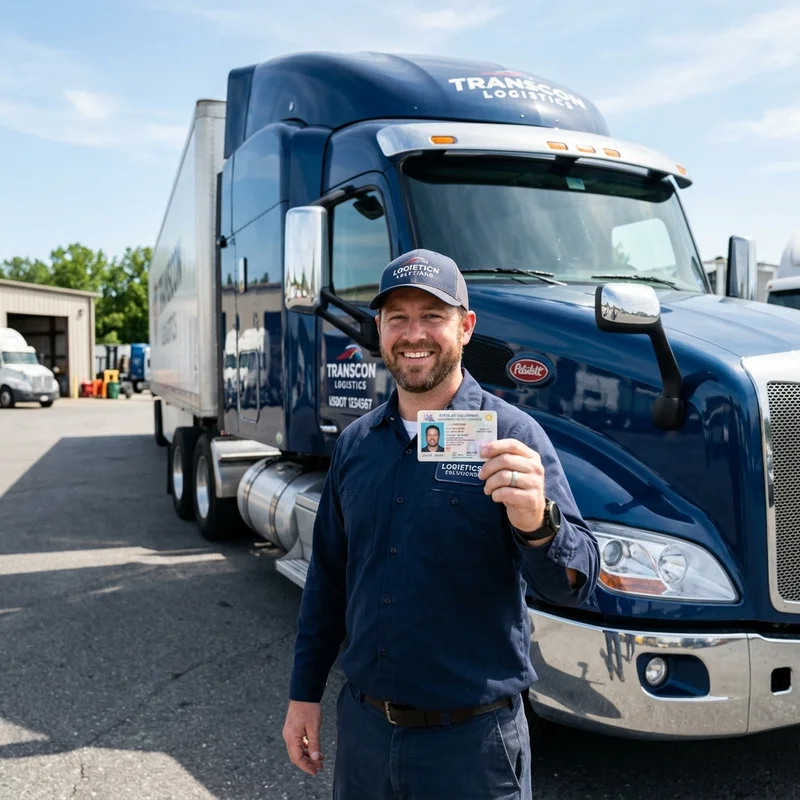
Securing your CLP requires passing the DOT medical physical, completing FMCSA ELDT theory training, and passing 3 core written exams.
Quick Answer & Key Takeaways
To obtain a Commercial Learner’s Permit (CLP) in 2026 under federal FMCSA regulations (49 CFR Part 383), you must complete four mandatory steps: 1) Pass a DOT Medical Exam conducted by a certified medical examiner to receive your Medical Examiner’s Certificate (MEC). 2) Provide proof of US citizenship / permanent residency and a valid Class C driver's license. 3) Pass 3 written knowledge exams at the DMV: General Knowledge (50 questions), Air Brakes (25 questions), and Combination Vehicles (20 questions for Class A). 4) Complete FMCSA Entry-Level Driver Training (ELDT) theory curriculum. Once issued, you must hold your CLP for a minimum of 14 days before you can schedule the practical behind-the-wheel CDL road exam.
- Age 18 vs. 21 Rule: Age 18 allows Intrastate driving (within your home state); age 21 is required for Interstate commerce across state lines.
- DOT Medical Card First: You cannot take the written permit test without an active Medical Examiner's Certificate (MEC Form MCSA-5876).
- Three Core Written Tests: Class A CLP applicants must pass General Knowledge (80% passing grade), Air Brakes, and Combination Vehicles.
- 14-Day Mandatory Holding Period: Federal rules require holding your CLP for at least 14 days of supervised practice before the 3-part CDL skills test.
What Is a Commercial Learner’s Permit (CLP)? Key Legal Privileges
A Commercial Learner’s Permit (CLP) authorizes you to operate a commercial motor vehicle (CMV) on public highways while accompanied by a licensed commercial driver.
Under FMCSA 49 CFR Part 383, the supervising commercial driver must possess a valid Class A or Class B CDL with all necessary endorsements and occupy the front passenger seat next to you at all times.
The Federal ELDT Mandate: Theory & Behind-the-Wheel Requirements
Since February 7, 2022, all first-time CDL applicants must comply with the federal Entry-Level Driver Training (ELDT) mandate.
Before you can sit for your state CDL practical skills road test, an FMCSA-registered training provider listed on the Training Provider Registry (TPR) must electronically transmit proof to the state DMV that you completed both:
- ELDT Theory Curriculum: 30+ units covering hours of service, hazard perception, vehicle systems, and speed management (scoring 80%+ on theory assessments).
- Behind-the-Wheel (BTW) Training: Range maneuvers and public road driving.
The DOT Physical: Blood Pressure, Vision, and the Medical Card
Before walking into the DMV, you must visit a physician certified on the FMCSA National Registry to pass a DOT Medical Examination:
- Vision Check: 20/40 visual acuity in each eye and 70-degree horizontal peripheral field.
- Blood Pressure: Below 140/90 mmHg for a standard 2-year medical card.
- Urinalysis: Checks for underlying medical conditions like diabetes (protein/glucose) and kidney disease.
- Medical Examiner’s Certificate (MEC Form MCSA-5876): You must present this physical green medical card at the DMV counter.
The Written CLP Knowledge Tests: General Knowledge, Air Brakes & Combination
To get your Class A CLP, you must pass three computerized written tests at the DMV (scoring at least 80% on each):
- General Knowledge Test (50 Questions): Covers vehicle inspection, basic vehicle control, shifting gears, space management, hazard awareness, and night driving.
- Air Brakes Test (25 Questions): Covers dual air brake systems, spring brakes, governor cut-in/cut-out pressures, and the 3-step air brake leakdown test.
- Combination Vehicles Test (20 Questions): Covers fifth-wheel coupling, rollover prevention, trailer skid control, and converter dollies.
The 14-Day Waiting Period & Supervising Driver Rules
Federal law strictly prohibits scheduling your practical CDL driving test until you have held your CLP for at least 14 full calendar days.
During this period, you practice the 3 components of the practical exam:
- Pre-Trip Vehicle Inspection: Pointing to and identifying ~90 mechanical components without missing safety defects.
- Basic Control Skills (Yard Maneuvers): Straight line backing, offset backing, and 90-degree alley docking.
- On-Road Driving Test: Real-world urban and highway driving, right-turn setup, and railroad crossings.
Commercial Learner’s Permit Roadmap Cheat Sheet Table
| Milestone Stage | Required Action | Passing Requirement |
|---|---|---|
| 1. Medical Exam | Visit certified FMCSA National Registry doctor | Issued DOT Medical Card (MCSA-5876) |
| 2. ELDT Theory | Complete online or in-person FMCSA theory course | 80%+ on theory assessments |
| 3. DMV Written Tests | General Knowledge, Air Brakes, Combination | 80% passing score on each exam |
| 4. Practice Period | Behind-the-wheel supervised driving | Hold CLP for minimum 14 days |
Interactive Knowledge Check
Question: Under federal FMCSA regulations, what is the minimum number of days a student driver must hold a Commercial Learner’s Permit (CLP) before they are legally eligible to take the CDL skills road test?
Authoritative Sources & Regulatory References
Content and statutory guidelines in this guide are verified against official state vehicle codes, federal transportation standards, and authoritative regulatory documentation:
- FMCSACommercial Driver’s License Standards, Requirements, and Penalties (49 CFR Part 383)(Federal Motor Carrier Safety Administration)
- FMCSAEntry-Level Driver Training (ELDT) Training Provider Registry(FMCSA Training Provider Registry)
- DOTMedical Examiner’s Certificate (MEC) and Commercial Driver Qualifications (49 CFR Part 391)(United States Department of Transportation)
97% of people found this article helpful.
Click a star to add your vote
145 votes • average 4.92 out of 5
Official 2026 CDL Practice Tests by State
Select your state to practice real Commercial Driver's License (CDL) exam questions based on the latest 2026 commercial handbook.
Ready to Pass Your CDL Permit Test on the First Try?
Practice real 2026 commercial driving questions with instant air brake explanations, combination vehicle dynamics, and pass-guaranteed study guides.
Start Free CDL Practice TestRecommended Driver Guides

CDL Class A vs. Class B vs. Class C: Gross Vehicle Weight Rating (GVWR) Decoded
CDL Endorsements Guide: Hazmat (H), Tanker (N), Doubles/Triples (T), Passenger (P), School Bus (S)