How to Pass the DMV Vision Test: Standards, Acuity & Fail Protocol
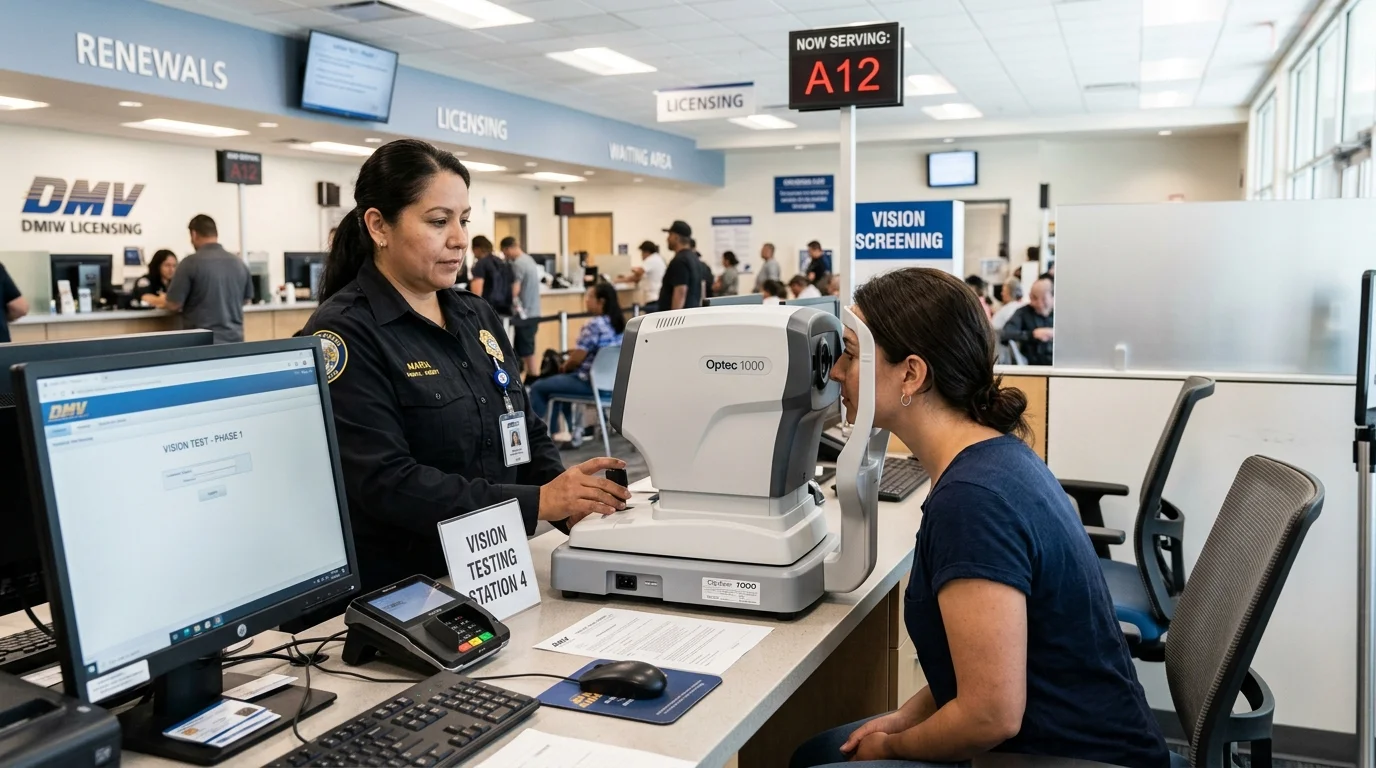
DMV vision tests require a minimum 20/40 visual acuity across both eyes to qualify for an unrestricted license.
Quick Answer & Key Takeaways
To pass the DMV vision screening in 42 states, you must demonstrate a minimum visual acuity of 20/40 (either with both eyes tested together, or in at least one eye) using a standard Snellen eye chart or stereoscopic Optec machine. 1) CORRECTIVE LENSES: You can take the test wearing eyeglasses or contact lenses; passing with lenses adds 'Restriction B: Corrective Lenses' to your license. 2) WHAT HAPPENS IF YOU FAIL: Failing does NOT revoke your license immediately. The DMV clerk issues an official Report of Vision Examination form (e.g., Form DL 62 in California or MV-619 in NY) to take to an optometrist/ophthalmologist for prescription correction. 3) PERIPHERAL FIELD: You must possess a horizontal peripheral field of at least 110 to 140 degrees.
- Universal Benchmark: 20/40 visual acuity is the standard passing threshold across most US state DMVs.
- Bring Your Glasses: Always bring your prescription eyewear; failing to wear them while driving with a Restriction B is a misdemeanor.
- Form DL 62 Referral: Failing triggers an optometrist referral rather than an immediate cancellation of driving privileges.
- Bioptic Telescopes: Drivers with 20/70 to 20/200 vision may qualify for restricted bioptic telescopic lenses in eligible states.
DMV Vision Standards: The 20/40 Snellen Benchmark
Safe driving requires crisp visual acuity to read distance street signs, detect pedestrian movements at crosswalks, and spot braking taillights hundreds of feet ahead.
The universal standard across 42 US states is 20/40 visual acuity, evaluated using the standard Snellen Eye Chart (where Line 5 typically corresponds to 20/40).
20/40 vision means that from 20 feet away, you can read what a person with normal 20/20 vision can clearly read from 40 feet away.
In-Person Screening: Wall Snellen Chart vs. Optec Stereo Machine
When you step up to the DMV testing counter, the clerk will conduct the test using one of two methods:
- Wall Snellen Chart: Mounted 20 feet away on the wall behind the counter. The examiner asks you to cover your left eye with an occluder, read Line 5, cover your right eye, read Line 5, and then read with both eyes open.
- Stereoscopic Optec Device: A binocular desktop machine. You press your forehead against the rubber viewing bar, looking into illuminated lenses that present randomized letter lines and flashing peripheral light targets.
Peripheral Vision Requirements: 110° to 140° Visual Field Limits
In addition to central visual sharpness, states mandate a continuous horizontal visual field to detect side collisions, merging vehicles, and cyclists:
- Standard Requirement: 110° to 140° total horizontal visual field across both eyes.
- Monocular Drivers (Vision in One Eye Only): Drivers with vision in only one eye can qualify for an unrestricted license if their functional eye meets 20/40 acuity and has a minimum 110° to 120° peripheral field, combined with an outside left/right rearview mirror restriction.
Corrective Lenses Restriction: What "Restriction B" Means Legally
If you take the vision screening wearing prescription eyeglasses or contact lenses, the DMV clerk will enter Restriction Code B (Corrective Lenses) onto your permanent driving record.
Legal Implication: If a police officer pulls you over and your driver's license displays Restriction B, you must be wearing eyeglasses or contacts. Driving without your lenses is classified as driving with an invalid license—resulting in a traffic citation, DMV points, and fines.
What Happens If You Fail: The Eye Exam Referral (Form DL 62)
Failing the vision test at the DMV window does not automatically revoke or cancel your driver's license.
- The examiner prints an official eye doctor referral form (e.g., California Form DL 62, Texas Form M-40, or New York Form MV-619).
- You schedule an appointment with a licensed optometrist or ophthalmologist for a comprehensive refractive exam.
- The eye specialist updates your lens prescription and signs the DMV medical report form.
- You return to the DMV with the completed form and your new glasses to pass the screening test.
50-State DMV Vision Acuity & Visual Field Standards Table
| State / Jurisdiction | Passing Visual Acuity | Min. Peripheral Field | Corrective Lens Code |
|---|---|---|---|
| California | 20/40 (Both Eyes or Best Eye) | 110° combined | Restriction 01 (Corrective Lenses) |
| Texas | 20/40 (or 20/50 with specialist note) | 140° combined | Restriction A (With Corrective Lenses) |
| Florida | 20/40 (or 20/70 with eye specialist) | 130° combined | Restriction A |
| New York | 20/40 in at least one eye | 140° combined | Restriction B (Corrective Lenses) |
Interactive Knowledge Check
Question: What is the universal minimum visual acuity threshold required by most state DMVs for an unrestricted driver's license?
Authoritative Sources & Regulatory References
Content and statutory guidelines in this guide are verified against official state vehicle codes, federal transportation standards, and authoritative regulatory documentation:
- AAMVAVisual Acuity Standards for Driver Licensing (AAMVA Vision Benchmark)(American Association of Motor Vehicle Administrators)
- California DMVCalifornia DMV Vision Examination Standards & Report of Vision Examination (DL 62)(California Department of Motor Vehicles)
- American Academy of OphthalmologyClinical Visual Standards for Motor Vehicle Operation(American Academy of Ophthalmology)
95% of people found this article helpful.
Click a star to add your vote
254 votes • average 4.79 out of 5
Official 2026 DMV Practice Tests by State
Select your state to practice real exam questions based on the latest 2026 driver handbook.
Ready to Pass the DMV Test on Your First Try?
Practice real 2026 DMV questions with instant answer explanations, simulated timers, and pass-guarantee study guides.
Start Free Practice TestRecommended Driver Guides
Senior Driver License Renewal (Age 70+): In-Person Rules, Vision & Re-Examinations
The Pre-Drive Safety Inspection Checklist: Behind-the-Wheel DMV Test Prep