The 20 Most Commonly Missed Questions on the DMV Written Exam
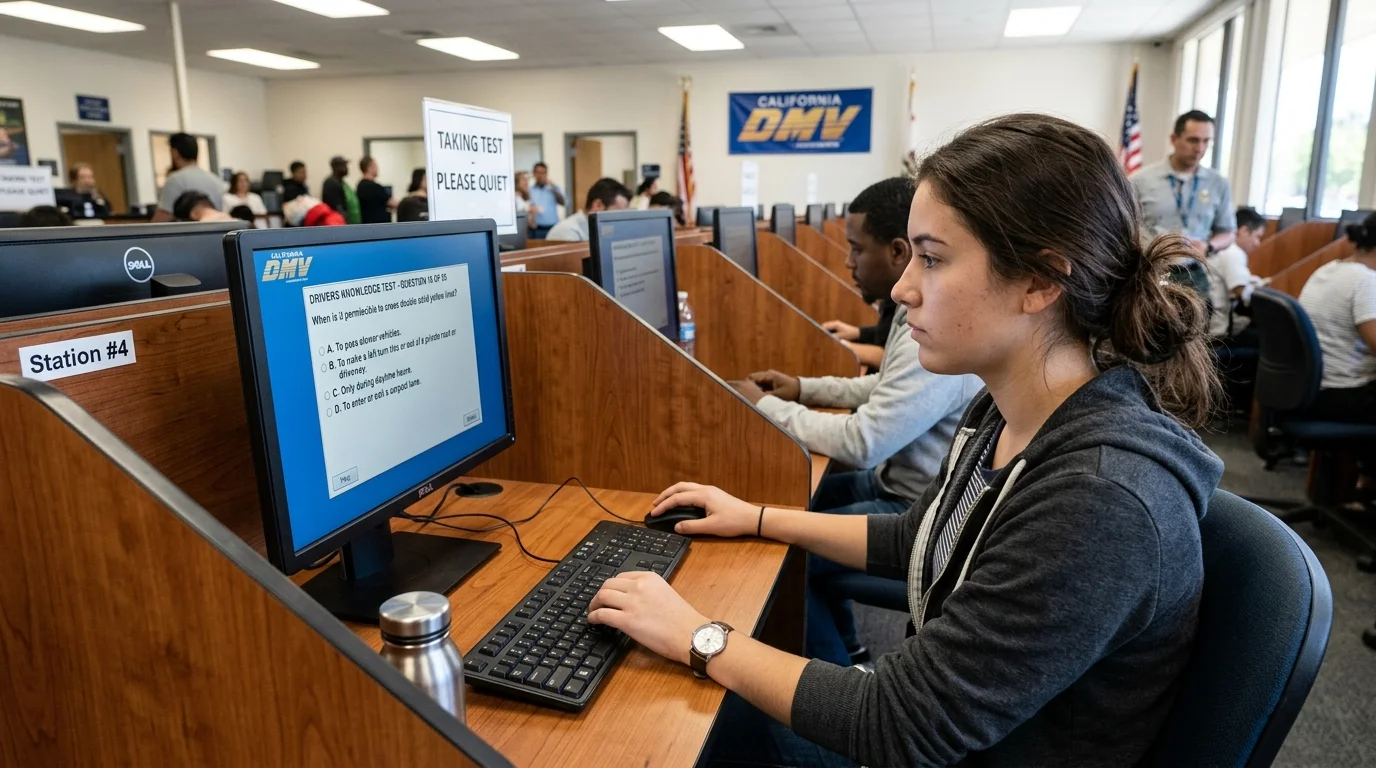
Mastering the 20 most frequently failed questions prevents costly DMV test retakes.
Quick Answer & Key Takeaways
Over 50% of first-time test takers fail the DMV written knowledge test due to subtle trick wording in four critical subject areas: 1) SPEED LAWS: The Basic Speed Law (never drive faster than safe for current conditions regardless of posted limit), School Zone limit (25 MPH, or 15 MPH near crossing guards), and Blind Intersections (15 MPH when view is blocked within 100 feet). 2) RIGHT-OF-WAY: Yielding to the driver on your RIGHT at uncontrolled 4-way stops; yielding to oncoming traffic during unprotected left turns. 3) PARKING DISTANCES: 15 feet from fire hydrants, 20 feet from crosswalks, 30 feet from stop signs. 4) BAC LIMITS: 0.08% for adults 21+, 0.04% for commercial drivers, and 0.01% for minors under Zero Tolerance.
- Blind Intersection Speed: 15 MPH if you cannot see 100 feet in either direction during the last 100 feet before entering.
- Fire Hydrant Distance: Minimum 15 feet of clearance is required in all states.
- Stop Sign Clearance: Minimum 30 feet required when parking on the approach to a stop sign or traffic signal.
- Basic Speed Law Trap: You can receive a speeding ticket even while driving UNDER the posted speed limit if weather/traffic makes that speed unsafe.
Why 50%+ Fail the DMV Written Test: Trick Wording & Technical Traps
According to data published by the American Association of Motor Vehicle Administrators (AAMVA), nationwide first-time failure rates on the DMV written permit test hover between 45% and 55%.
Applicants do not fail because the road signs are difficult; they fail because statutory test questions contain exact numbers (footage, speeds, percentages, and holding times) with plausible distractor answers designed to penalize guesswork.
Speed Laws & Dilemma Zones (Questions 1–5)
Question 1: What is the speed limit in a residential or business district unless posted otherwise?
Answer: 25 MPH in nearly all US states (unless local ordinances designate 20 MPH).
Question 2: What is the speed limit for a blind intersection?
Answer: 15 MPH. An intersection is legally "blind" if you cannot see for 100 feet in either direction during the last 100 feet before crossing.
Question 3: What does the Basic Speed Law state?
Answer: You may never drive faster than is safe for current conditions (weather, road surface, traffic density), regardless of the posted speed limit sign.
Question 4: What is the speed limit at a railroad crossing where you cannot see tracks for 400 feet?
Answer: 15 MPH within 100 feet of the crossing.
Question 5: What is the speed limit in an alleyway?
Answer: 15 MPH.
Right-of-Way & Intersections (Questions 6–10)
Question 6: Two vehicles arrive simultaneously at an uncontrolled 4-way intersection. Who yields?
Answer: The vehicle on the left must yield right-of-way to the vehicle on the immediate right.
Question 7: When two vehicles meet on a steep single-lane mountain grade, which vehicle yields?
Answer: The vehicle facing downhill must yield and back up to a turnout because the uphill-traveling vehicle has less control while reversing.
Question 8: When entering a traffic roundabout, who has the right-of-way?
Answer: Vehicles already circulating within the circulatory roadway. Entering drivers must yield.
Question 9: Can you make a right turn against a red arrow signal?
Answer: No. You may never turn on a red arrow signal until the arrow changes to green (unlike a solid circular red light where turns are permitted after stopping).
Question 10: How many seconds of following distance should you maintain under normal conditions?
Answer: A minimum of 3 seconds (4 to 5 seconds behind large commercial trucks or in rainy conditions).
Curb Colors & Statutory Parking Distances (Questions 11–15)
Question 11: What is the minimum legal parking distance from a fire hydrant?
Answer: 15 feet.
Question 12: What is the minimum legal parking distance from a railroad track?
Answer: 7.5 feet from the nearest rail (some states test 50 feet from a grade crossing).
Question 13: What does a yellow painted curb indicate?
Answer: Loading or unloading freight or passengers only. Commercial drivers must stay with vehicle.
Question 14: What direction should front wheels be turned when parking downhill with a curb?
Answer: Turn wheels TOWARD the curb (to the right).
Question 15: What direction should front wheels be turned when parking uphill WITH a curb?
Answer: Turn wheels AWAY from the curb (to the left).
BAC Limits, Zero Tolerance & Implied Consent (Questions 16–20)
Question 16: What is the illegal Blood Alcohol Concentration (BAC) for an adult driver age 21 or older?
Answer: 0.08% or higher (0.05% in Utah).
Question 17: What is the BAC limit for commercial vehicle operators (Class A/B)?
Answer: 0.04% or higher.
Question 18: What is the BAC limit under Underage Zero Tolerance laws for drivers under 21?
Answer: 0.01% or higher (any measurable alcohol).
Question 19: What happens under Implied Consent laws if you refuse a chemical breath or blood test?
Answer: Your driving privileges are automatically suspended for 1 full year, regardless of whether you are convicted in court.
Question 20: How many feet prior to a turn must you activate your turn signal?
Answer: A minimum of 100 continuous feet before making the turn.
The Top 20 Missed Questions Quick Reference Table
| Exam Topic | Statutory Numerical Rule | Common Wrong Distractor |
|---|---|---|
| Blind Intersection Speed Limit | 15 MPH | 25 MPH |
| Fire Hydrant Clearance Distance | 15 Feet | 10 Feet / 20 Feet |
| Stop Sign Parking Clearance | 30 Feet | 15 Feet |
| Turn Signal Advance Notice | 100 Feet | 50 Feet |
| Zero Tolerance Minor BAC Limit | 0.01% | 0.08% |
Interactive Knowledge Check
Question: According to standard DMV traffic law, what is the legal speed limit when crossing a "blind intersection" where your view is obstructed for 100 feet in either direction?
Authoritative Sources & Regulatory References
Content and statutory guidelines in this guide are verified against official state vehicle codes, federal transportation standards, and authoritative regulatory documentation:
- AAMVAAAMVA Driver Knowledge Examination Standardization Study(American Association of Motor Vehicle Administrators)
- California DMVCalifornia DMV Driver Handbook: Sample Knowledge Examination Questions(California Department of Motor Vehicles)
- NHTSANHTSA Analysis of Novice Driver Traffic Law Misconceptions (DOT HS 811 412)(National Highway Traffic Safety Administration)
95% of people found this article helpful.
Click a star to add your vote
145 votes • average 4.82 out of 5
Official 2026 DMV Practice Tests by State
Select your state to practice real exam questions based on the latest 2026 driver handbook.
Ready to Pass the DMV Test on Your First Try?
Practice real 2026 DMV questions with instant answer explanations, simulated timers, and pass-guarantee study guides.
Start Free Practice TestRecommended Driver Guides

How to Study for the DMV Knowledge Test in 48 Hours: Proven Cram Strategy

Top 10 Automatic Fails on the DMV Driving Test (And How to Avoid Them)