Railroad Crossing Safety: Warning Signs, Flashing Lights, and Crossbuck Rules
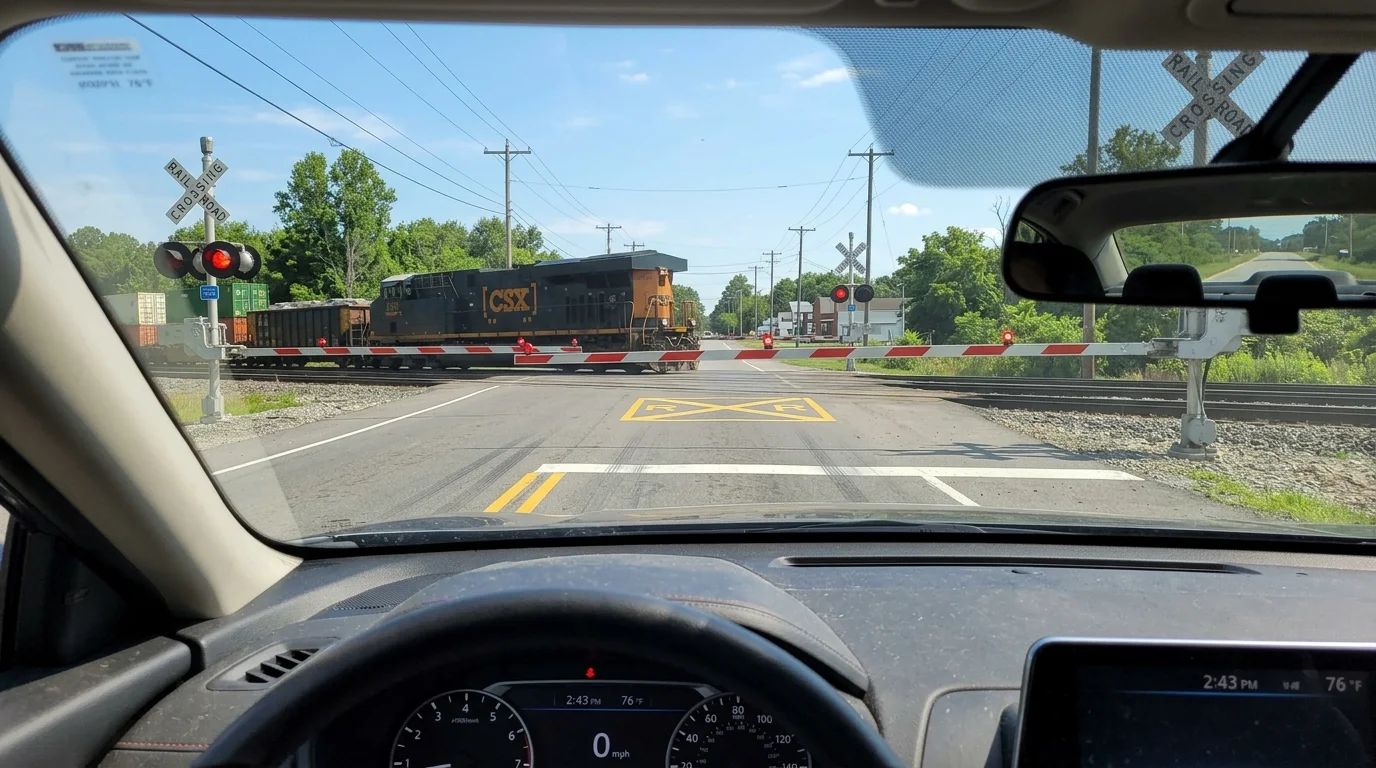
Drivers must stop between 15 and 50 feet from the nearest rail whenever crossing lights flash, bells sound, or gates descend.
Quick Answer & Key Takeaways
Under state and federal traffic laws, a driver approaching a railroad grade crossing must stop between 15 FEET and 50 FEET from the nearest rail when: 1) Flashing red lights are activated. 2) A crossing gate is lowered or descending. 3) A train is visible within 1,500 feet or blowing its horn. 4) A human flagger signals a stop. Never drive around lowered gates. If your car stalls on the tracks, immediately evacuate all passengers and run at a 45-degree angle TOWARD the oncoming train to avoid flying debris, then call the 1-800 Emergency Notification System (ENS) number on the blue sign.
- Stopping Distance: Stop at least 15 feet but no more than 50 feet from the nearest rail.
- Crossbuck = Yield Sign: The white X-shaped crossbuck (R15-1) carries the exact same legal duty as a standard YIELD sign.
- Never Drive Around Gates: Driving around lowered or descending railroad gates is a major misdemeanor carrying heavy fines and license points.
- ENS Blue Sign: Every railroad crossing has an official blue metal placard listing the railroad emergency 1-800 hotline and crossing ID number.
Why Grade Crossings Demand Extreme Caution (Train Physics)
A standard freight train traveling at 55 mph weighs over 12 million pounds (6,000 tons).
Under basic laws of momentum and stopping distance physics, a train cannot steer, swerve, or stop rapidly. It takes a fully loaded freight train over one full mile (5,280 feet / 18 football fields) to come to a complete stop after emergency braking is initiated.
According to Operation Lifesaver, a motorist is 20 times more likely to die in a collision with a train than in a collision with another motor vehicle.
The 4-Tier Railroad Warning System: Signs, Signals & Gates
Under FHWA MUTCD Part 8, grade crossings use a synchronized four-stage safety system:
Advance Warning Sign & Pavement "RXR" Markings
The circular yellow Railroad Advance Warning Sign (W10-1), as covered in our guide on warning road signs, is posted 100 to 750 feet before the tracks. Large white "R X R" letters and stopping limit lines are painted directly on the asphalt.
The Crossbuck Sign (R15-1): A Mandatory Yield
The white X-shaped RAILROAD CROSSING Crossbuck is a regulatory sign.
- Legal Meaning: The Crossbuck functions as an enforceable YIELD SIGN. You must yield the right-of-way to all approaching trains.
- Multiple Tracks Number Plaque: If there is a number plaque mounted below the crossbuck (e.g. "3 TRACKS"), it indicates the exact number of railway tracks you must cross. Always check for a second train coming from the opposite direction on parallel tracks.
Flashing Red Beacons & Warning Bells
When the two horizontal red lights begin flashing alternately and bells sound:
Flashing red railroad lights mean FULL STOP. It is strictly illegal to proceed onto the tracks while the lights are flashing.
Automatic Drop-Down Crossing Gates
Red-and-white reflective barrier arms descend across the roadway.You must remain stopped behind the limit line until the gates are fully raised and all flashing lights have ceased completely.
The Mandatory 15-to-50 Foot Stopping Distance Rule
Under California Vehicle Code § 22451 and universal traffic statutes:
- The Distance Benchmark: When stopping for an approaching train, you must stop no closer than 15 feet and no farther than 50 feet from the nearest rail.
- Commercial Vehicle Mandate: School buses carrying children, passenger vans for hire, and commercial tanker trucks hauling hazardous materials are required by law to stop at ALL railroad crossings, regardless of whether a train is approaching.
The Deadly Optical Illusion of Train Speed and Proximity
Why do smart drivers misjudge approaching trains?
Because of a massive locomotive's enormous visual profile, the human brain suffers an optical illusion: the train appears to be moving much slower and is much farther away than it actually is (similar to how a massive jumbo jet looks like it is floating slowly in midair). Never try to beat a train to a crossing.
Emergency Protocol: What to Do If Your Car Stalls on Tracks
If your vehicle becomes trapped or stalls on railroad tracks, execute this 3-step survival protocol:
- Get Everyone Out Immediately: Do not waste time trying to restart the engine or save personal belongings. Evacuate all passengers within 5 seconds.
- Run at a 45-Degree Angle TOWARD the Train: Do NOT run down the tracks away from the train. When the train smashes your vehicle, it will throw thousands of pounds of sharp metal and glass forward down the tracks in the direction of the train's travel. Running toward the train (at a 45-degree angle away from the tracks) moves you away from the debris zone.
- Call the Emergency Notification System (ENS) Number: Locate the small blue metal sign mounted on the crossbuck mast or silver signal bungalow. Call the toll-free 1-800 dispatch number and read the 6-digit crossing ID number so railway dispatchers can halt approaching trains immediately.
Interactive Knowledge Check
Question: When stopping for a train at a railroad crossing, what is the legally mandated stopping distance from the nearest rail?
Authoritative Sources & Regulatory References
Content and statutory guidelines in this guide are verified against official state vehicle codes, federal transportation standards, and authoritative regulatory documentation:
- California LegislatureCalifornia Vehicle Code § 22451: Train Signals and Railroad Crossings(State of California Vehicle Code)
- FHWARailroad-Highway Grade Crossing Handbook (MUTCD Part 8)(Federal Highway Administration)
- Operation LifesaverOperation Lifesaver Rail Safety Education and Crash Statistics(Operation Lifesaver Rail Safety)
89% of people found this article helpful.
Click a star to add your vote
102 votes • average 4.49 out of 5
Official 2026 DMV Practice Tests by State
Select your state to practice real exam questions based on the latest 2026 driver handbook.
Ready to Pass the DMV Test on Your First Try?
Practice real 2026 DMV questions with instant answer explanations, simulated timers, and pass-guarantee study guides.
Start Free Practice TestRecommended Driver Guides

Legal Parking Distances: How Far Must You Park from Hydrants, Crosswalks, and Stop Signs?
Regulatory Road Signs: The Top 25 Must-Know Signs for the DMV Exam