Tanker Endorsement (N): Liquid Surge Physics, Baffles, and Rollover Prevention
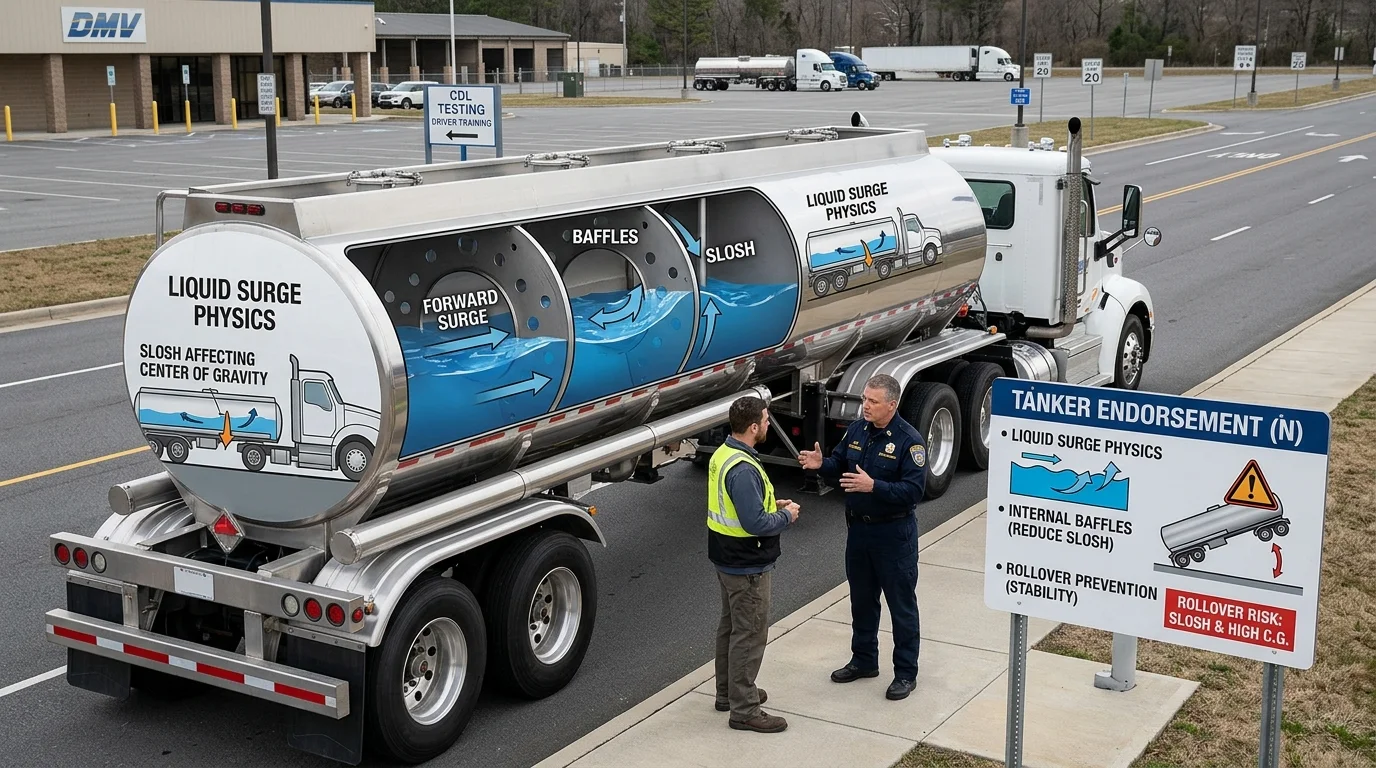
Operating commercial tank vehicles requires specialized knowledge of internal liquid wave surge physics, high centers of gravity, and baffle structures.
Quick Answer & Key Takeaways
Operating commercial liquid tankers requires the CDL Tanker Endorsement (N), required whenever transporting liquid or gaseous tanks with an individual rated capacity over 119 gallons and an aggregate capacity of 1,000+ gallons. 1) LIQUID SURGE: When stopping or turning, thousands of gallons of shifting liquid slam against tank walls with enormous kinetic wave force, shoving the truck forward through red lights or flipping it laterally on curves. 2) UNBAFFLED SMOOTH-BORE TANKS: Used for food-grade liquids (milk, fruit juice) for sanitation; they provide ZERO internal resistance, creating violent front-to-back surges. 3) BAFFLED TANKS: Feature internal bulkheads with holes that slow longitudinal wave surge (though they do NOT stop side-to-side roll surge). 4) OUTAGE: Liquids expand when heated, requiring drivers to leave 1% to 5% empty air space ('outage') to prevent tank rupture.
- The 1,000-Gallon Legal Rule: Any permanent or portable tank aggregate volume exceeding 1,000 gallons legally mandates the 'N' Endorsement.
- Smooth-Bore Food Grade Tanks: Milk and juice tanks have zero internal baffles for sanitary cleaning, causing the most violent front-to-back liquid surge.
- Baffles Do NOT Stop Side Roll: Baffles have large holes that control forward-and-backward waves but do nothing to stop lateral rollover forces.
- The 50% Load Trap: Tanks filled only 40% to 60% full are far more dangerous to maneuver than completely full tanks due to extreme liquid movement.
- Ramp Speed Warning: Tankers must navigate freeway cloverleaf ramps at speeds 10 to 15 MPH below posted advisory limits.
The Tank Vehicle (N) Endorsement: Definition & 1,000-Gallon Threshold
Hauling bulk liquids is one of the highest-paying sectors in commercial trucking, but it is also one of the most physically demanding.
Under FMCSA 49 CFR § 383.119, a driver must possess the Tanker Endorsement (N) if the vehicle carries:
- Any individual liquid or gas tank with a rated capacity of more than 119 gallons.
- Where the aggregate total capacity of all tanks on board equals 1,000 gallons or more (including Intermediate Bulk Container "IBC totes" hauled in standard dry vans).
Liquid Surge Dynamics: Forward, Backward & Lateral Momentum
Unlike solid cargo that remains anchored to trailer floor tracks, liquids move freely inside a tank:
- Forward Surge Under Braking: When a driver hits the brakes, 45,000 pounds of liquid rushes forward like a tidal wave, slamming against the front bulkhead. This secondary kinetic shock wave can shove a stopped semi-truck 20 to 30 feet forward straight through a red light or into cross-traffic.
- Backward Surge on Acceleration: Liquid sloshes backward, pulling the tractor backward and causing drive wheels to spin on wet pavement.
- Lateral Surge on Curves: Liquid shifts to the outside wall of the tank, pulling the high center of gravity outward and causing instant rollovers.
Tank Internal Designs: Smooth-Bore (Unbaffled), Baffled & Compartments
There are three primary interior tank engineering styles:
- Unbaffled / Smooth-Bore Tanks: Completely hollow internal cylinders. Mandated for hauling food-grade sanitary liquids (milk, fruit juice, liquid sugar, wine) because internal baffles would trap bacteria. These vehicles produce the most violent forward-and-backward surges and require extreme driver skill.
- Baffled Tanks: Contain internal metal walls with large flow holes. The holes allow liquid to flow between chambers while breaking up longitudinal wave momentum. Crucial CDL Exam Fact: Baffles control front-to-back surge, but DO NOT prevent side-to-side roll surge!
- Compartmented Tanks (Bulkheads): Divided into sealed, independent bulkheads (e.g. fuel tankers carrying regular unleaded, premium, and diesel in separate compartments).
The "Outage" Rule & The Extreme Danger of Under-Loaded Tanks
Liquids expand significantly when exposed to ambient summer temperatures.
Under DOT 49 CFR Part 178, drivers must leave "Outage" (empty expansion air space, typically 1% to 5% of tank volume) to prevent thermal hydraulic pressure from bursting tank seams or valves.
However, hauling a partially filled tank (e.g. 40% to 60% full) is the most dangerous scenario in trucking: the massive empty air space allows the liquid to build enormous wave velocity before slamming into the tank walls.
Rollover Prevention: High Center of Gravity & Ramp Speeds
Tank vehicles have a dangerously high Center of Gravity (CG) because the liquid payload is suspended high off the ground in a cylindrical vessel.
Under CVSA safety data, over 65% of commercial tanker rollovers occur on freeway on/off-ramp cloverleafs.
The Golden Tanker Rule: Always take curved highway exit ramps at least 10 to 15 MPH BELOW the posted advisory speed limit!
Tank Vehicle Design Comparison & Operating Limits
| Tank Type | Internal Structure | Surge Characteristics | Typical Cargo |
|---|---|---|---|
| Smooth-Bore (Unbaffled) | Completely smooth interior | Extreme forward/backward surge | Milk, juice, food products |
| Baffled Tank | Internal walls with flow holes | Reduced front-to-back surge; lateral surge remains | Fuel, chemicals, water |
| Compartmented | Solid sealed internal bulkheads | Isolated loads; requires balanced distribution | Multi-grade gasoline |
Interactive Knowledge Check
Question: On a commercial tanker vehicle equipped with internal baffles, which type of liquid movement do the baffles NOT control or reduce?
Authoritative Sources & Regulatory References
Content and statutory guidelines in this guide are verified against official state vehicle codes, federal transportation standards, and authoritative regulatory documentation:
- FMCSATank Vehicle Endorsement Knowledge Requirements (49 CFR § 383.119)(Federal Motor Carrier Safety Administration)
- CVSATank Truck Rollover Dynamics and Slosh Force Modeling(Commercial Vehicle Safety Alliance)
- DOTBulk Liquid Logistics and Outage Expansion Standards (49 CFR Part 178)(Pipeline and Hazardous Materials Safety Administration)
89% of people found this article helpful.
Click a star to add your vote
150 votes • average 4.52 out of 5
Official 2026 CDL Practice Tests by State
Select your state to practice real Commercial Driver's License (CDL) exam questions based on the latest 2026 commercial handbook.
Ready to Pass Your CDL Permit Test on the First Try?
Practice real 2026 commercial driving questions with instant air brake explanations, combination vehicle dynamics, and pass-guaranteed study guides.
Start Free CDL Practice TestRecommended Driver Guides

CDL Endorsements Guide: Hazmat (H), Tanker (N), Doubles/Triples (T), Passenger (P), School Bus (S)
CDL Class A vs. Class B vs. Class C: Gross Vehicle Weight Rating (GVWR) Decoded