7 Things DMV Examiners Secretly Look For on the Road Test
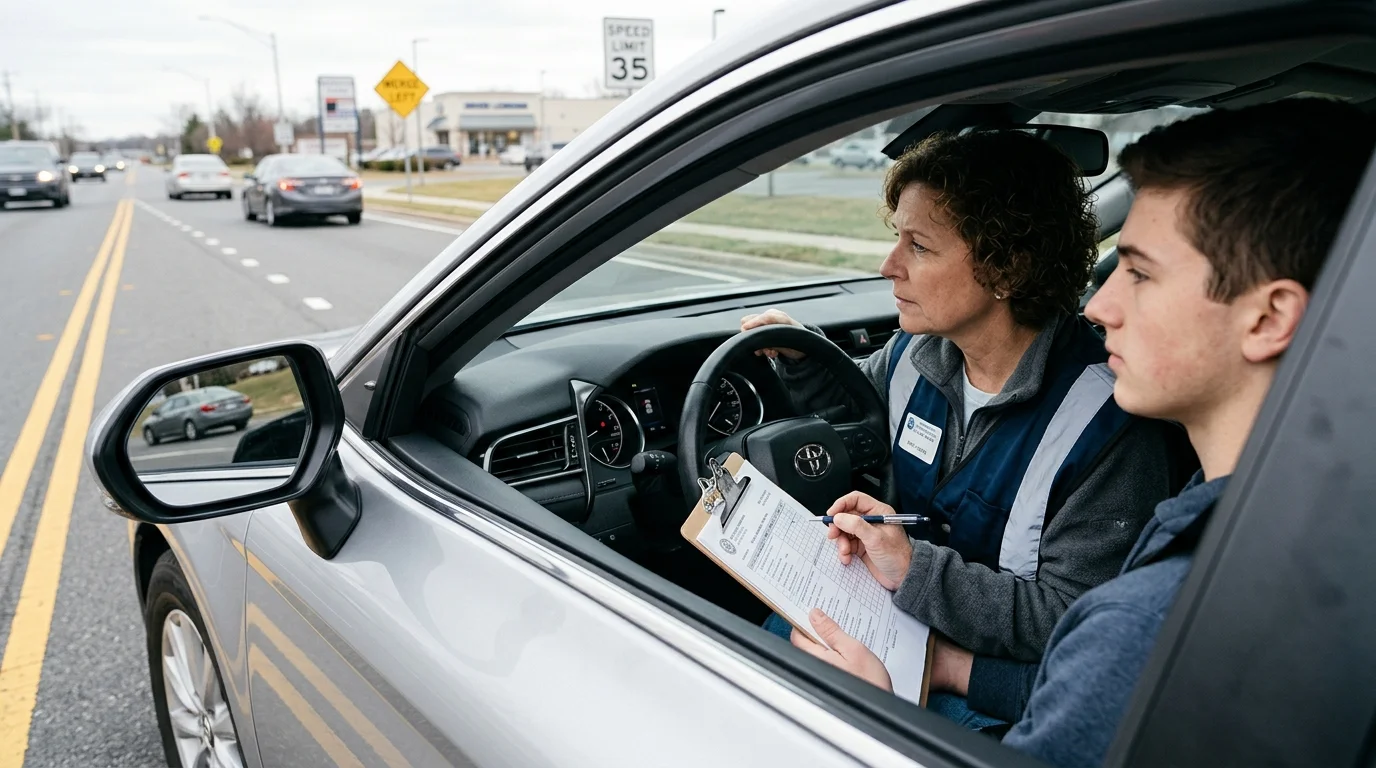
Examiners look for deliberate physical head movement and decisive speed control behind the wheel.
Quick Answer & Key Takeaways
Behind-the-wheel licensing examiners evaluate subtle behavioral cues that reveal whether an applicant is a confident, safe motorist or an anxious hazard: 1) EXAGGERATED HEAD MOVEMENTS: Examiners look at your CHIN and BASEBALL CAP BRIM, not your eyeballs. Moving only your eyes to check mirrors looks like you aren't checking at all. 2) SPEED CONFIDENCE: Driving 10 MPH below the speed limit signals hesitation and lack of control; examiners want to see you drive within 2 to 3 MPH of the posted limit when safe. 3) SCANNING GREEN LIGHTS: Glancing Left-Right-Left before entering green lights proves you anticipate red-light runners. 4) SMOOTH BRAKING: Stopping without pitching the examiner's head forward. 5) 90-DEGREE SHOULDER CHECKS: Checking blind spots when pulling away from curbs and changing lanes.
- Exaggerate Head Movements: Rotate your entire head so the examiner physically sees you checking rearview and side mirrors every 5 to 8 seconds.
- Avoid 'Timid Driving': Driving 10 MPH under the limit is scored as an 'Improper Speed' minor deduction.
- Scan Green Intersections: Never blindly blast through green lights; actively scan cross-traffic before entering.
- Curb Pullout Shoulder Checks: Failing to look over your shoulder when pulling away from a curb is the #1 missed deduction on test day.
The Examiner’s Subconscious Assessment: Evaluating Confidence vs. Panic
A DMV examiner gets into vehicles with hundreds of strangers every month. Their primary subconscious objective within the first 60 seconds of the test is determining: "Is this driver safe and in control, or am I in danger in this passenger seat?"
When applicants project nervous hesitation (driving 15 MPH below the limit, gripping the wheel in white-knuckle panic, or failing to turn their heads), examiners become hyper-vigilant and mark every minor flaw.
Demonstrating the 7 core behavioral habits instantly establishes professional competence.
Exaggerated Head Turns: Why Eye Movement Is Invisible
The single most common complaint from failed applicants is: "The examiner deducted points for mirror checks, but I checked my mirrors with my eyes!"
Why Eye Darting Fails: From the passenger seat, an examiner looking at your profile cannot see your pupils dart toward the rearview mirror.
- Physically rotate your chin toward each mirror (Center, Left, Right) every 5 to 8 seconds.
- Pro Tip: Wear a baseball cap on test day. The brim exaggerates your head movements, making every mirror check unmistakably obvious to the examiner.
Speed Confidence: Driving the Posted Limit vs. Timid 10-Under Crawling
Many nervous test takers believe driving 15 MPH in a 25 MPH residential zone proves caution.
In reality, on the DMV scoring sheet, driving more than 5 to 7 MPH below the posted speed limit when road conditions are clear is scored as a "Speed: Too Slow / Impediment" deduction.
Examiners want you to accelerate decisively and maintain a steady cruising speed within 1 to 2 MPH of the posted limit.
Smooth Braking: The "Coffee Cup" Deceleration Standard
Examiners evaluate your pedal modulation:
- Begin braking early and progressively.
- As the vehicle comes to the final halt, ease up on the brake pedal slightly so the car settles flat on its springs without pitching the examiner's torso forward.
Green Light Scans: Checking for High-Speed Red-Light Runners
Having a green light gives you legal right-of-way, but defensive driving requires verifying intersection safety:
When approaching a green traffic light, glance Left, Center, and Right before crossing the limit line. Examiners actively watch for this scan; it demonstrates you are aware that cross-street drivers frequently run stale red lights.
Curb Pullouts: The Over-the-Shoulder Blind Spot Check
Whenever you start the test, pull away from a curb, or complete a parallel parking maneuver, you must perform the complete SMOG sequence:
Signal left, check rearview mirror, check side mirror, and turn your head 90 degrees over your left shoulder to look out the driver's side window before pulling into traffic. Omitting this head check is an instant point deduction every single time.
DMV Examiner Secret Evaluation Matrix Table
| Behavior Observed | What the Examiner Wants | Common Failure Habit | Scoring Result |
|---|---|---|---|
| Mirror Scanning | Physical head movement every 5–8 sec | Moving only eyeballs | 1-Point Minor (Traffic Check) |
| Speed Maintenance | Drive at posted limit (25 in 25 zone) | Driving 15 MPH out of fear | 1-Point Minor (Too slow) |
| Curb Departure | 90° chin-to-shoulder head turn | Looking only in side mirror | Critical Error if car near |
| Green Light Entry | Left-Right-Left cross-traffic scan | Tunnel vision staring straight | Examiner notes lack of defensive awareness |
Interactive Knowledge Check
Question: Why is moving your entire head rather than just your eyes critical when checking mirrors during a DMV behind-the-wheel exam?
Authoritative Sources & Regulatory References
Content and statutory guidelines in this guide are verified against official state vehicle codes, federal transportation standards, and authoritative regulatory documentation:
- AAMVAAAMVA Non-Commercial Driver Skills Examiner Scoring and Psychological Assessment Manual(American Association of Motor Vehicle Administrators)
- California DMVCalifornia DMV Driving Performance Evaluation: Examiner Observation Manual (Form DL 385)(California Department of Motor Vehicles)
- NHTSAVisual Search Behavior and Hazard Perception in Novice Driver Testing(National Highway Traffic Safety Administration)
86% of people found this article helpful.
Click a star to add your vote
108 votes • average 4.37 out of 5
Official 2026 DMV Practice Tests by State
Select your state to practice real exam questions based on the latest 2026 driver handbook.
Ready to Pass the DMV Test on Your First Try?
Practice real 2026 DMV questions with instant answer explanations, simulated timers, and pass-guarantee study guides.
Start Free Practice Test