Driver's License Point Systems: How Violations Lead to Suspension
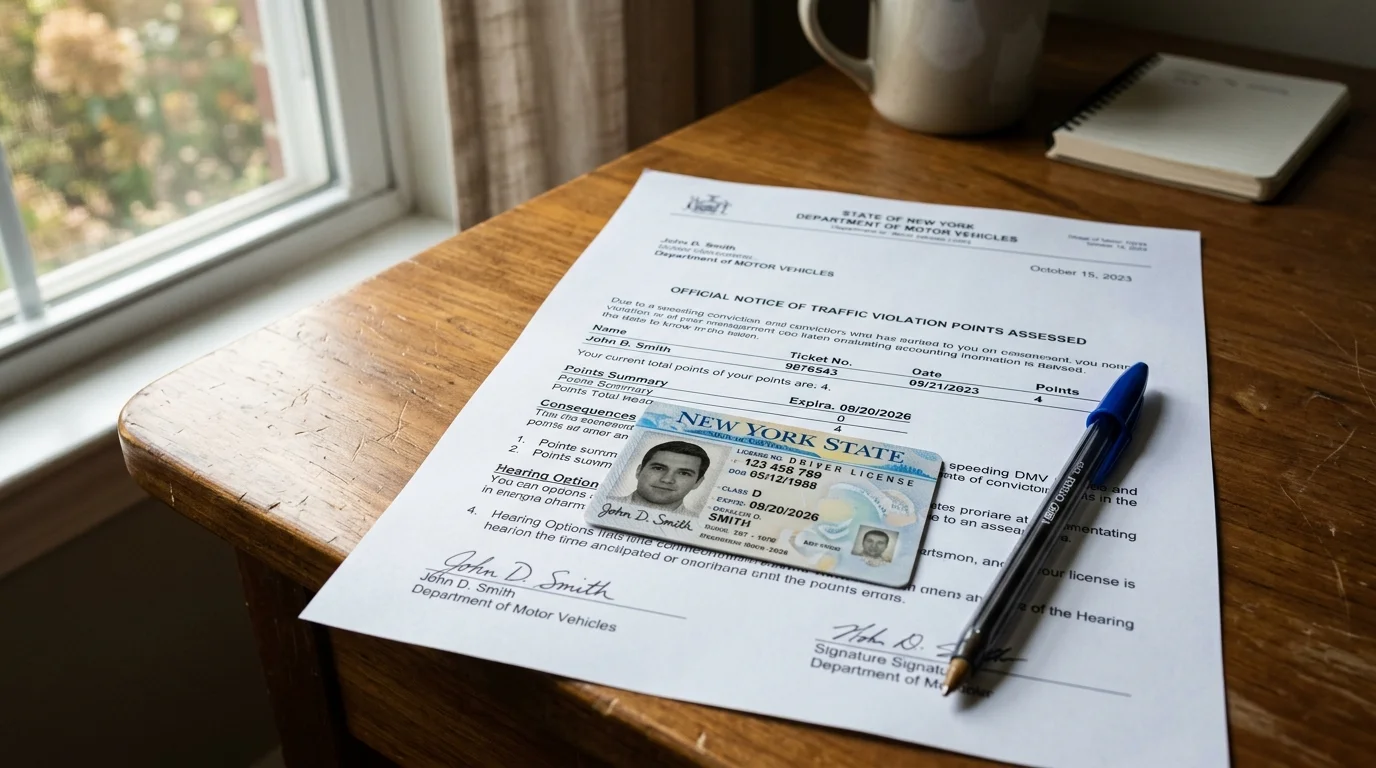
Accumulating traffic points triggers warning letters, administrative probation, and mandatory license suspensions.
Quick Answer & Key Takeaways
State DMVs use administrative Driver License Point Systems (such as California's NOTS or New York's Point System) to track driving violations and identify negligent operators. 1) POINT ACCRUAL: Minor moving violations (speeding 1–15 MPH over, illegal turns, running a red light, at-fault accidents) add 1 point (or 3–4 points in NY). Major offenses (reckless driving, speed contests, DUI, driving on a suspended license, hit-and-run) add 2 points (or 11 points in NY). 2) SUSPENSION LIMITS: In California, accumulating 4 points in 12 months, 6 points in 24 months, or 8 points in 36 months results in an automatic 6-month license suspension and 1-year probation. In New York, 11 points in 18 months results in suspension. 3) REMOVAL: Minor points remain on your public record for 36 months (3 years), but can be masked by attending state-approved Traffic Violator School once every 18 months.
- California NOTS Rule: 4 points in 1 year = 6-month license suspension and 1 year probation.
- New York Rule: 11 points within an 18-month window triggers mandatory DMV suspension.
- Major Violations: Reckless driving, DUI, and hit-and-run carry double points and remain on your record for 10 years.
- Traffic School Masking: Completing traffic school conceals 1 moving violation point from insurance companies every 18 months.
How DMV Driver License Point Systems Work: Negligent Operator Laws
Every time you are convicted of a moving traffic violation, the court clerk transmits an electronic conviction abstract to your state Department of Motor Vehicles.
The DMV records numerical "points" on your driving record under statutory Negligent Operator Treatment Systems (CVC § 12810.5).
The system is progressive: early point accumulation triggers warning letters, while reaching statutory thresholds results in license suspension and vehicle impoundment.
Violation Point Values: Speeding vs. Red Lights vs. Reckless Driving
Traffic violations are categorized into minor infractions and major criminal misdemeanors:
- 1-Point Infractions (California / Florida Scale): Speeding 1–25 MPH over the limit, running a red light, failure to yield right-of-way, illegal U-turns, making an unsafe lane change, and at-fault traffic collisions.
- 2-Point Major Misdemeanors: Reckless driving (CVC § 23103), driving under the influence of alcohol or drugs (DUI), hit-and-run collisions, driving over 100 MPH, and driving on a suspended license.
- Commercial Drivers (Class A/B): CDL operators receive 1.5 times the standard point value for violations committed in commercial vehicles.
Suspension Thresholds: The 4 Points in 12 Months Rule (NOTS)
In California, the DMV's Negligent Operator Treatment System (NOTS) enforces four administrative intervention levels:
- Level 1 (Warning Letter): 2 points within 12 months, 4 points in 24 months, or 6 points in 36 months.
- Level 2 (Notice of Intent to Suspend): 3 points in 12 months, 5 points in 24 months, or 7 points in 36 months.
- Level 3 (Order of Probation & 6-Month Suspension): 4 points in 12 months, 6 points in 24 months, or 8 points in 36 months.
- Level 4 (Violation of Probation): Any moving violation during the 1-year probation period adds a 6-month suspension extension.
Point Lifespans: 3 Years (Standard) vs. 10 Years (DUI Violations)
Points do not stay on your driver record forever:
- Standard Moving Violations (1 Point): Remain active on your DMV driving record for 36 months (3 years) from the conviction date.
- Accidents (1 Point): Remain for 3 years.
- Major Criminal Offenses (DUI, Hit-and-Run, Reckless Driving): Remain on your permanent DMV printout for 10 years and cannot be removed by traffic school.
Point Removal: How Traffic School Masks Moving Violations
If you receive a ticket for a 1-point moving violation, you can mask the point by attending a state-certified Traffic Violator School (TVS) or Defensive Driving course:
- 18-Month Eligibility Rule: You can only use traffic school to mask a point once every 18 months (measured ticket date to ticket date).
- Insurance Protection: Completing the course marks the ticket as a "confidential dismissal" on public records, preventing auto insurance underwriters from raising your rates.
State-by-State Point System & Suspension Threshold Table
| State | Suspension Threshold | Minor Violation Value | Major Violation Value |
|---|---|---|---|
| California (NOTS) | 4 Points in 12 Months | 1 Point | 2 Points |
| New York (Point System) | 11 Points in 18 Months | 3 to 4 Points | 8 to 11 Points |
| Texas (Driver Responsibility) | 4 Moving Violations in 12 Mos | 2 Points | 3 Points |
| Florida | 12 Points in 12 Months (30-day susp.) | 3 Points | 6 Points |
Interactive Knowledge Check
Question: Under California's Negligent Operator Treatment System (NOTS), how many DMV points accumulated within a 12-month period will trigger an automatic 6-month license suspension and 1-year probation?
Authoritative Sources & Regulatory References
Content and statutory guidelines in this guide are verified against official state vehicle codes, federal transportation standards, and authoritative regulatory documentation:
- California DMVCalifornia Vehicle Code § 12810 & § 12810.5: Negligent Operator Treatment System (NOTS)(California Department of Motor Vehicles)
- NY DMVNew York DMV Driver Violation Point System Standards(New York State Department of Motor Vehicles)
- NHTSADriver License Point Systems and Traffic Violation Recidivism (DOT HS 809 568)(National Highway Traffic Safety Administration)
85% of people found this article helpful.
Click a star to add your vote
143 votes • average 4.32 out of 5
Official 2026 DMV Practice Tests by State
Select your state to practice real exam questions based on the latest 2026 driver handbook.
Ready to Pass the DMV Test on Your First Try?
Practice real 2026 DMV questions with instant answer explanations, simulated timers, and pass-guarantee study guides.
Start Free Practice Test