Freeway Fender-Benders: 'Steer It, Clear It' Laws Explained
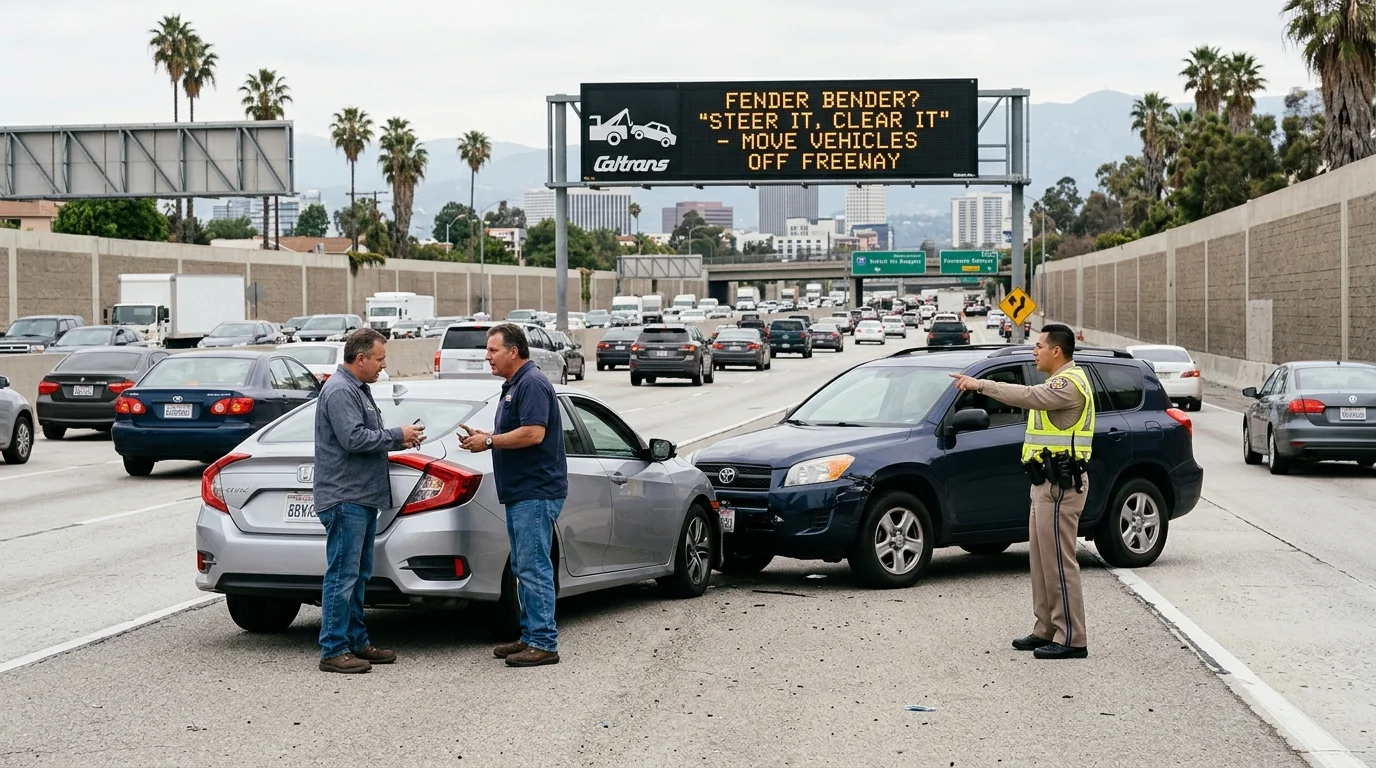
State laws legally mandate moving drivable vehicles involved in minor collisions off active freeway lanes.
Quick Answer & Key Takeaways
A persistent and deadly urban myth is that drivers involved in a minor freeway fender-bender must leave their vehicles stopped in active traffic lanes 'so the police can see the accident scene.' Under 'Steer It, Clear It' (Quick Clearance) laws in all 50 states (including California CVC § 20002, Texas Trans. Code § 550.022, and Florida Stat. § 316.061): 1) IF THE VEHICLE IS DRIVABLE AND NO INJURIES OCCURRED, YOU MUST IMMEDIATELY MOVE THE CAR OFF THE FREEWAY TO THE NEXT EXIT OR RIGHT SHOULDER. 2) SECONDARY CRASHES: Leaving cars stopped in 65 MPH lanes creates catastrophic chain-reaction pileups. 3) STAYING SAFE: Never stand in active lanes or between bumpers; remain buckled inside the car on the shoulder or stand behind a metal guardrail.
- Mandatory Vehicle Relocation: Moving drivable cars to the shoulder or off-ramp is legally required by state statute.
- Moving Your Car Does NOT Admit Fault: Relocating to a safe shoulder has zero impact on insurance liability determinations.
- Secondary Crashes Are Fatal: Over 20% of highway fatalities occur in secondary collisions caused by stopped vehicles.
- Stay Buckled In: If pulled onto the shoulder, keep your seatbelt fastened until highway patrol arrives.
The Lethal Freeway Myth: Leaving Vehicles in Active Traffic
Every day on American interstates, drivers involved in minor cosmetic scratches—where neither airbag deployed and no one was hurt—stop dead in Lane 1 or Lane 2, get out of their cars, and begin taking photos on their smartphones.
According to NHTSA secondary collision research, a stopped vehicle in an active 65 MPH highway lane creates a secondary crash risk that increases by 2.8% for every single minute the lane remains blocked.
Stopping in live traffic lanes turns a $500 bumper repair into a fatal multi-car disaster.
"Steer It, Clear It" Statutes: Mandatory Relocation Laws
Federal Highway Administration (FHWA) guidelines and state vehicle codes (e.g., California Vehicle Code § 20002 and Texas Trans. Code § 550.022) explicitly mandate:
"If a motor vehicle collision occurs on a main lane, ramp, shoulder, or median of a freeway and each vehicle can be safely driven, each driver shall move the driver's vehicle as soon as possible to a designated accident investigation site, location on the frontage road, or the nearest suitable off-ramp."
Failing to move your drivable vehicle is a moving violation punishable by fines of $100 to $250.
The 4-Step Minor Freeway Crash Protocol: Move to Right Shoulder
Follow this exact sequence following a minor collision on the interstate:
- Assess Mobility & Injuries: Check yourself and passengers. If no one requires emergency ambulance medical care and the vehicle drives, do not stop in the lane.
- Signal & Guide to the Far Right Shoulder: Turn on your hazard lights, steer smoothly across lanes, and pull onto the far-right shoulder or take the very next exit into a well-lit parking lot.
- Never Stop on the Left Center Median: The narrow concrete center divider offers zero escape zone. Always navigate to the right shoulder or off-ramp.
- Call Highway Patrol: Dial 911 or non-emergency highway patrol dispatch.
Pedestrian Vulnerability: Staying Buckled vs. Standing Behind Guardrails
Once stopped on the highway shoulder:
- DO NOT Stand on the Shoulder: Standing between two stopped cars or walking along the white shoulder stripe makes you an unprotected pedestrian against distracted 70 MPH traffic.
- Option A (Best): If a metal guardrail or grassy embankment is available, exit from the passenger-side door and stand behind the guardrail at least 20 feet up the embankment.
- Option B: If no guardrail exists, stay inside your vehicle with your seatbelt buckled and hazard lights flashing until police arrive. Your car's crumple zone and airbags protect you if another vehicle strikes your rear.
Information Exchange & DMV Reporting: State SR-1 Accident Forms
Under accident reporting rules:
- Exchange driver's license numbers, full names, phone numbers, vehicle license plates, insurance policy numbers, and insurance carrier names.
- Snap photos of vehicle damage and insurance cards in the safety of the parking lot or shoulder.
- State DMV Crash Report (Form SR-1): In states like California, if damage exceeds $1,000 (or $750 to $1,500 in other states), you must submit a completed DMV Form SR-1 within 10 days, regardless of who was at fault.
"Steer It, Clear It" State Laws, Relocation Mandates & Fines Table
| State | Statutory Rule | Mandatory Relocation Target | Fine for Blocking Lane |
|---|---|---|---|
| California (CVC § 20002) | Quick Clearance Mandate | Right shoulder or nearest off-ramp | $100–$250 Infraction |
| Texas (Trans. Code § 550.022) | Steer It, Clear It | Frontage road or accident site | Class C Misdemeanor ($500) |
| Florida (Stat. § 316.061) | Move-It Law | Every drivable car must clear lane | Non-criminal moving violation |
| New York (VTL § 600) | Move to Safe Shoulder | Shoulder or emergency turnout | $150 Fine |
Interactive Knowledge Check
Question: You are involved in a minor fender-bender in the fast lane of a 65 MPH interstate highway. Both cars have minor bumper scratches, all tires are intact, and nobody is injured. What are you legally required to do?
Authoritative Sources & Regulatory References
Content and statutory guidelines in this guide are verified against official state vehicle codes, federal transportation standards, and authoritative regulatory documentation:
- FHWAFHWA Traffic Incident Management: Quick Clearance & "Move It" Laws (23 CFR Part 658)(Federal Highway Administration)
- California LegislatureCalifornia Vehicle Code § 20002 & § 22651: Removal of Vehicles Involved in Minor Damage Accidents(California Vehicle Code)
- NHTSASecondary Crash Risks and Pedestrian Fatalities on Interstate Highways (DOT HS 811 698)(National Highway Traffic Safety Administration)
90% of people found this article helpful.
Click a star to add your vote
241 votes • average 4.56 out of 5
Official 2026 DMV Practice Tests by State
Select your state to practice real exam questions based on the latest 2026 driver handbook.
Ready to Pass the DMV Test on Your First Try?
Practice real 2026 DMV questions with instant answer explanations, simulated timers, and pass-guarantee study guides.
Start Free Practice TestRecommended Driver Guides
What to Do After a Car Accident: Step-by-Step Emergency Checklist
Move Over Laws: What Every Driver Must Do When Passing Emergency Vehicles