How to Reverse in a Straight Line Along a Curb Without Striking the Sidewalk
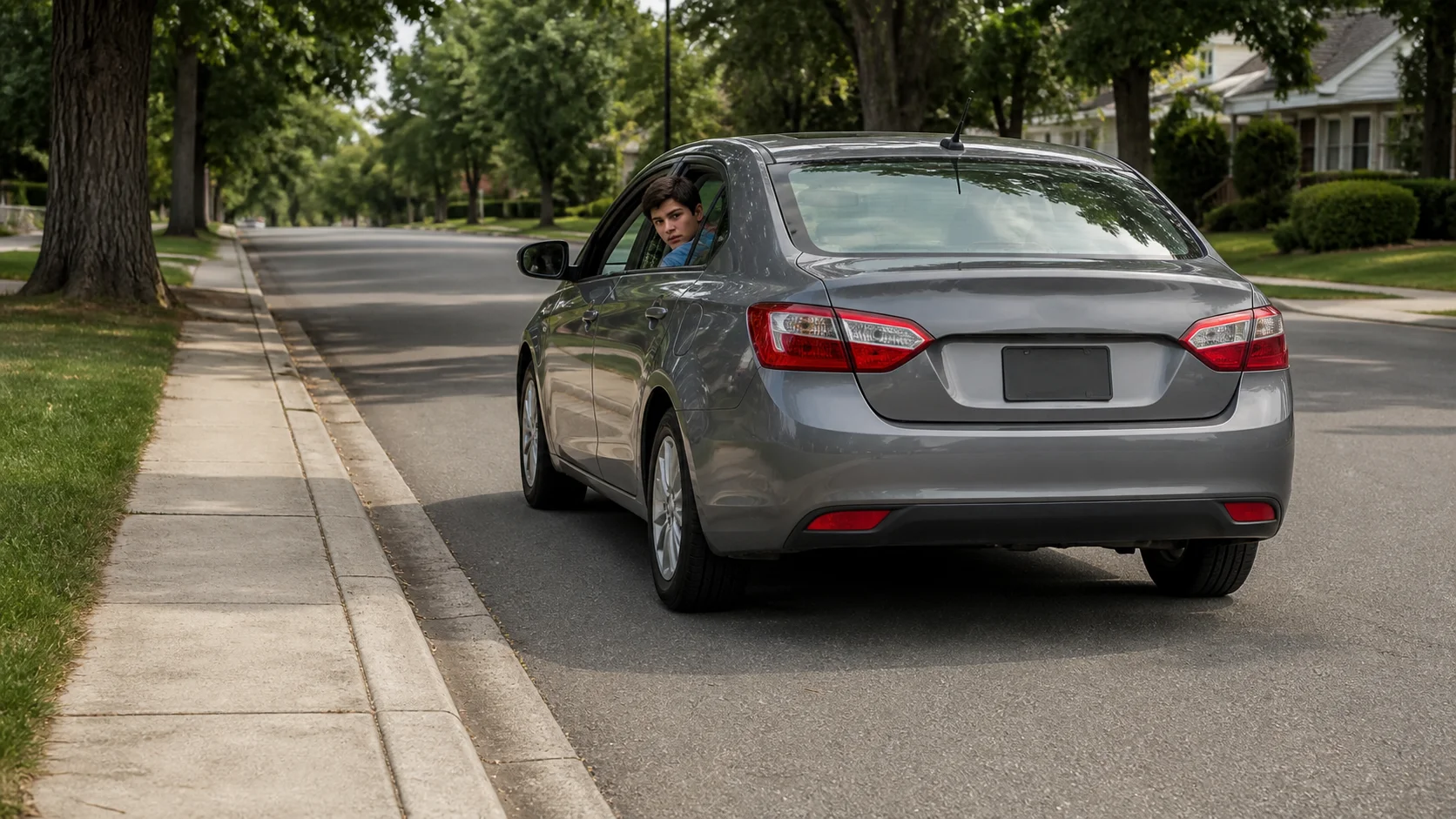
The straight-line backing maneuver requires maintaining a consistent 1 to 2-foot distance from the curb for three full car lengths.
Quick Answer & Key Takeaways
To pass the straight-line backing test: 1) Pull parallel within 12–18 inches of the curb. 2) Shift into Reverse and drape your right arm over the back of the front passenger seat. 3) Place your left hand at the 12 o'clock position on the steering wheel. 4) Look directly out the rear window (do NOT stare at your backup screen or mirrors). 5) Creep backward at 2–3 mph for 50 feet (3 car lengths) using tiny micro-corrections (turn top of wheel toward the curb to get closer, away to move out).
- Body posture: Turn your upper torso 45° to the right and look directly through the rear glass.
- One-hand control: Keep your left hand at top-dead-center (12 o'clock) for precise directional control.
- Speed discipline: Control momentum purely using brake modulation; do not touch the accelerator pedal.
- Curb strike = Auto Fail: Touching or hopping the curb with the rear tire results in immediate disqualification.
Why Examiners Test Straight-Line Backing
During your behind-the-wheel exam, the examiner will instruct you to pull over to the right curb in a quiet residential neighborhood, stop, and reverse in a straight line for roughly 3 to 4 car lengths (about 50 feet).
This test evaluates your spatial awareness, your ability to control vehicle trajectory in reverse, and your peripheral observation. Alongside parallel parking and three-point turns, straight-line backing is a compulsory grading element on DMV driving exams in states like California, Washington, New York, Texas, and Florida.
A single harsh curb strike or drifting more than three feet away from the curb line can result in an immediate disqualification under critical error road test criteria.
Official DMV Test Standards (3–4 Car Lengths / 50 Feet)
Under standard California DMV DL 653 evaluation sheets and state guidelines, the examiner looks for three specific passing metrics:
- Consistent Parallel Distance: The vehicle must remain within 12 to 18 inches of the curb throughout the entire 50-foot reverse movement.
- Straight Trajectory (No Weaving): The car must travel straight without fishtailing back and forth or drifting out into the roadway.
- Constant Rearward Scanning: The driver must look out the rear window for at least 90% of the maneuver, using brief 1-second mirror glances only to verify curb spacing.
The Proper Body & Hand Position (The Over-the-Seat Pose)
To achieve maximum visibility and steering stability, adopt the classic driving school backing posture:
- Right Arm: Drape your right arm comfortably over the backrest of the front passenger seat. This mechanically pivots your upper torso and head 45 degrees to the right.
- Left Hand at 12 O’Clock: Place your left palm securely at the top-dead-center of the steering wheel.
- Eyes Through the Rear Glass: Look directly through the center of the rear window. Pick an imaginary focal point (like a distant parked vehicle's bumper or tree trunk) to anchor your straight line.
Step-by-Step Curb Backing Technique
Follow this exact sequence from the moment the examiner issues the backing instruction:
- Pull to the Curb and Stop: Signal right, check your mirrors and blind spot using the S.M.O.G. technique, and align parallel to the curb roughly 12 inches away. Straighten your front wheels completely before stopping.
- 360-Degree Perimeter Scan: Check your front, left side, right side, and rear for pedestrians, joggers, cyclists, or approaching vehicles.
- Shift into Reverse: Keep your right foot pressed on the brake pedal and move the shifter into Reverse (R).
- Establish Posture: Place your left hand at 12 o'clock, right arm over the passenger seat, and look out the rear window.
- Control Speed with Brake Feathering: Ease off the brake pedal slightly to allow the car to creep backward at 2 to 3 mph (walking pace). Keep your foot poised over the brake pedal the entire time.
- Stop Smoothly: When the examiner says "Stop" or when you reach the required 50-foot mark, depress the brake pedal to a smooth stop, shift into Park (P), and set the parking brake if requested.
Micro-Steering Corrections: Which Way to Turn the Wheel
Beginner drivers often get disoriented steering in reverse. Remember this golden rule of reverse steering:
The back of the car always moves in the direction you turn the top of the steering wheel.
- If the Car Drifts Away From the Curb: Move the top of the steering wheel 1 to 2 inches to the RIGHT (Toward the curb). As soon as the vehicle begins moving closer, return the wheel to center.
- If the Car Drifts Too Close to the Curb: Move the top of the steering wheel 1 to 2 inches to the LEFT (Away from the curb) to steer the rear wheels out, then return to center.
- Rule of Micro-Adjustments: Never make large, sweeping turns of the steering wheel. Movements should never exceed 2 to 3 inches from the 12 o'clock center line.
Can You Use Your Backup Camera on the DMV Test?
Under Federal Motor Vehicle Safety Standard (FMVSS No. 111), all passenger cars manufactured after May 2018 come equipped with factory backup cameras.
However, you CANNOT rely on the backup camera screen during the DMV road test. Examiners evaluate your physical human driving skills. While you are allowed a brief 1-second glance at the camera screen to verify that no small obstacles or pets are directly behind your bumper, staring continuously at the dashboard screen will result in an immediate point deduction or automatic test disqualification for "Failure to Look Back."
Top Errors That Fail or Penalize Your Exam
Watch out for these common test-day pitfalls:
- Striking or Mounting the Curb (Automatic Failure): If your tire bumps hard against the curb, rubs the curb sidewall, or hops onto the sidewalk, the exam is immediately terminated.
- Backing Too Fast: Reversing faster than 5 mph shows a lack of vehicle control and prevents precise steering adjustments.
- Looking Exclusively in Side Mirrors: Side mirrors have blind spots and distort distance perspective; you must physically look out the rear window.
- Forgetting to Yield to Approaching Traffic: If a vehicle approaches from either direction while you are backing, you must immediately stop and yield right-of-way.
Interactive Knowledge Check
Question: While reversing along a curb in a straight line, you notice your vehicle is slowly drifting too far away into the street. How should you steer to correct?
Authoritative Sources & Regulatory References
Content and statutory guidelines in this guide are verified against official state vehicle codes, federal transportation standards, and authoritative regulatory documentation:
- California DMVDriving Performance Evaluation Score Sheet (DL 653)(State of California Department of Motor Vehicles)
- WA DOLDriver Guide: Backing and Parking Maneuvers(Washington State Department of Licensing)
- NHTSARearview Camera Standards and Driver Backing Safety (FMVSS No. 111)(National Highway Traffic Safety Administration)
84% of people found this article helpful.
Click a star to add your vote
77 votes • average 4.25 out of 5
Official 2026 DMV Practice Tests by State
Select your state to practice real exam questions based on the latest 2026 driver handbook.
Ready to Pass the DMV Test on Your First Try?
Practice real 2026 DMV questions with instant answer explanations, simulated timers, and pass-guarantee study guides.
Start Free Practice TestRecommended Driver Guides
How to Parallel Park in 3 Easy Steps (With Diagrams & Reference Points)
How to Do a 3-Point Turn (K-Turn) on the DMV Road Test: Step-by-Step Guide
