MSF Basic RiderCourse: What to Expect, Exercises & Exam Breakdown
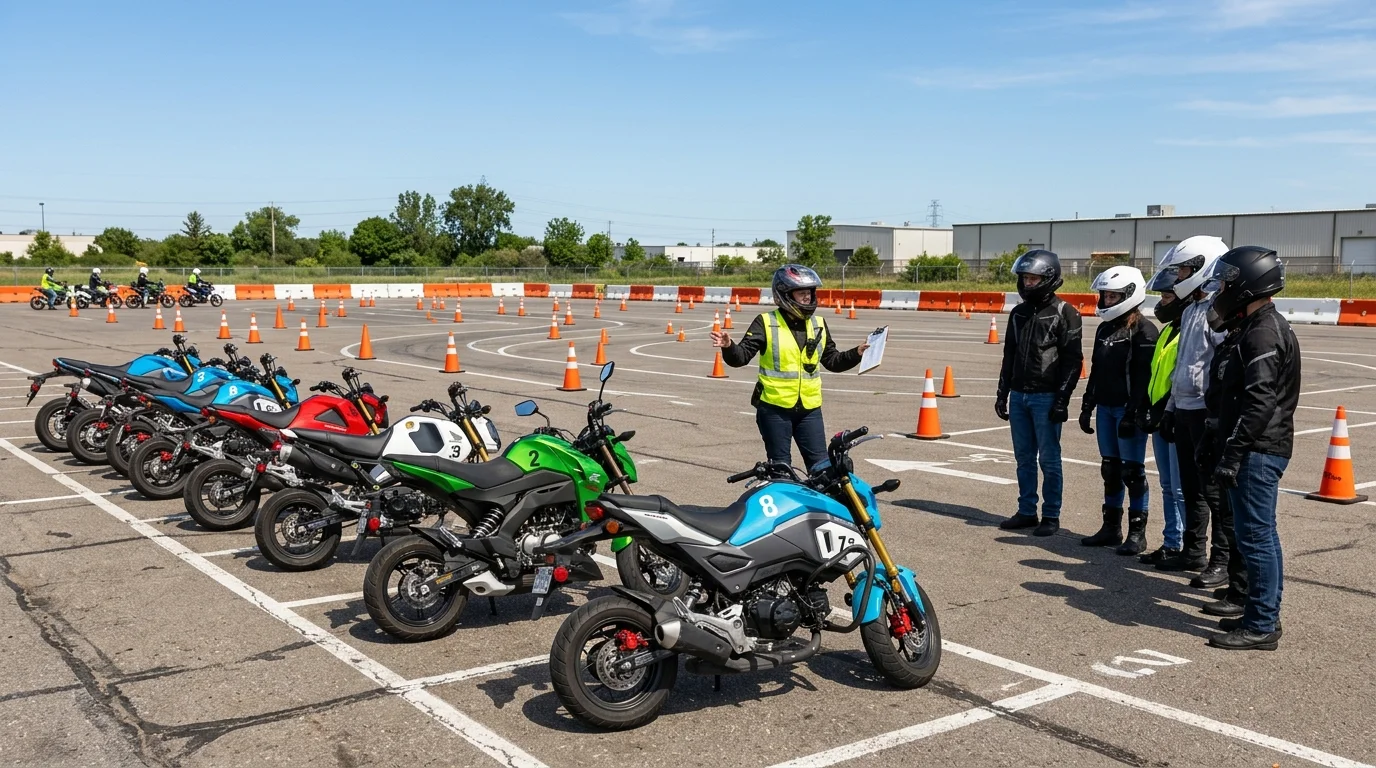
The MSF Basic RiderCourse teaches entry-level riders clutch friction control, countersteering, and collision avoidance over 15 hours.
Quick Answer & Key Takeaways
The Motorcycle Safety Foundation (MSF) Basic RiderCourse (BRC) is a 15-hour weekend training program designed for individuals with ZERO prior motorcycle experience. 1) STRUCTURE: Consists of a 5-hour online or classroom eCourse followed by two 5-hour days of hands-on parking lot riding exercises. 2) MOTORCYCLES PROVIDED: Schools supply 250cc–300cc motorcycles (Honda Rebel, Kawasaki Z125, Yamaha V-Star) and DOT helmets. 3) CORE SKILLS TAUGHT: Finding the clutch friction zone, power walking, straight-line shifting, cornering, countersteering at speed, 20 MPH emergency swerves, and threshold quick stopping. 4) FINAL EXAM: A 4-part scored skills evaluation (cone weave, U-turn in a box, quick stop, and obstacle swerve); scoring under 21 penalty points earns your DMV Skills Waiver certificate.
- No Experience Needed: Designed from the ground up for people who have never sat on a motorcycle.
- Mandatory Gear: Over-the-ankle sturdy boots, long non-flare denim pants, long sleeves, full-fingered gloves, and eye protection.
- The 4 Scored Final Exercises: Cone weave/normal stop, figure-8 U-turn box, emergency braking from 15 mph, and 15 mph obstacle swerve.
- Immediate Disqualification (Auto-Fail): Dropping the motorcycle, crashing, or reckless riding during the skills test results in immediate test failure.
Anatomy of the MSF Basic RiderCourse (BRC): Weekend Structure
For novice motorcyclists, learning to balance clutch friction, throttle roll-on, and foot brakes while leaning at 25 MPH can feel intimidating.
The Motorcycle Safety Foundation (MSF) Basic RiderCourse is a research-proven, incremental curriculum designed to take absolute beginners from zero experience to licensed motorcyclists in a single weekend.
The course is split into 5 hours of interactive classroom theory and 10 hours of practical range maneuvers across 14 progressive exercises.
Required Riding Gear: The Mandatory 5-Piece Protection Checklist
If you arrive at the training range without the correct gear, instructors are federally mandated to dismiss you without a refund:
- Sturdy Over-the-Ankle Footwear: Leather work boots or motorcycle boots that completely cover and support the ankle bones (canvas Converse and low-top sneakers are strictly prohibited).
- Long Pants: Sturdy denim jeans or abrasion-resistant riding pants with zero rips or tears.
- Long-Sleeved Shirt or Jacket: Heavy cotton, denim, or motorcycle armor.
- Full-Fingered Gloves: Leather or durable textile gloves with no exposed fingers.
- Eye Protection & DOT Helmet: Sunglasses, clear glasses, or helmet face shield. (Most schools supply loaner DOT-certified helmets).
Range Day 1: Mastering the Clutch Friction Zone & Shifting
Saturday morning starts with the engine off:
- Exercise 1 (Motorcycle Controls & T-CLOCS): Locating the clutch lever (left hand), front brake (right hand), throttle (right wrist), gear shifter (left foot), and rear brake (right foot).
- Exercise 2 (Friction Zone & Power Walking): Slowly easing out the clutch until the bike begins to roll, walking alongside the motorcycle with your feet down to build muscle memory for the clutch bite point.
- Exercises 3–7 (Riding, Stopping & Shifting): Lifting your feet onto the footpegs, riding in wide perimeter loops, smooth progressive 2-finger braking, and upshifting into 2nd gear.
Range Day 2: Countersteering, Emergency Swerves & Quick Stops
Sunday focuses on life-saving defensive maneuvers:
- Countersteering Physics: Learning the counter-intuitive principle: "Press left to turn left; press right to turn right" to initiate controlled lean angles at speeds over 15 MPH.
- The 20 MPH Obstacle Swerve: Accelerating in 2nd gear toward a line of cones, maintaining constant throttle, pushing the handlebar to swerve 4 feet laterally, and righting the bike before braking.
- Emergency Threshold Quick Stops: Applying 70% front brake pressure and 30% rear brake pressure simultaneously without locking the wheels under braking physics.
The Final Skills Evaluation: The 4 Graded Scoring Tests
At the end of Day 2, riders take the standardized 4-part practical skills test:
- Test 1 (Cone Weave & Normal Stop): Weaving smoothly through 5 offset cones at 12–15 MPH and stopping inside a painted box.
- Test 2 (Turn from a Stop & U-Turn in the "Box"): Making a 90-degree right turn from a dead stop, riding into a 20-foot painted box, and executing a tight figure-8 double U-turn without touching the boundary lines or putting a foot down.
- Test 3 (Quick Stop): Accelerating to 12–18 MPH and stopping in the shortest possible distance based on radar gun speed measurements.
- Test 4 (Obstacle Swerve): Accelerating to 12–18 MPH and executing a rapid swerve to the right or left on instructor cue.
The Top 5 Failure Traps: Stalling, Target Fixation & Foot Drops
Students who accumulate more than 20 penalty points fail the evaluation. The most common point deductions:
- Target Fixation: Looking down at the front tire or orange cones instead of turning your head and looking through the turn.
- Putting a Foot Down: Touching the asphalt during the tight U-turn box (+5 points per foot touch).
- Grabbing the Front Brake While Turned: Grabbing the front brake lever with handlebars turned snaps the front suspension and causes an immediate low-side tip-over (which is an automatic test disqualification).
MSF Basic RiderCourse 14-Exercise Breakdown Table
| Course Phase | Core Exercises | Key Skill Learned |
|---|---|---|
| Phase 1: Basics | Ex 1 to Ex 4 (Controls, Friction Zone, Starting/Stopping) | Smooth clutch release & balance |
| Phase 2: Cornering | Ex 5 to Ex 8 (Shifting, Perimeter Curves, Cone Weaves) | Looking through turns & countersteering |
| Phase 3: Emergency | Ex 9 to Ex 14 (U-Turn Box, Emergency Swerves, Quick Stops) | Threshold braking & collision avoidance |
| Phase 4: Skills Test | 4 Graded Evaluated Maneuvers | Qualifies for DMV Riding Test Waiver |
Interactive Knowledge Check
Question: During the MSF Basic RiderCourse practical evaluation, what action results in an immediate automatic failure and test termination?
Authoritative Sources & Regulatory References
Content and statutory guidelines in this guide are verified against official state vehicle codes, federal transportation standards, and authoritative regulatory documentation:
- MSFBasic RiderCourse (BRC) Rider Handbook & Range Exercises Guide(Motorcycle Safety Foundation)
- CHPCMSP Motorcyclist Training Course (MTC) Policies and Procedures(California Highway Patrol CMSP)
- NHTSAEvaluation of Motorcyclist Novice Training and Crash Reductions(National Highway Traffic Safety Administration)
93% of people found this article helpful.
Click a star to add your vote
276 votes • average 4.70 out of 5
Official 2026 DMV Practice Tests by State
Select your state to practice real exam questions based on the latest 2026 driver handbook.
Ready to Pass the DMV Test on Your First Try?
Practice real 2026 DMV questions with instant answer explanations, simulated timers, and pass-guarantee study guides.
Start Free Practice TestRecommended Driver Guides

How to Get a Motorcycle License (Class M): Permit Test vs. MSF Waiver
Motorcycle Lane Splitting vs. Lane Filtering: State-by-State Laws Explained