Right Turn on Red: When Is It Legal and When Is It Prohibited?
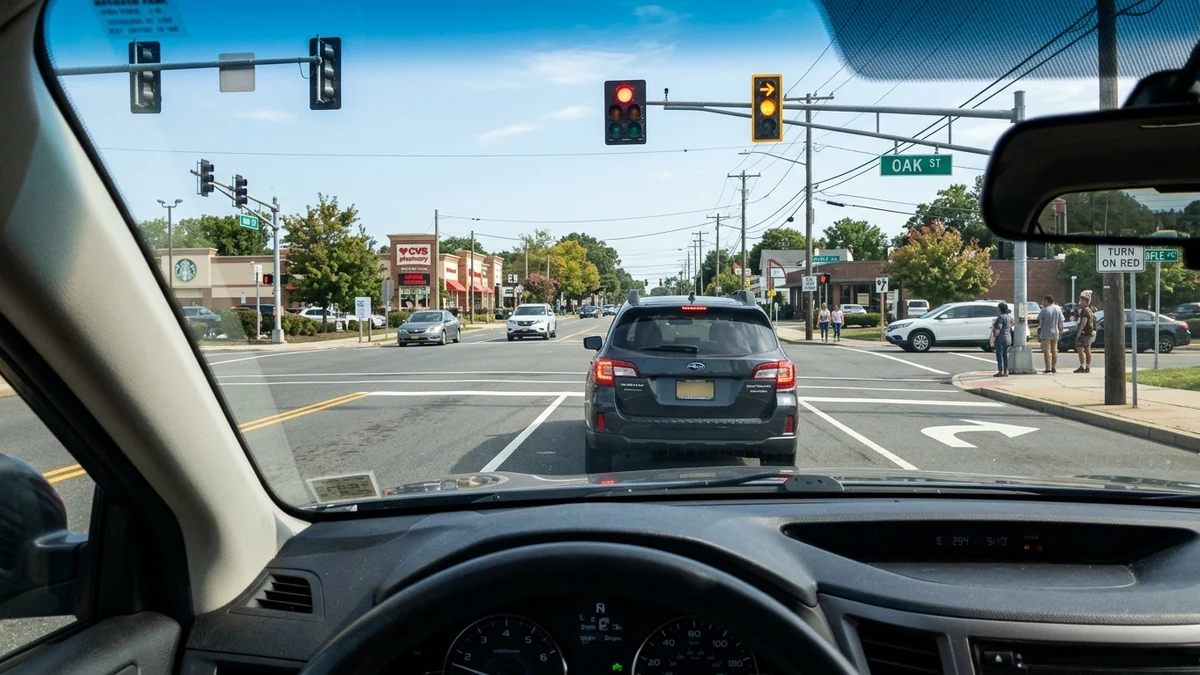
A complete 100% stop behind the limit line is legally required before initiating any right turn on a red signal.
Quick Answer & Key Takeaways
In all 50 states, you may turn right on a solid red light IF: 1) You come to a full, complete stop behind the limit line or crosswalk first (no rolling stops). 2) There is NO 'No Turn on Red' sign posted. 3) The light is a circular red ball (NOT a solid Red Arrow in states like California). 4) You yield right-of-way to all oncoming traffic, U-turning vehicles with green arrows, bicyclists, and pedestrians crossing the street. The major exception is New York City, where turns on red are strictly prohibited unless a sign explicitly authorizes it.
- Full stop mandatory: A rolling stop through a red light is an automatic failure on the DMV road test and carries moving violation fines up to $500.
- Red Arrow vs Red Ball: A solid Red Arrow prohibits turning across most states (CA, NY, IL, TX).
- NYC Exception: Prohibited across all five boroughs of New York City unless a specific sign states 'After Stop Right Turn on Red Permitted.'
- Pedestrians always have priority: You must yield to pedestrians legally crossing with a walk signal or countdown timer.
Why Right Turn on Red Is Allowed in the US
Right Turn on Red (RTOR) was universally adopted across the United States in the late 1970s following the Energy Policy and Conservation Act of 1975 to reduce vehicle idling time and fuel consumption at traffic signals.
Today, the standard rule across all 50 states is that right turns on red are permissible by default, provided the driver executes a complete stop and yields to all conflicting traffic. However, misunderstandings surrounding right turn on red remain one of the top causes of intersection collisions with pedestrians, as well as one of the most frequent automatic fail errors on DMV driving exams.
The 3 Mandatory Steps for a Legal Right Turn on Red
Executing a lawful right turn on red requires a strict, sequential driving protocol under California Vehicle Code § 21453 and standard state traffic laws:
- Come to a 100% Complete Stop Behind the Limit Line: Your vehicle must achieve zero velocity behind the solid white stop line (limit line) or marked crosswalk. A "rolling California stop" (coasting through at 3–5 mph while checking for cross traffic) is a direct red-light violation carrying fines up to $500 and points on your driving record.
- Scan for Pedestrians, Bicyclists & Cross Traffic: Look left for oncoming vehicles with the green light, look right for pedestrians stepping off the far curb, and check your passenger-side blind spot for bicyclists approaching in the bike lane.
- Yield Right-of-Way and Turn Smoothly: Vehicles traveling on the green light, as well as oncoming vehicles making U-turns on an advance green arrow under protected left-turn signal phasing, hold legal right-of-way. Proceed only when a safe, continuous gap in traffic opens.
When Right Turns on Red Are Strictly Prohibited
You must remain stationary until the signal turns green under any of these specific conditions:
- "No Turn on Red" Sign Posted: A regulatory white-and-black sign stating "NO TURN ON RED" (or displaying a red slash over a right turn arrow symbol) strictly forbids turns under all circumstances. Some signs include time restrictions (e.g., "NO TURN ON RED 7 AM – 4 PM SCHOOL DAYS").
- Solid Red Arrow Displayed: In California, New York, Texas, Washington, and many other states, a Solid Red Arrow means you cannot turn right under any circumstances. You must remain stopped behind the line until the signal changes to a green arrow or green ball.
- Pedestrian Walk Signal Active: Even if vehicle traffic is clear, you cannot turn if pedestrians are within the half of the roadway your vehicle is traversing.
- Blind Intersection Visibility: If heavy foliage, parked commercial trucks, or bridge abutments obstruct your view of oncoming traffic traveling at 45+ mph, it is safer to wait for the green light rather than nosing blindly into the lane.
The New York City and Island Municipality Exception
The most famous geographic exception in the United States is New York City. Under NYC Traffic Rules (34 RCNY § 4-03), right turns on red are strictly illegal across all five boroughs (Manhattan, Brooklyn, Queens, the Bronx, and Staten Island), unless a specific roadside sign explicitly states:
"AFTER STOP RIGHT TURN ON RED PERMITTED"
Similar complete bans apply across the island of Montreal in Canada and in specific island municipalities. If you are driving into New York City from out of state, assume turns on red are prohibited unless you see the authorizing sign.
Can You Ever Turn LEFT on a Red Light Legally?
In 38 US states, turning LEFT on red is actually legal under one very specific condition:
Turning from a ONE-WAY street onto another ONE-WAY street (where traffic flows to the left).
Just like a right turn on red, you must first come to a complete stop at the limit line, yield to all pedestrians and oncoming one-way traffic, and only proceed when clear. In five states (including Alaska, Idaho, Michigan, Oregon, and Washington), you can even turn left on red from a two-way street onto a one-way street!
Top 4 Errors That Trigger DMV Test Disqualifications
DMV examiners closely scrutinize red light turns during road examinations:
- Rolling the Stop Line (Immediate Automatic Fail): Creeping forward across the white line without feeling the car's weight settle into a dead stop fails your exam instantly on critical safety grounds.
- Cutting Off Approaching Traffic: Forcing a driver with the green light to tap their brakes or swerve is an automatic deduction for "Intervention by Examiner."
- Turning on a Solid Red Arrow: Mistaking a red arrow for a standard circular red light is considered a direct red-light infraction.
- Waiting Unnecessarily (Hesitation Deductions): While you should never rush, refusing to turn on red when traffic is clear for hundreds of yards and no prohibition signs exist may lead to minor point deductions for "Impeding Traffic Flow / Undue Hesitation."
Interactive Knowledge Check
Question: You arrive at a red traffic light with a solid Red Arrow pointing right in California. No pedestrians or oncoming vehicles are present. Can you make a right turn after stopping?
Authoritative Sources & Regulatory References
Content and statutory guidelines in this guide are verified against official state vehicle codes, federal transportation standards, and authoritative regulatory documentation:
- FHWATraffic Control Signals: Right Turn on Red Provisions (MUTCD Section 4D)(Federal Highway Administration)
- California LegislatureCalifornia Vehicle Code § 21453: Red Signal Indications and Turns(State of California Vehicle Code)
- NHTSAIntersection Safety and Pedestrian Right-of-Way at Signals(National Highway Traffic Safety Administration)
84% of people found this article helpful.
Click a star to add your vote
98 votes • average 4.21 out of 5
Official 2026 DMV Practice Tests by State
Select your state to practice real exam questions based on the latest 2026 driver handbook.
Ready to Pass the DMV Test on Your First Try?
Practice real 2026 DMV questions with instant answer explanations, simulated timers, and pass-guarantee study guides.
Start Free Practice TestRecommended Driver Guides
Unprotected Left Turns vs. Flashing Yellow Arrows: Rules & Common Mistakes
Who Has the Right-of-Way at a 4-Way Stop? The Complete Rulebook
