Road Pavement Marking Colors: White, Yellow, Red, Blue & Green Guide
Mastering statutory driver licensing regulations and highway laws ensures first-time test success.
Quick Answer & Key Takeaways
Federal Highway Administration (MUTCD) pavement marking color codes: 1) YELLOW LINES: Separate traffic traveling in OPPOSITE directions. Broken yellow = Passing permitted; Solid yellow = No passing. 2) WHITE LINES: Separate traffic traveling in the SAME direction. Solid white = Lane changes discouraged; Double solid white = Lane changes strictly prohibited. 3) BLUE MARKINGS / REFLECTORS: Blue reflectors in the center of the road mark fire hydrant locations for fire engines; blue curbs mark disabled parking. 4) GREEN PAVEMENT: Designated bicycle priority lanes. 5) RED PAVEMENT / REFLECTORS: You are traveling the wrong way into oncoming traffic.
- Yellow Separates Opposing Traffic: White separates lanes traveling in the same direction.
- Blue Roadway Raised Reflectors: Indicate fire hydrant locations on the roadside.
- Double Solid White Lines: Absolutely no crossing allowed (HOV express barriers).
- Red Raised Pavement Reflectors: Warns you are heading the wrong way on an off-ramp.
Color is one of the most powerful communication tools on the road. Every color you see — on a sign, a curb, a traffic light, or a painted line — is sending you a specific message. And once you understand what each color means, reading the road becomes almost intuitive.
Part 1: Curb Colors — What Painted Curbs Mean
This guide covers every color you need to know for both the DMV permit test and real-world driving: curb colors, traffic light colors, road sign colors, and road marking colors. No memorization tables. Just clear explanations that make the colors stick.
- Statutory Compliance: Obeying exact vehicle code thresholds rather than informal habits ensures zero penalty points on exam day.
- Defensive Safety Standard: Maintaining safe following distances and active visual scanning eliminates collision risks under Basic Speed Law principles.
- Hazard Recognition: Anticipating changing traffic patterns and road conditions allows proactive rather than reactive braking.
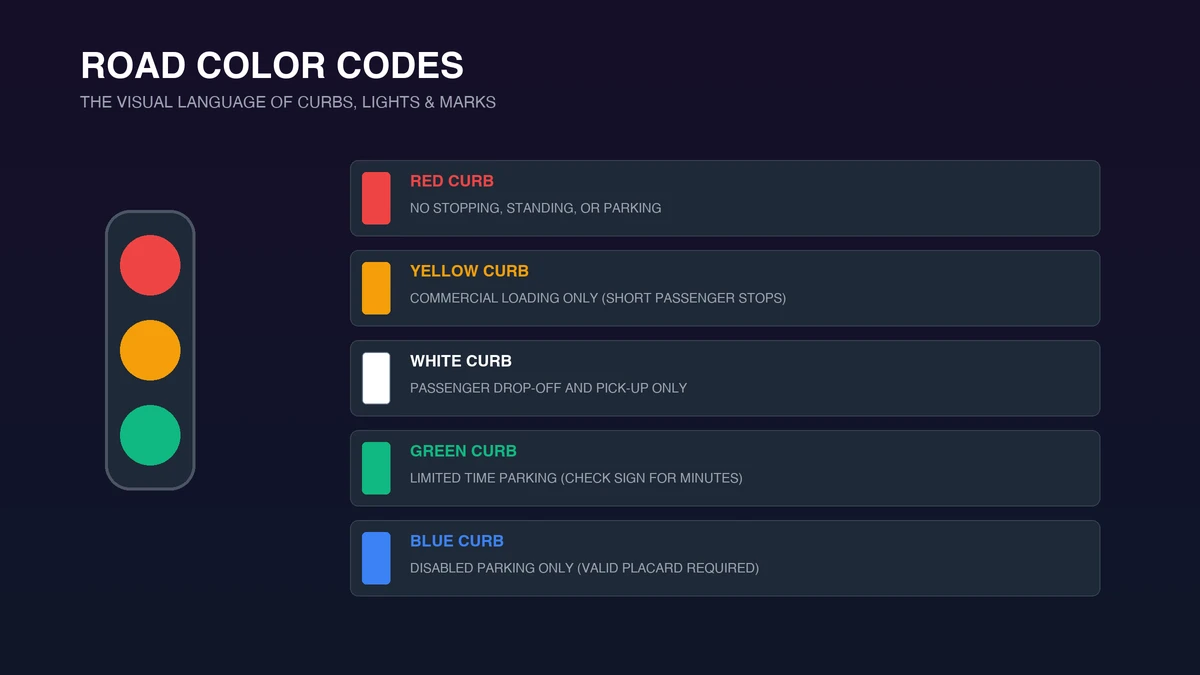
Painted curbs control where and how long you can park. The color of the curb tells you everything you need to know at a glance.
Part 2: Traffic Light Colors
Red Curb — No Stopping, No Parking, No Standing
- Statutory Compliance: Obeying exact vehicle code thresholds rather than informal habits ensures zero penalty points on exam day.
- Defensive Safety Standard: Maintaining safe following distances and active visual scanning eliminates collision risks under Basic Speed Law principles.
- Hazard Recognition: Anticipating changing traffic patterns and road conditions allows proactive rather than reactive braking.
Red is the most restrictive. You cannot stop, stand, or park here — ever — unless a sign specifically allows it. Red curbs are typically found near fire hydrants, fire stations, bus stops, and intersections where stopping is dangerous.
Arrow Signals
Yellow Curb — No Parking, but Brief Stops Allowed
- Statutory Compliance: Obeying exact vehicle code thresholds rather than informal habits ensures zero penalty points on exam day.
- Defensive Safety Standard: Maintaining safe following distances and active visual scanning eliminates collision risks under Basic Speed Law principles.
- Hazard Recognition: Anticipating changing traffic patterns and road conditions allows proactive rather than reactive braking.
Yellow means commercial loading and unloading. Drivers of non-commercial vehicles may stop briefly to drop off or pick up passengers, but cannot park and walk away. Commercial vehicles may load/unload during posted hours.
Flashing Signals
White Curb — Passenger Loading Only (Short Stop)
- Statutory Compliance: Obeying exact vehicle code thresholds rather than informal habits ensures zero penalty points on exam day.
- Defensive Safety Standard: Maintaining safe following distances and active visual scanning eliminates collision risks under Basic Speed Law principles.
- Hazard Recognition: Anticipating changing traffic patterns and road conditions allows proactive rather than reactive braking.
White curbs are for picking up or dropping off passengers only — usually for a very short time (often just a few minutes). No parking. Think of it as the "drop-off/pick-up zone" in front of airports, schools, or hotels.
Part 3: Road Sign Colors — What Each Color Means
Green Curb — Time-Limited Parking
- Statutory Compliance: Obeying exact vehicle code thresholds rather than informal habits ensures zero penalty points on exam day.
- Defensive Safety Standard: Maintaining safe following distances and active visual scanning eliminates collision risks under Basic Speed Law principles.
- Hazard Recognition: Anticipating changing traffic patterns and road conditions allows proactive rather than reactive braking.
Green means you can park here — but only for the time limit posted on a nearby sign. Common in downtown areas and shopping districts. Check the sign: it might say "15 minutes" or "1 hour."
Interactive Knowledge Check
Question: What does a blue raised reflective marker (cat's eye) embedded in the center of a public street roadway indicate?
Authoritative Sources & Regulatory References
Content and statutory guidelines in this guide are verified against official state vehicle codes, federal transportation standards, and authoritative regulatory documentation:
- AAMVAOfficial State Driver Handbooks & Licensing Examination Criteria (2026)(American Association of Motor Vehicle Administrators)
- NHTSANational Highway Traffic Safety Administration (NHTSA) Uniform Guidelines for State Highway Safety(National Highway Traffic Safety Administration)
- FHWAFederal Highway Administration (FHWA) Manual on Uniform Traffic Control Devices (MUTCD)(Federal Highway Administration)
93% of people found this article helpful.
Click a star to add your vote
238 votes • average 4.72 out of 5
Official 2026 DMV Practice Tests by State
Select your state to practice real exam questions based on the latest 2026 driver handbook.
Ready to Pass the DMV Test on Your First Try?
Practice real 2026 DMV questions with instant answer explanations, simulated timers, and pass-guarantee study guides.
Start Free Practice Test