Intersection Turning Rules: Left Turns, Right on Red & U-Turns
Mastering statutory driver licensing regulations and highway laws ensures first-time test success.
Quick Answer & Key Takeaways
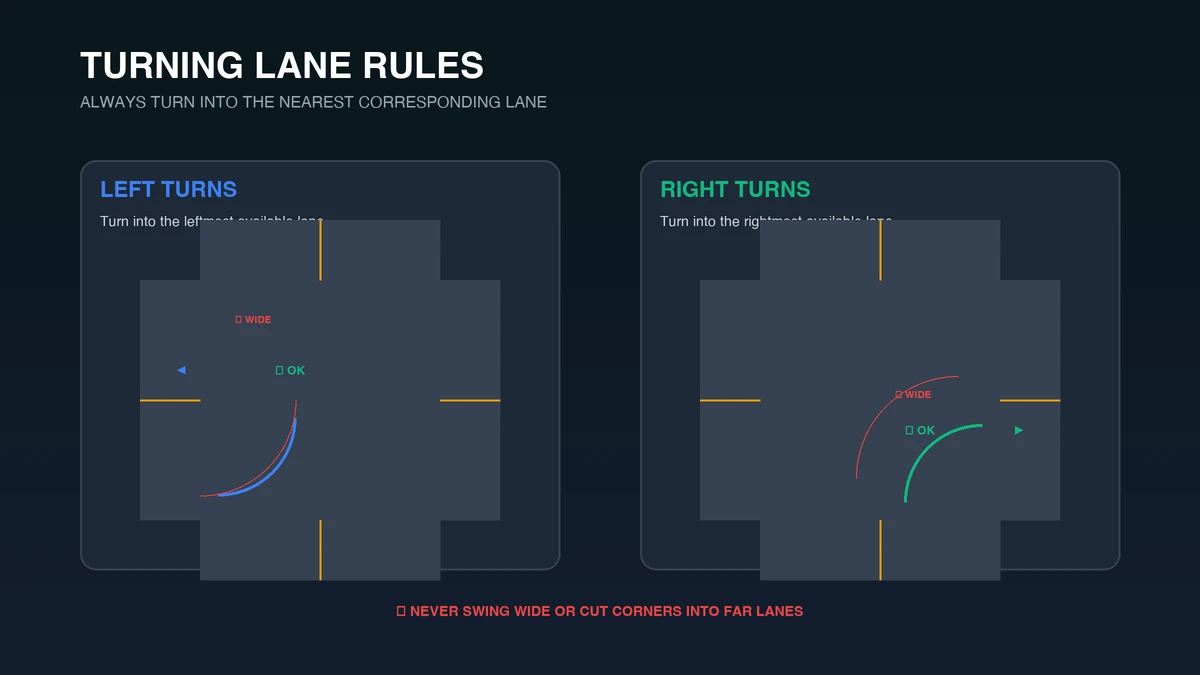
Statutory intersection turning rules: 1) SIGNAL 100 FEET: Signal continuously for at least 100 feet before the turn. 2) RIGHT TURNS: Turn from the rightmost lane into the rightmost lane. Right turn on red is legal AFTER a complete stop unless a "NO TURN ON RED" sign is posted. 3) LEFT TURNS: Turn from the leftmost lane into the leftmost lane; keep front tires pointed straight while waiting for oncoming traffic. 4) U-TURNS: Legal across double yellow lines in residential districts if no vehicles are approaching within 200 feet; illegal in business districts unless at an intersection.
- Signal 100 Feet Prior: Mandatory advance warning distance under state vehicle codes.
- Finish in the Corresponding Lane: Left turns enter leftmost lane; right turns enter rightmost lane.
- Tires Pointed Straight: Never pre-turn wheels while waiting to make an unprotected left.
- Business District U-Turn Restriction: U-turns in business districts are illegal unless made at an official intersection opening.
Turning is something you'll do hundreds of times every day as a driver. Yet many new drivers get confused about which lane they're supposed to end up in — especially when there are multiple lanes involved.
Left Turns — The Core Rule
The rules for turning are actually very logical. Once you understand the underlying principle, you'll never be confused again — whether you're turning from a one-lane road, a multi-lane road, coming out of a parking lot, or navigating a complex intersection.
- Statutory Compliance: Obeying exact vehicle code thresholds rather than informal habits ensures zero penalty points on exam day.
- Defensive Safety Standard: Maintaining safe following distances and active visual scanning eliminates collision risks under Basic Speed Law principles.
- Hazard Recognition: Anticipating changing traffic patterns and road conditions allows proactive rather than reactive braking.
The Master Principle
Left Turn: Single-Lane to Single-Lane
When you turn, you must end up in the corresponding lane on the new road. Think of it like lanes being "paired" — left lanes turn into left lanes, right lanes turn into right lanes.
- Statutory Compliance: Obeying exact vehicle code thresholds rather than informal habits ensures zero penalty points on exam day.
- Defensive Safety Standard: Maintaining safe following distances and active visual scanning eliminates collision risks under Basic Speed Law principles.
- Hazard Recognition: Anticipating changing traffic patterns and road conditions allows proactive rather than reactive braking.
Let's break down every scenario step by step.
Left Turn: Multi-Lane to Multi-Lane
When making a left turn, always turn into the leftmost available lane of the road you're entering.
- Statutory Compliance: Obeying exact vehicle code thresholds rather than informal habits ensures zero penalty points on exam day.
- Defensive Safety Standard: Maintaining safe following distances and active visual scanning eliminates collision risks under Basic Speed Law principles.
- Hazard Recognition: Anticipating changing traffic patterns and road conditions allows proactive rather than reactive braking.
This is the rule regardless of how many lanes you're turning from or turning onto. You hug the center — approach from close to the center line, and land in the nearest lane on the other side of the center line.
Right Turns — The Core Rule
The simplest case. You're on a two-lane road turning left onto another two-lane road.
- Statutory Compliance: Obeying exact vehicle code thresholds rather than informal habits ensures zero penalty points on exam day.
- Defensive Safety Standard: Maintaining safe following distances and active visual scanning eliminates collision risks under Basic Speed Law principles.
- Hazard Recognition: Anticipating changing traffic patterns and road conditions allows proactive rather than reactive braking.
After completing the turn, you may then change to a different lane if needed — but you must complete the turn into the correct lane first.
Right Turn: Single-Lane to Single-Lane
This is where confusion most often happens. You're on a 4-lane road (two lanes going your direction) and turning left onto another 4-lane road.
- Statutory Compliance: Obeying exact vehicle code thresholds rather than informal habits ensures zero penalty points on exam day.
- Defensive Safety Standard: Maintaining safe following distances and active visual scanning eliminates collision risks under Basic Speed Law principles.
- Hazard Recognition: Anticipating changing traffic patterns and road conditions allows proactive rather than reactive braking.
The Rule:
Interactive Knowledge Check
Question: When making a left turn from a single left-turn lane onto a multi-lane one-way street, which lane must your vehicle enter to complete the turn legally?
Authoritative Sources & Regulatory References
Content and statutory guidelines in this guide are verified against official state vehicle codes, federal transportation standards, and authoritative regulatory documentation:
- AAMVAOfficial State Driver Handbooks & Licensing Examination Criteria (2026)(American Association of Motor Vehicle Administrators)
- NHTSANational Highway Traffic Safety Administration (NHTSA) Uniform Guidelines for State Highway Safety(National Highway Traffic Safety Administration)
- FHWAFederal Highway Administration (FHWA) Manual on Uniform Traffic Control Devices (MUTCD)(Federal Highway Administration)
93% of people found this article helpful.
Click a star to add your vote
248 votes • average 4.69 out of 5
Official 2026 DMV Practice Tests by State
Select your state to practice real exam questions based on the latest 2026 driver handbook.
Ready to Pass the DMV Test on Your First Try?
Practice real 2026 DMV questions with instant answer explanations, simulated timers, and pass-guarantee study guides.
Start Free Practice Test