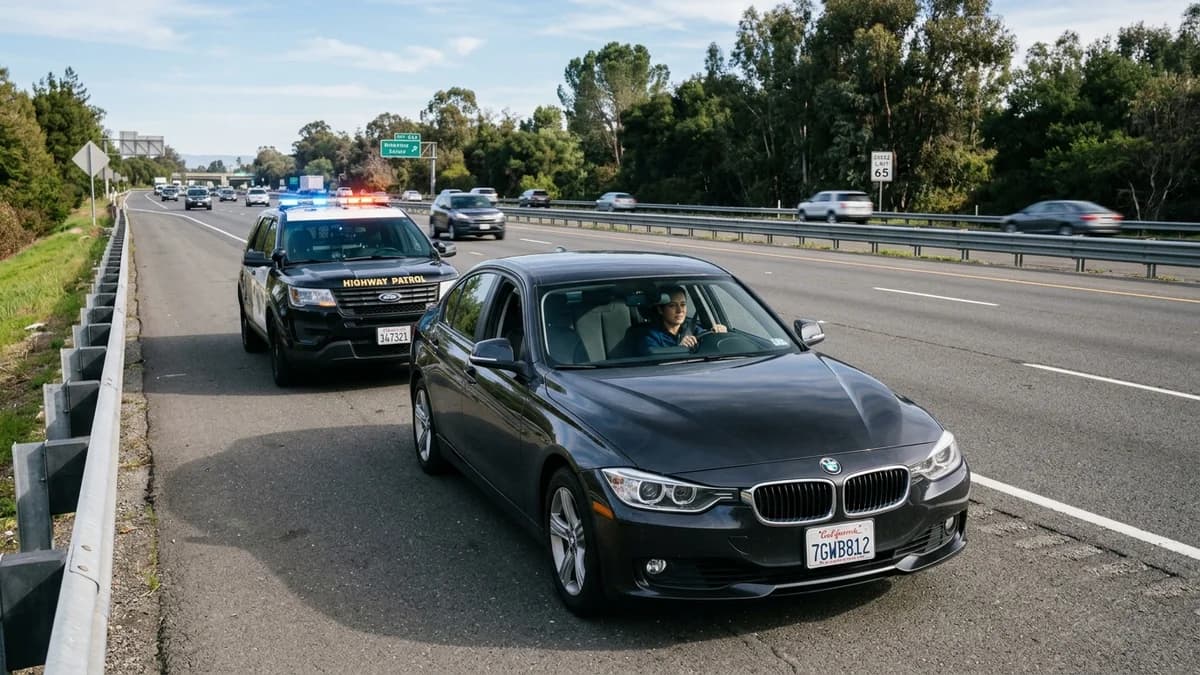
Which Way to Turn Your Wheels When Parking on a Hill: Complete Guide
Mastering statutory driver licensing regulations and highway laws ensures first-time test success.
Quick Answer & Key Takeaways
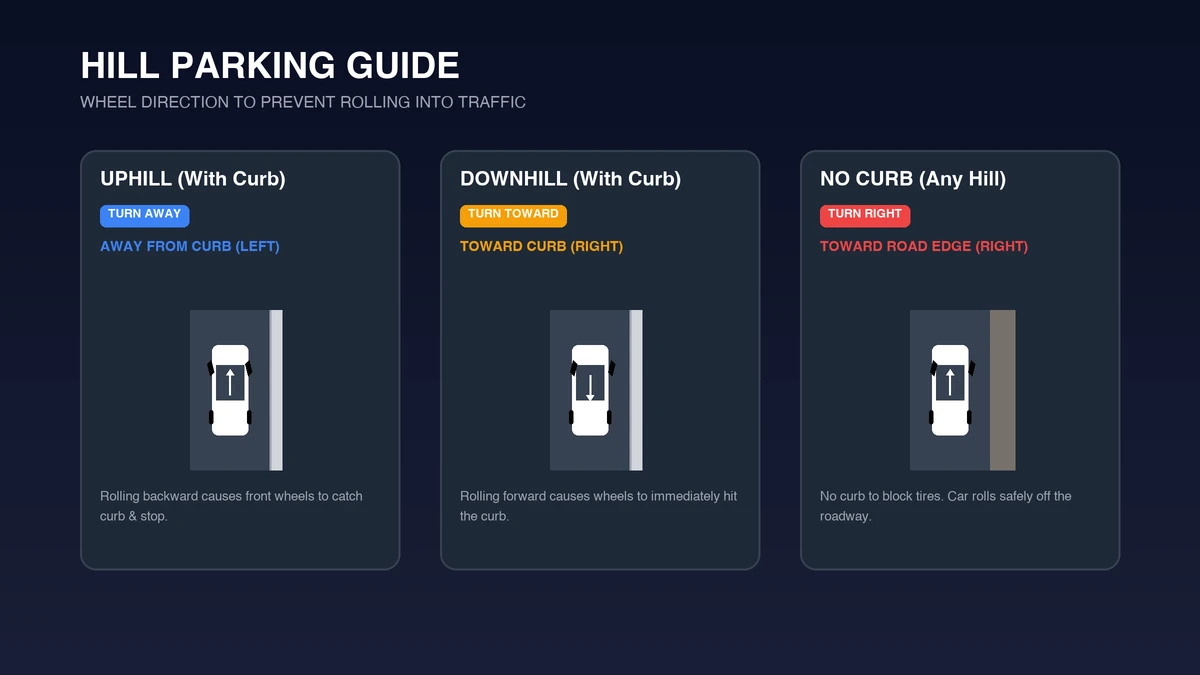
How to turn your front wheels when parking on a hill: 1) UPHILL WITH A CURB: Turn front wheels LEFT (away from the curb / toward the center of the street). Let the vehicle roll back until the back of the front tire touches the curb. 2) DOWNHILL WITH A CURB: Turn front wheels RIGHT (toward the curb). Let the front of the front tire rest against the curb. 3) UPHILL OR DOWNHILL WITHOUT A CURB: Turn front wheels RIGHT (toward the side of the road/shoulder) so a rolling vehicle rolls off the roadway into the dirt. 4) ALWAYS ENGAGE EMERGENCY BRAKE.
- UCLA Memory Rule: Uphill Curb Left Always. Every other scenario = Turn wheels RIGHT.
- Downhill With Curb: Turn wheels RIGHT toward the curb.
- No Curb (Any Grade): Turn wheels RIGHT toward the shoulder/ditch.
- Transmission Setting: Park (P) in automatics; Reverse for downhill or 1st gear for uphill in manuals.
One of the most commonly tested — and most commonly memorized incorrectly — topics on the DMV permit test is which way to turn your wheels when parking on a hill.
The One Principle That Explains Everything
Most people try to brute-force memorize: "uphill with curb = turn wheels away... or was it toward?" and then panic when they forget.
- Statutory Compliance: Obeying exact vehicle code thresholds rather than informal habits ensures zero penalty points on exam day.
- Defensive Safety Standard: Maintaining safe following distances and active visual scanning eliminates collision risks under Basic Speed Law principles.
- Hazard Recognition: Anticipating changing traffic patterns and road conditions allows proactive rather than reactive braking.
This article is different. By the end of it, you'll understand the reason behind the rule so well that you'll never need to memorize anything again. You'll be able to figure it out from logic, every single time.
Scenario 1: Parking Facing Uphill — With a Curb
Before we look at any specific scenario, here is the single principle you need to understand:
- Statutory Compliance: Obeying exact vehicle code thresholds rather than informal habits ensures zero penalty points on exam day.
- Defensive Safety Standard: Maintaining safe following distances and active visual scanning eliminates collision risks under Basic Speed Law principles.
- Hazard Recognition: Anticipating changing traffic patterns and road conditions allows proactive rather than reactive braking.
The Goal
Think It Through
If your brakes fail and your car starts to roll, the curb should stop your car — not let it roll into traffic.
- Statutory Compliance: Obeying exact vehicle code thresholds rather than informal habits ensures zero penalty points on exam day.
- Defensive Safety Standard: Maintaining safe following distances and active visual scanning eliminates collision risks under Basic Speed Law principles.
- Hazard Recognition: Anticipating changing traffic patterns and road conditions allows proactive rather than reactive braking.
Your job is to angle the wheels so that if the car moves, it moves toward the curb (where it can be stopped), not away from the curb (into the road).
Scenario 2: Parking Facing Downhill — With a Curb
That's it. That's the whole rule. Everything else follows from this.
- Statutory Compliance: Obeying exact vehicle code thresholds rather than informal habits ensures zero penalty points on exam day.
- Defensive Safety Standard: Maintaining safe following distances and active visual scanning eliminates collision risks under Basic Speed Law principles.
- Hazard Recognition: Anticipating changing traffic patterns and road conditions allows proactive rather than reactive braking.
Situation
Think It Through
Your car is pointed uphill. There is a curb to your right.
- Statutory Compliance: Obeying exact vehicle code thresholds rather than informal habits ensures zero penalty points on exam day.
- Defensive Safety Standard: Maintaining safe following distances and active visual scanning eliminates collision risks under Basic Speed Law principles.
- Hazard Recognition: Anticipating changing traffic patterns and road conditions allows proactive rather than reactive braking.
If your brakes fail, gravity will pull your car backward down the hill. The car will roll backward.
Interactive Knowledge Check
Question: You are parking your vehicle facing DOWNHILL on a steep street with a raised concrete curb on your right. Which direction should you turn your front wheels?
Authoritative Sources & Regulatory References
Content and statutory guidelines in this guide are verified against official state vehicle codes, federal transportation standards, and authoritative regulatory documentation:
- AAMVAOfficial State Driver Handbooks & Licensing Examination Criteria (2026)(American Association of Motor Vehicle Administrators)
- NHTSANational Highway Traffic Safety Administration (NHTSA) Uniform Guidelines for State Highway Safety(National Highway Traffic Safety Administration)
- FHWAFederal Highway Administration (FHWA) Manual on Uniform Traffic Control Devices (MUTCD)(Federal Highway Administration)
84% of people found this article helpful.
Click a star to add your vote
31 votes • average 4.20 out of 5
Official 2026 DMV Practice Tests by State
Select your state to practice real exam questions based on the latest 2026 driver handbook.
Ready to Pass the DMV Test on Your First Try?
Practice real 2026 DMV questions with instant answer explanations, simulated timers, and pass-guarantee study guides.
Start Free Practice Test