Parent's Guide: How to Teach a Teen to Drive Without Stress
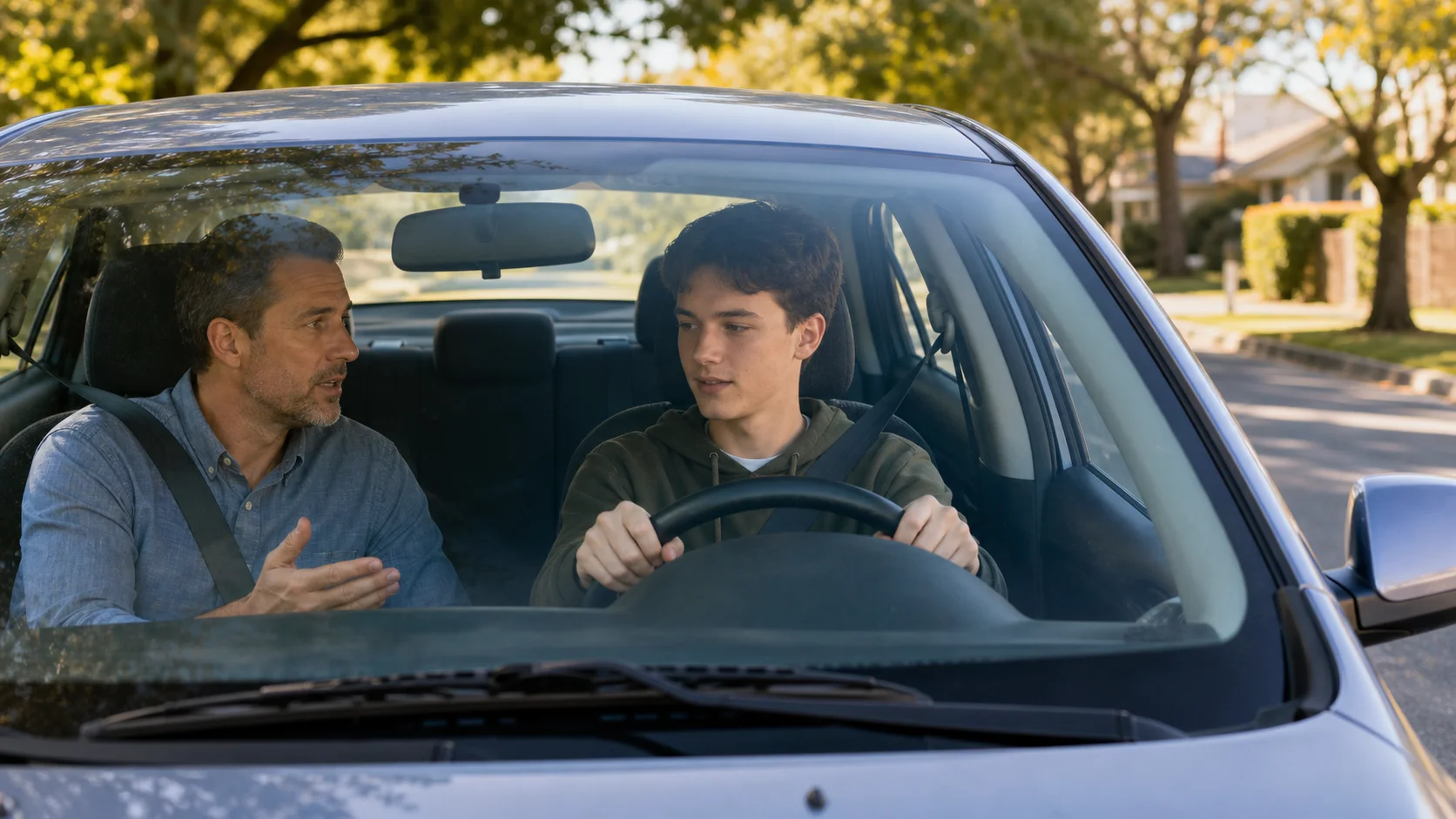
Structured verbal cues and progressive practice environments eliminate parent-teen driving anxiety.
Quick Answer & Key Takeaways
Teaching a teenager to drive is one of the most stressful parenting milestones, frequently triggering shouting and panic. To eliminate friction and maximize safety: 1) ESTABLISH VERBAL CODES BEFORE STARTING: Ban vague commands like 'Stop!' or 'Watch out!' in favor of clear, calibrated directives like 'Foot off gas,' 'Smooth braking,' or 'Prepare to stop at the next intersection.' 2) FOLLOW A 4-PHASE PROGRESSION: Spend 5 hours in an empty parking lot mastering throttle/braking transitions, 15 hours on 25 MPH residential loops, 15 hours on 45 MPH commercial boulevards, and 15 hours on highways and night driving. 3) CONDUCT DEBRIEFS OUTSIDE THE CAR: Wait until the vehicle is parked in the driveway to discuss technical mistakes rather than lecturing mid-drive.
- Eliminate Ambiguous Commands: Use directional, actionable phrases ('Begin braking now') rather than panic-inducing screams ('Look out!').
- Give 5-Second Advance Warnings: Tell your teen to make a turn at least 5 to 7 seconds before the intersection.
- Stick to the 4-Phase Roadmap: Never take a novice on a high-speed arterial or freeway until parking lot and residential controls are second nature.
- Log 50 Supervised Hours: Ensure at least 10 hours are completed after dark under real-world low-light conditions.
The Psychology of Parent-Teen In-Car Conflict: Emotional Regulation
When a parent sits in the passenger seat with their newly permitted teenager, biological stress responses spike on both sides.
For parents, handing over physical control of a high-speed vehicle triggers genuine fear. For teens, processing dozens of new tactile inputs (pedal pressure, mirror scans, oncoming traffic) leaves their cognitive working memory maxed out—making them hyper-sensitive to emotional criticism.
According to AAA Foundation driver research, successful parent coaching requires shifting your role from an emotional critic to a calm, professional flight instructor.
Phase 1: The Pre-Drive Pact: Establishing Clear Verbal Codes
Before turning the key in the ignition, agree on standard in-car communication rules:
- Ban Panic Shouting: Yelling "Stop!" or "Watch out!" causes a beginner's brain to freeze or slam the brakes erratically.
- Use Calibrated Verbal Directives:
- "Cover the brake" (hover right foot over brake pedal without depressing).
- "Gentle braking" (smooth deceleration).
- "Firm braking" (controlled emergency stopping).
- "Scan left, scan right" (intersection clearance).
- 5-Second Navigation Rule: Never announce a turn at the last second. Tell your teen: "At the upcoming traffic light with the gas station, we will be making a right turn from the curb lane."
Phase 2: Empty Lot Drills: Accelerator Control & Geometry
Dedicate the first 5 to 7 hours exclusively to an empty school or commercial parking lot:
- Smooth Starts & Stops: Practice accelerating to 15 MPH and stopping precisely on a painted parking stripe without the vehicle's nose bouncing.
- Hand-Over-Hand Steering: Practice tight 90-degree turns and figure-eights around empty light poles.
- Reversing Straight: Practice driving backward 100 feet in a straight line while looking over the right shoulder.
Phase 3: Residential Roads: Visual Lead Time & Following Distances
Transition to quiet suburban neighborhoods (15–20 hours):
- Look 12–15 Seconds Ahead: Teach your teen to look far down the block for pedestrians stepping off curbs, delivery vans opening doors, and backing vehicles.
- Full 3-Second Stop Sign Stops: Enforce complete cessation of tire rotation behind the limit line before creeping forward to view cross-traffic under right-of-way rules.
- The 3-Second Following Rule: Pick a fixed roadside landmark (tree, telephone pole) to measure following distance behind the lead car.
Phase 4: Multi-Lane Arterials, Freeways & Night Logging
Complete the final 20 hours on complex road environments:
- SMOG Lane Changes: Drill Signal, Mirrors, Over-the-shoulder, Go until head checks are 100% automatic.
- Freeway On-Ramp Acceleration: Teach teens to accelerate aggressively down the ramp to match 65 MPH highway speed before merging under freeway merge rules.
- Nighttime Driving (10 Hours Required): Practice scanning past oncoming high-beam glare and adjusting speed for headlight sight distances under teen night driving guidelines.
50-Hour Parent-Teen Driver Coaching Progression Table
| Coaching Phase | Target Hours | Practice Environment | Mastery Checklist |
|---|---|---|---|
| Phase 1: Basic Controls | Hours 1–5 | Empty Parking Lots | Smooth braking, 90° turns, 50-ft reverse |
| Phase 2: Residential | Hours 6–20 | 25 MPH Neighborhood Streets | Complete stops, right-of-way ties, curb parking |
| Phase 3: Arterials | Hours 21–35 | 45 MPH Multi-Lane Boulevards | SMOG lane changes, left turns across traffic |
| Phase 4: Freeway & Night | Hours 36–50 | Interstates & Nighttime Roads | 65 MPH on-ramp merges, 10 night hours logged |
Interactive Knowledge Check
Question: When coaching a teen driver approaching an intersection where they need to slow down, which verbal instruction is most effective according to driver training experts?
Authoritative Sources & Regulatory References
Content and statutory guidelines in this guide are verified against official state vehicle codes, federal transportation standards, and authoritative regulatory documentation:
- NHTSAParent-Supervised Driving Guidelines and Coaching Methodologies (DOT HS 811 056)(National Highway Traffic Safety Administration)
- AAA FoundationThe Parent Coaching Handbook: Effective Behind-the-Wheel Instruction(AAA Foundation for Traffic Safety)
- CDC Injury CenterGraduated Driver Licensing Parent-Teen Driving Agreement Guidelines(Centers for Disease Control and Prevention)
85% of people found this article helpful.
Click a star to add your vote
247 votes • average 4.32 out of 5
Official 2026 DMV Practice Tests by State
Select your state to practice real exam questions based on the latest 2026 driver handbook.
Ready to Pass the DMV Test on Your First Try?
Practice real 2026 DMV questions with instant answer explanations, simulated timers, and pass-guarantee study guides.
Start Free Practice Test