Truck Blind Spots: The 4 Major No-Zones Around an 18-Wheeler
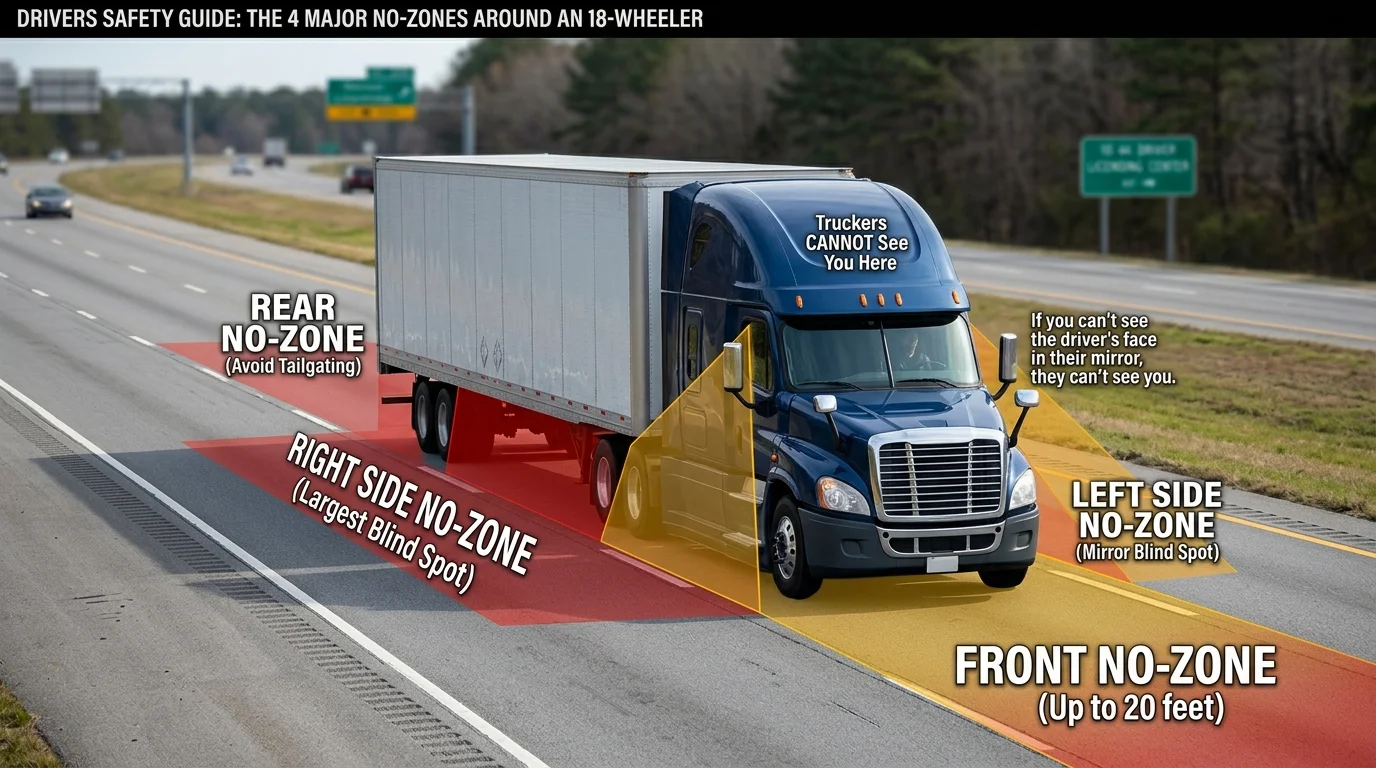
Large commercial trucks have four massive blind spots where passenger cars completely disappear from the trucker's side mirrors.
Quick Answer & Key Takeaways
Commercial 18-wheelers have four massive blind spots known as 'No-Zones' where passenger vehicles become completely invisible to the truck driver: 1) RIGHT-SIDE NO-ZONE: The single largest and most dangerous blind spot, extending diagonally across THREE LANES of traffic and extending backwards past the trailer. 2) FRONT NO-ZONE: Extends 20 feet directly in front of the truck's tall hood (never cut closely in front of a truck). 3) LEFT-SIDE NO-ZONE: Extends from the driver's window back alongside the trailer. 4) REAR NO-ZONE: Extends 200 feet behind the trailer; truckers have no rearview mirror and cannot see tailgaters. THE GOLDEN RULE: If you cannot see the driver's face in their side mirror, the truck driver CANNOT see you.
- Right Side Is Worst: The right side blind spot is three times wider than the left side; always pass trucks on the LEFT.
- 20-Foot Front Hood Blind Spot: Cutting directly in front of a truck puts your car inside an invisible zone while eliminating the truck's stopping room.
- 200-Foot Rear No-Zone: Semi-trucks have zero interior rearview mirrors; tailgating leaves you completely blind to upcoming road hazards.
- The Mirror Test: Look at the truck's side mirror—if you don't see the trucker's reflection, you are in a No-Zone.
The Physics of Semi-Truck Blind Spots: The "No-Zone" Concept
A loaded Class 8 commercial tractor-trailer measures over 70 feet in length and weighs up to 80,000 pounds.
Because commercial cabs sit high off the ground with no center rearview mirror and tall solid-walled freight trailers, large trucks have four massive geometric blind zones where passenger cars, motorcycles, and pedestrians vanish completely from view.
The Federal Motor Carrier Safety Administration (FMCSA) designated these danger areas as "The No-Zones."
The Front No-Zone: The 20-Foot Forward Hood Blind Spot
Due to the elevated driving cab and long aerodynamic hood:
A commercial truck driver cannot see the road for approximately 20 feet directly in front of their front bumper!
When passenger cars abruptly merge or cut directly in front of a truck after passing, they enter this blind spot. Furthermore, under stopping distance physics, a semi-truck requires over 525 feet to stop from 65 MPH—cutting in front robs the trucker of critical emergency braking space.
The Right-Side No-Zone: The Most Dangerous Blind Spot (3 Lanes Wide)
The right side of an 18-wheeler is the single most dangerous place on the highway!
Because the driver sits on the far left side of the vehicle, the right-side convex mirror creates a massive blind angle that spans across three full lanes of highway traffic and extends from the cab door all the way past the rear of the trailer.
Crucial Rule: Never pass a semi-truck on the right side. Always pass decisively on the LEFT where the driver has a much shorter blind spot.
The Left-Side No-Zone: Blind Spots Along the Driver Door
While smaller than the right side, the left side still features a dangerous blind zone extending from directly below the driver’s side mirror alongside the drive axles and trailer midpoint.
When passing on the left, maintain consistent speed and complete the pass smoothly—never cruise or match speeds next to the trailer wheels.
The Rear No-Zone: The 200-Foot Tailgating Trap
Semi-truck trailers have solid steel doors with no rear window. Truck drivers have zero rear visibility behind their trailer.
The Rear No-Zone extends approximately 200 feet behind the trailer (the length of 20 car lengths).
If you tailgate a truck, you not only make your car invisible to the driver, but you also block your own forward line of sight, preventing you from seeing debris, stopped traffic, or tire tread blowouts in time to react.
The Golden Mirror Rule: Visual Line of Sight Verification
How do you instantly know if you are in a truck's blind spot?
Look at the truck’s exterior side mirror: If you cannot see the truck driver’s face in their mirror, the truck driver CANNOT see you!
If you see the trucker's reflection looking into the mirror, you have established a direct optical line of sight and are outside the blind zone.
18-Wheeler No-Zone Dimensions & Danger Matrix Table
| Blind Spot Zone | Blind Zone Distance | Primary Danger Scenario | Safe Driving Action |
|---|---|---|---|
| Right-Side No-Zone | Extends across 3 lanes | Truck lane change sideswipe / Wide right turn crush | Never pass on the right; pass on left only |
| Front No-Zone | 20 Feet in front of hood | Truck rear-ends cut-in vehicle | Leave at least 1–2 car lengths after passing before merging |
| Rear No-Zone | 200 Feet behind trailer | Underride collision upon sudden braking | Maintain 4+ second following distance |
| Left-Side No-Zone | Driver cab door to midpoint | Sideswipe during lane merge | Pass promptly without lingering |
Interactive Knowledge Check
Question: Which of the four blind spot No-Zones around an 80,000-pound commercial semi-truck is the LARGEST and most dangerous for passenger vehicles?
Authoritative Sources & Regulatory References
Content and statutory guidelines in this guide are verified against official state vehicle codes, federal transportation standards, and authoritative regulatory documentation:
- FMCSAThe No-Zone: Sharing the Road Safely with Commercial Motor Vehicles(Federal Motor Carrier Safety Administration)
- NHTSAHeavy Vehicle Crash Avoidance and Commercial Driver Visibility Geometry(National Highway Traffic Safety Administration)
- CVSAOperation Safe Driver: Blind Spot Collision Prevention Guidelines(Commercial Vehicle Safety Alliance)
89% of people found this article helpful.
Click a star to add your vote
219 votes • average 4.53 out of 5
Official 2026 CDL Practice Tests by State
Select your state to practice real Commercial Driver's License (CDL) exam questions based on the latest 2026 commercial handbook.
Ready to Pass Your CDL Permit Test on the First Try?
Practice real 2026 commercial driving questions with instant air brake explanations, combination vehicle dynamics, and pass-guaranteed study guides.
Start Free CDL Practice TestRecommended Driver Guides

Blind Spot Driving Rules: How to Adjust Mirrors to Completely Eliminate Blind Spots
CDL Class A vs. Class B vs. Class C: Gross Vehicle Weight Rating (GVWR) Decoded