Uncontrolled Intersections: Who Goes First When There Are No Signs or Lights?
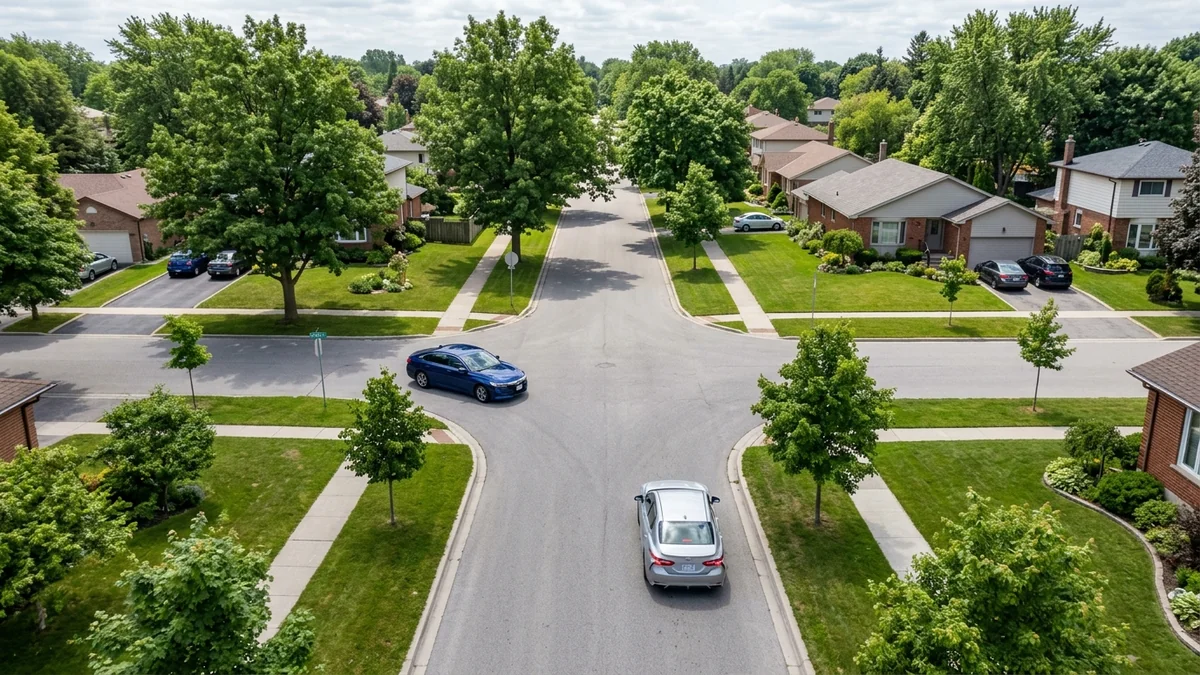
At uncontrolled intersections, vehicles must yield to the car on their right, slow to 15 mph if views are obstructed, and yield to through traffic on T-junctions.
Quick Answer & Key Takeaways
An uncontrolled intersection has zero stop signs, yield signs, or traffic signals (frequently found in rural roads and quiet residential neighborhoods). The right-of-way rules are: 1) Slow down and prepare to yield. 2) The vehicle that arrives and enters the intersection first has priority. 3) If two vehicles arrive simultaneously, the driver on the left must yield to the vehicle on their right. 4) At a T-intersection, the vehicle traveling on the dead-end/terminating road must yield to all through traffic.
- Yield to the vehicle on your right: If arriving at the same time, the car to your right always has legal right-of-way.
- T-Intersections: Traffic on the continuing 'through' road has automatic priority over the road that ends.
- Blind intersection speed: If buildings, trees, or parked cars block your view of cross-traffic within 100 feet, the legal speed limit drops to 15 mph.
- Pedestrians always have right-of-way: Even without painted crosswalk lines, unmarked crosswalks legally exist at every intersection corner.
What Is an Uncontrolled Intersection?
An uncontrolled intersection (also known as an unregulated intersection) is any road junction that lacks traffic signals, yield signs, or stop signs to assign right-of-way under the FHWA Manual on Uniform Traffic Control Devices.
While most urban multi-lane corridors feature clear automated signals, uncontrolled intersections remain common in older residential neighborhoods, rural country roads, and private commercial parking networks. Because there are no physical signs telling you to stop, state vehicle codes establish universal legal default rules to avoid collisions.
The 3 Core Right-of-Way Rules
When approaching an intersection without regulatory signs (unlike an all-way stop with clear sign markers—see our guide on who has the right-of-way at a 4-way stop):
- First to Enter Has Priority: The vehicle that reaches and enters the intersection first has the legal right-of-way to cross or turn.
- The "Yield to the Right" Rule (Simultaneous Arrival): If two vehicles approach or arrive at the intersection from different directions at approximately the same time, the driver on the left must yield to the vehicle on the right.
- Left Turns Must Yield to Oncoming Straight Traffic: If two opposing vehicles arrive at an uncontrolled intersection across from each other, the vehicle turning left must yield to oncoming vehicles traveling straight or turning right.
T-Intersections: Through Road vs. Terminating Street
A common point of confusion on DMV written exams involves T-intersections—where one road ends and terminates directly into a cross street.
The Rule for T-Intersections:
Under statutes such as California Vehicle Code § 21800(d), the driver on the terminating road (the road that ends) must yield the right-of-way to all vehicles traveling on the through street.
Even if you arrive at the T-junction first, you cannot pull out in front of moving traffic on the continuous through road. You must wait until both directions of traffic are completely clear before making your left or right turn.
The 15 MPH "Blind Intersection" Rule
An intersection is legally defined as "blind" if you cannot see along the intersecting roadway for at least 100 feet in both directions during the last 100 feet of your approach.
Obstructions that create a blind intersection include tall hedges, parked delivery vans, fences, trees, and corner buildings.
Statutory Speed Limit:
In most states, the statutory speed limit for any blind uncontrolled intersection is 15 mph. You must slow down, cover your brake pedal, and look left, right, and left again before proceeding into the intersection.
Defensive Tactics: Never Assume Priority
In legal theory, the vehicle on the right has the right-of-way. In real-world driving, however, many motorists do not know the rules of uncontrolled intersections and may blast through without looking. (If a collision ever occurs, review our 8-step car accident emergency protocol).
- Right-of-way is given, never taken: If another driver fails to yield to you, surrender your legal priority and let them pass. Avoiding a collision always takes precedence over insisting on legal rights.
- Look Left First: Cross-traffic approaching from your left is in the closest lane to your car. Scan left, scan right, and then double-check left before committing to enter.
- Watch for Unmarked Crosswalks: Pedestrians legally have the right-of-way at every intersection corner, regardless of whether painted crosswalk lines are present.
You arrive at a T-intersection on a road that dead-ends into a through street with no traffic signs or signals. Who has the right-of-way?
Frequently Asked Questions
Are you required to come to a full stop at every uncontrolled intersection?
No. You are not legally required to come to a complete stop if there are no other vehicles, cyclists, or pedestrians present. However, you must reduce speed and be prepared to stop if another road user approaches.
What should you do if traffic signals are blacked out due to a power outage?
When traffic signal lights are completely dark or non-functional, state law requires all drivers to treat the intersection as a 4-way all-way stop: come to a complete stop and yield to the right.
Who goes first if an uncontrolled intersection connects a paved road and a dirt road?
In many states (including Texas), traffic on an unpaved gravel or dirt road must yield the right-of-way to traffic traveling on a paved public road.
Authoritative Sources & Regulatory References
Content and statutory guidelines in this guide are verified against official state vehicle codes, federal transportation standards, and authoritative regulatory documentation:
- NCUTLOUniform Vehicle Code: Right-of-Way at Intersections(National Committee on Uniform Traffic Laws and Ordinances)
- CA LegislatureCalifornia Vehicle Code § 21800: Intersection Right-of-Way & T-Intersections(California Vehicle Code)
- FHWAManual on Uniform Traffic Control Devices (MUTCD)(Federal Highway Administration)
87% of people found this article helpful.
Click a star to add your vote
79 votes • average 4.44 out of 5
Official 2026 DMV Practice Tests by State
Select your state to practice real exam questions based on the latest 2026 driver handbook.
Ready to Pass the DMV Test on Your First Try?
Practice real 2026 DMV questions with instant answer explanations, simulated timers, and pass-guarantee study guides.
Start Free Practice TestRecommended Driver Guides
Who Has the Right-of-Way at a 4-Way Stop? The Complete Rulebook
Master the 4 golden rules of four-way stops: first-come first-served, the car-on-the-right tiebreaker, and straight vs turns.
Left & Right Turns Explained: Which Lane Do You End Up In?
Learn the exact lane selection rules for single-turn, multi-turn, and intersecting highway corridors.
What to Do When Being Pulled Over by Police: Step-by-Step Safety & Legal Protocol
Learn the exact steps to take when pulled over: where to stop safely, cabin preparation, and your legal rights.