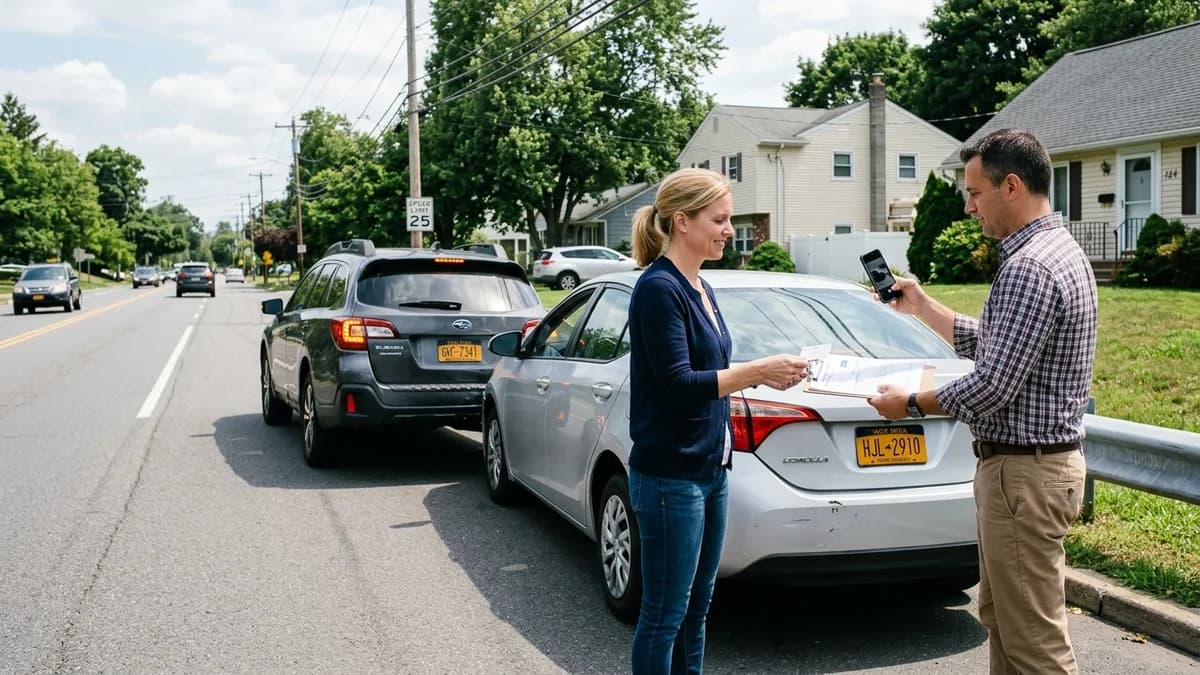
Following Distance Rules: The 3-Second Rule vs. The 4-Second Weather Rule

The 3-second following distance rule automatically scales buffer distance as vehicle speed increases.
Quick Answer & Key Takeaways
The 3-Second Rule is the universal formula for safe following distance on dry roads: 1) Pick a fixed roadside landmark (a tree, signpost, or bridge shadow) ahead of you. 2) When the rear bumper of the car ahead passes it, count: 'one-thousand-one, one-thousand-two, one-thousand-three.' 3) If your front bumper passes the landmark before you finish counting, you are tailgating and must ease off the accelerator. In adverse conditions (rain, fog, icy roads, or behind large trucks), expand this to a 4- to 6-second cushion.
- Time scales with speed: At 30 mph, 3 seconds equals 132 feet; at 65 mph, 3 seconds scales to 286 feet (nearly a football field).
- Why seconds instead of car lengths: Counting seconds works at any velocity without requiring mental distance conversion.
- The 4-Second Weather Rule: Wet roads increase stopping distance by over 40%; double your cushion during heavy rain.
- Tailgating = At-fault liability: In 99% of rear-end crashes, the following driver is legally held 100% liable for following too closely.
The Physics of Tailgating & Rear-End Collisions
Rear-end collisions account for roughly 30% of all multi-vehicle traffic crashes in the United States, causing over 1.7 million accidents and 500,000 injuries every year according to NHTSA traffic research.
The overwhelming majority of these crashes are caused by one universal mistake: tailgating (following too closely).
When a lead driver slams on their brakes, your brain requires time to recognize the red brake lights (perception time), physically move your foot from the gas pedal to the brake pedal (reaction time), and allow hydraulic calipers to clamp down on the brake discs (mechanical braking distance). Without an adequate following cushion, avoiding a crash is physically impossible.
How to Calculate the 3-Second Rule in Real Time
Decades ago, driver education manuals taught the "one car length per 10 mph" rule. However, humans are notoriously poor at estimating 20-foot intervals while traveling at 60 mph. Today, the National Safety Council (NSC) teaches the 3-Second Rule:
- Choose a Fixed Shadow or Object: Look ahead at the vehicle in front of you. Pick a stationary landmark along the roadway—an overhead road sign, a mile marker, a light pole, or an overpass shadow.
- Start Counting as Lead Bumper Clears: The instant the rear bumper of the vehicle ahead crosses that landmark, begin counting in your head: "One-thousand-one, one-thousand-two, one-thousand-three."
- Evaluate Your Position: If the front bumper of your vehicle crosses the same landmark before you finish saying "three," you are following too closely. Ease off the gas pedal to expand the gap.
When to Expand to 4, 5, or 6 Seconds (Rain, Fog, Snow)
The 3-second rule is calibrated strictly for ideal conditions: dry pavement, sunny daylight, and alert drivers. Under the Basic Speed Law, you must expand your following cushion in adverse conditions:
- Wet Roads & Rain (4 Seconds): Water on asphalt reduces tire friction coefficient and creates risk of hydroplaning. Expand your buffer to at least 4 seconds.
- Dense Fog & Night Driving (5 Seconds): Reduced visibility degrades your depth perception and reaction speed. Allow 5 seconds.
- Packed Snow & Ice (6 to 10 Seconds): On slippery winter roadways under winter driving conditions, braking distances multiply by 400% to 900%. A 6-to-10 second cushion is mandatory.
Following Large Semi-Trucks and Motorcycles
Special vehicle types require modified following cushions:
- Following 18-Wheel Commercial Semi-Trucks (4–5 Seconds): If you follow a semi-truck too closely, you are trapped in its massive rear blind spot ("No-Zone"). The truck driver cannot see you, and you cannot see road debris, tire retreads, or sudden braking traffic ahead. If you cannot see the truck’s side wing mirrors, the driver cannot see you!
- Following Motorcycles (4 Seconds): Motorcycles are lightweight and can stop in far shorter distances than a 4,000-lb SUV. If a motorcyclist brakes hard or hits a pothole and falls, following too closely will result in running over the rider.
Perception Time + Reaction Distance + Braking Distance
Total stopping distance consists of three distinct mathematical components under FMCSA stopping distance models:
Total Stopping Distance = Perception Distance + Reaction Distance + Braking Distance
- Perception Distance: The distance your vehicle travels while your eyes spot a hazard and your brain recognizes the danger (approx. 0.75 to 1.5 seconds). At 60 mph, you travel 66 to 132 feet before your brain even realizes you need to brake!
- Reaction Distance: The distance traveled while lifting your right foot off the throttle and slamming the brake pedal down (approx. 0.75 seconds = 66 feet at 60 mph).
- Braking Distance: The physical distance required for tires and brakes to bring the vehicle from 60 mph to 0 mph on dry pavement (approx. 130 to 180 feet).
- Total Distance at 60 MPH: Over 300 feet (longer than a full football field)!
Tailgating Citations (CVC § 21703) and Road Test Scoring
Following too closely is an infraction under California Vehicle Code § 21703 and state traffic laws:
- Fines & Points: Carries fines up to $250 plus penalty assessments, adds 1 DMV point, and raises auto insurance rates.
- DMV Road Test Evaluation: Examiners require maintaining a full 3-second cushion throughout the exam. Riding the bumper of a lead car is scored as a critical safety error under driving test failure rules.
Interactive Knowledge Check
Question: Under ideal, dry weather driving conditions on a highway, what is the minimum recommended following distance behind the vehicle ahead?
Authoritative Sources & Regulatory References
Content and statutory guidelines in this guide are verified against official state vehicle codes, federal transportation standards, and authoritative regulatory documentation:
- National Safety CouncilDefensive Driving and Following Distance Standards(National Safety Council)
- NHTSAPerception-Reaction Time and Total Stopping Distance Data(National Highway Traffic Safety Administration)
- FMCSACommercial Motor Vehicle Braking Distances and Following Safety(Federal Motor Carrier Safety Administration)
87% of people found this article helpful.
Click a star to add your vote
142 votes • average 4.42 out of 5
Official 2026 DMV Practice Tests by State
Select your state to practice real exam questions based on the latest 2026 driver handbook.
Ready to Pass the DMV Test on Your First Try?
Practice real 2026 DMV questions with instant answer explanations, simulated timers, and pass-guarantee study guides.
Start Free Practice TestRecommended Driver Guides
The Basic Speed Law Explained: Why You Can Get a Ticket Driving Under the Speed Limit
How to Prevent and Recover from Hydroplaning in Heavy Rain