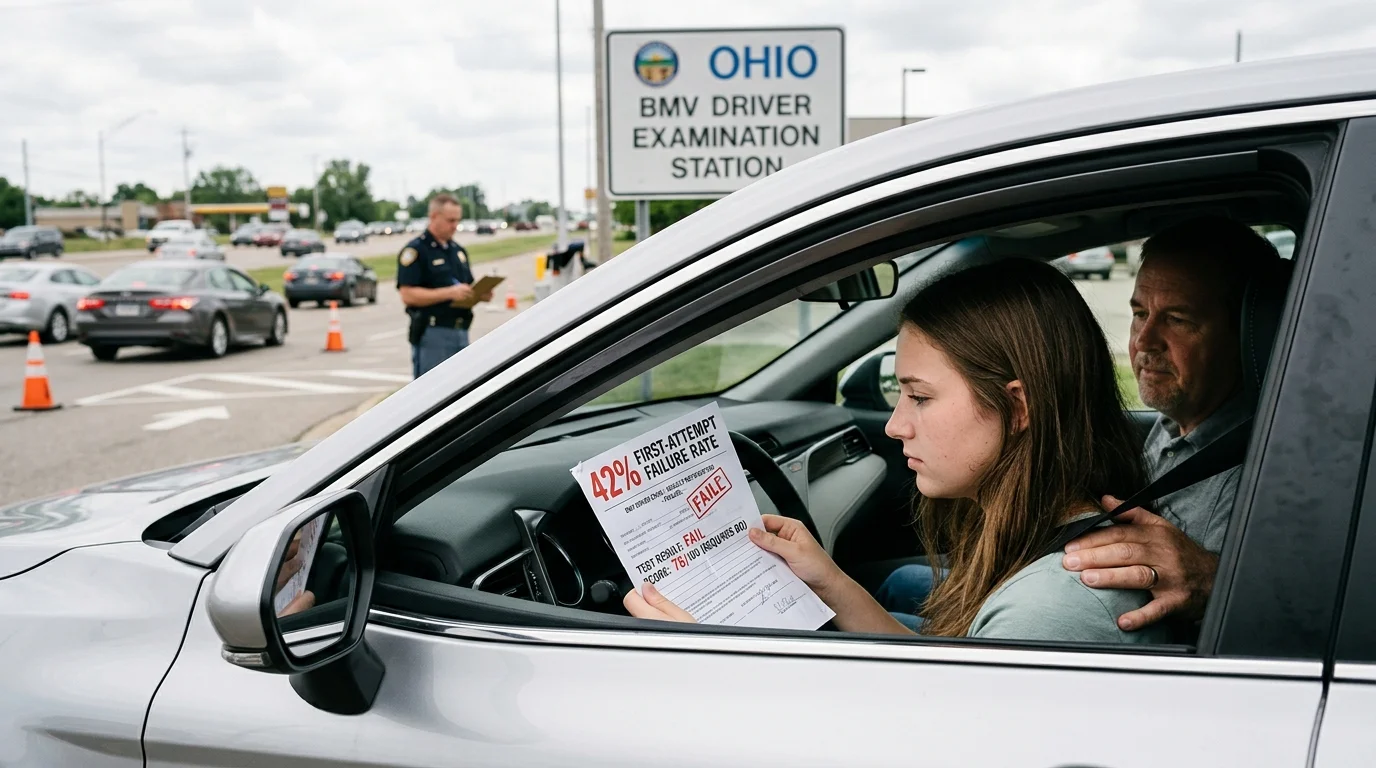
Ohio BMV Test Failure Rates: Why 42% Fail on First Attempt
Mastering statutory driver licensing regulations and highway laws ensures first-time test success.
Quick Answer & Key Takeaways
Ohio BMV testing statistics and failure analysis: 1) WRITTEN TEST (42% FAILURE RATE): 40 total questions split into two sections: 20 road rules (must get 15 correct - 75%) and 20 road signs (must get 15 correct - 75%). You must pass BOTH sections independently; scoring 20/20 on rules but 14/20 on signs results in an overall failure. 2) SKILLS TEST (MANEUVERABILITY): Ohio is the only state testing the 5-cone point-box maneuverability test, responsible for over 35% of road test failures.
- Split 40-Question Test: 20 Road Rules (15 to pass) + 20 Road Signs (15 to pass).
- Must Pass Both Halves: Failing either half fails the entire test.
- Maneuverability Test: 5-marker cone box forward and reverse navigation.
- 24-Hour Adult Remedial Course: Required if an applicant fails the road test twice.
Did you know that nearly 40% of first-time test takers fail the Ohio BMV written temps test? It's one of the highest failure rates for a written exam, primarily because students assume the test is pure "common sense" and neglect to study the specific traffic laws, fines, and road rules of Ohio.
The 3 Most Common Reasons Students Fail
The Ohio BMV temporary permit test features 40 questions split into two sections: Regulations and Signs. Failing either section (by getting more than 5 wrong in either) results in an automatic fail for the entire test.
- Statutory Compliance: Obeying exact vehicle code thresholds rather than informal habits ensures zero penalty points on exam day.
- Defensive Safety Standard: Maintaining safe following distances and active visual scanning eliminates collision risks under Basic Speed Law principles.
- Hazard Recognition: Anticipating changing traffic patterns and road conditions allows proactive rather than reactive braking.
Ohio does not use standard 25/55/65 mph limits everywhere. You will see questions asking about the 15 mph limit in alleys, the 20 mph limit in school zones, or the 35 mph limit on municipal state routes. Relying on "common sense" will lead to incorrect answers.
Underestimating Ohio-Specific Speed Limits
For teen drivers, Ohio GDL laws are strict. 16-year-old drivers have a curfew of midnight to 6 a.m., while 17-year-old drivers have a curfew of 1 a.m. to 5 a.m. These curfew questions are frequently missed.
- Statutory Compliance: Obeying exact vehicle code thresholds rather than informal habits ensures zero penalty points on exam day.
- Defensive Safety Standard: Maintaining safe following distances and active visual scanning eliminates collision risks under Basic Speed Law principles.
- Hazard Recognition: Anticipating changing traffic patterns and road conditions allows proactive rather than reactive braking.
You must identify signs by shape, color, and symbol. Since you must get at least 15 out of 20 signs correct, missing a few unusual warning signs (like school crosswalks vs. pedestrian crossings) will cause an immediate fail.
Confusing the Curfew and GDL Restrictions
Passing the test is simple if you follow a structured study plan:
- Statutory Compliance: Obeying exact vehicle code thresholds rather than informal habits ensures zero penalty points on exam day.
- Defensive Safety Standard: Maintaining safe following distances and active visual scanning eliminates collision risks under Basic Speed Law principles.
- Hazard Recognition: Anticipating changing traffic patterns and road conditions allows proactive rather than reactive braking.
Do not skip reading the handbook. Spend 2-3 hours reading the official Ohio BMV Handbook to build a solid foundation.
Failing the Road Signs Section
Use our Ohio BMV practice tests repeatedly. Do not schedule your real test until you consistently score 90% or higher on our practice tests.
- Statutory Compliance: Obeying exact vehicle code thresholds rather than informal habits ensures zero penalty points on exam day.
- Defensive Safety Standard: Maintaining safe following distances and active visual scanning eliminates collision risks under Basic Speed Law principles.
- Hazard Recognition: Anticipating changing traffic patterns and road conditions allows proactive rather than reactive braking.
The Ohio BMV exam is split into two distinct 20-question parts (Traffic Rules and Road Signs); applicants must achieve at least 75% (15/20) on each individual part.
How to Beat the Odds and Pass on Your First Try
Understanding the exact statutory requirements and defensive driving benchmarks for ohio bmv test failure rates: why 42% fail on first attempt is essential for passing your examination on the first try.
- Statutory Compliance: Obeying exact vehicle code thresholds rather than informal habits ensures zero penalty points on exam day.
- Defensive Safety Standard: Maintaining safe following distances and active visual scanning eliminates collision risks under Basic Speed Law principles.
- Hazard Recognition: Anticipating changing traffic patterns and road conditions allows proactive rather than reactive braking.
Vehicle code statutes require drivers to demonstrate strict compliance with right-of-way rules, speed adjustments, and proper signaling.
Interactive Knowledge Check
Question: How is the Ohio BMV 40-question written exam structured and evaluated?
Authoritative Sources & Regulatory References
Content and statutory guidelines in this guide are verified against official state vehicle codes, federal transportation standards, and authoritative regulatory documentation:
- AAMVAOfficial State Driver Handbooks & Licensing Examination Criteria (2026)(American Association of Motor Vehicle Administrators)
- NHTSANational Highway Traffic Safety Administration (NHTSA) Uniform Guidelines for State Highway Safety(National Highway Traffic Safety Administration)
- FHWAFederal Highway Administration (FHWA) Manual on Uniform Traffic Control Devices (MUTCD)(Federal Highway Administration)
87% of people found this article helpful.
Click a star to add your vote
175 votes • average 4.43 out of 5
Official 2026 DMV Practice Tests by State
Select your state to practice real exam questions based on the latest 2026 driver handbook.
Ready to Pass the DMV Test on Your First Try?
Practice real 2026 DMV questions with instant answer explanations, simulated timers, and pass-guarantee study guides.
Start Free Practice Test