Texas DPS Fines and Limits Permit Practice Test 2026
Perfect for: Learner's permit applicants • First-time adult applicants
Master Texas's traffic fines, speed limits, and surcharge system with 25 challenging practice questions. Texas uses a unique surcharge-based penalty system that goes beyond just fines — violations can cost you thousands over 3 years.
Updated for July 2026
This practice test is up to date as of July 2026. All 25 questions are based on Texas's official 2026 Texas Driver Handbook and the Texas Transportation Code (TTC Title 7).
Understanding Texas's traffic fines and the Driver Responsibility Program is crucial for passing the DPS knowledge test — and for keeping your license. Texas is unique: it layers a surcharge system on top of standard fines, meaning one DUI can cost you thousands of dollars annually for years.
This free practice test covers the penalties you'll face for violating Texas traffic laws. Questions are intentionally challenging — these topics trip up many test-takers. You'll learn about Texas's speed limit system (which reaches 85 mph on one toll road), the fine structure, the surcharge program, license suspension thresholds, and the serious consequences of DWI under Texas Penal Code §49.04.
Expect questions about: how unpaid tickets affect your license, how the surcharge system works, first-offense DWI penalties in Texas, the implied consent law, age-specific BAC limits, and the consequences for leaving the scene of an accident. These are real Texas laws you need to know.
Why is this on the Texas DPS Test?
The Texas DPS wants drivers to understand the serious consequences of traffic violations before they get a license. On your knowledge exam, expect 3–5 questions about:
- Speed limits by zone type
- Texas's surcharge system
- DWI penalties and BAC limits
- License suspension triggers
Texas Speed Limits
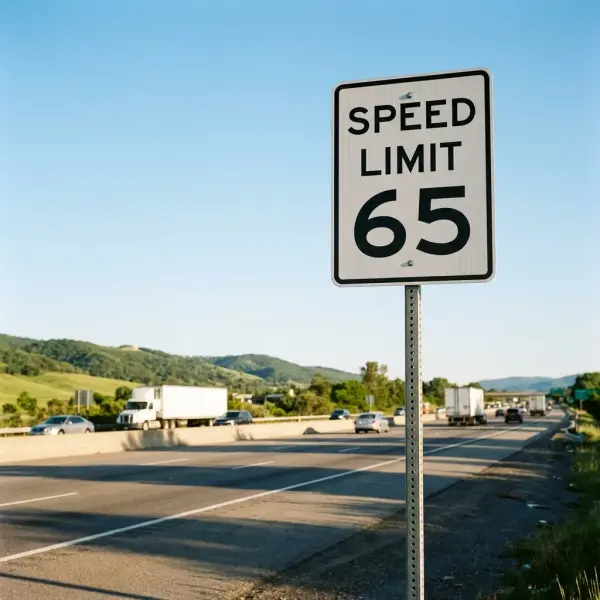
Texas uses statutory (default) speed limits under Texas Transportation Code §545.352 that apply even when no posted sign is visible. Texas is notable for having the highest speed limit in the U.S. — 85 mph on a designated section of SH 130.
| Zone | Texas Limit |
|---|---|
| Urban district / city street | 30 mph |
| School zone (children present) | 20 mph |
| Alley | 15 mph |
| Two-lane rural highway (day) | 70 mph |
| Two-lane rural highway (night) | 65 mph |
| Interstate / divided highway (day) | 70 mph |
| Interstate / divided highway (night) | 65 mph |
| SH 130 designated section (toll) | 85 mph |
Texas Day vs. Night Speed Limits
Texas is one of the few states with separate day and night speed limits on rural highways and interstates. The nighttime limit is typically 5 mph lower than the daytime limit. This is a common DPS test question — always note whether a scenario specifies day or night.
DPS Test Tip: Texas Absolute Speed Law (§545.351)
Texas uses an "absolute" speed limit law — exceeding the posted limit by any amount is a violation. However, Texas also has a reasonably safe and prudent standard: even below the posted limit, if your speed is unsafe for conditions (rain, fog, ice), you can be cited. Going above 85 mph (or a posted limit) on any Texas public road is a criminal offense.
Texas Urban District Speed Limit
Note that Texas sets the urban default at 30 mph — higher than many other states' 25 mph residential limit. School zones reduce this to 20 mph. When the area transitions from urban to rural, the applicable limit changes even without a posted sign.
Minimum Speed on Texas Highways
Texas law (§545.363) prohibits driving so slowly as to obstruct the normal flow of traffic. If you must drive slowly due to a mechanical issue, activate hazard lights and move to the right shoulder. On multi-lane freeways, slower traffic must keep right.
Texas Fines & Penalties
Texas traffic fines are set locally, so the exact amount you pay depends on the county. However, the Texas Transportation Code sets maximums. Texas is also unique in operating a Driver Responsibility Program (DRP) that imposes annual surcharges on top of fines for certain violations.
Texas Speeding Fine Ranges
| Offense | TX Fine Range |
|---|---|
| Speeding (any amount) | $1–$200 (Class C misdemeanor) |
| Speeding in school zone | $25–$200 (doubled: up to $400) |
| Speeding in construction zone | Double standard fines |
| Reckless driving | Up to $200 fine + possible jail |
| Racing on public road | Up to $500 fine + criminal charges |
Texas Driver Responsibility Surcharges
Texas operates the Driver Responsibility Program (DRP) under Texas Transportation Code §708. These are annual surcharges assessed in addition to your fine and billed directly by the Texas DPS for 3 years:
| DWI conviction (1st) | $1,000/year × 3 years = $3,000 |
| DWI with BAC ≥ 0.16% | $2,000/year × 3 years = $6,000 |
| License suspension violation | $250/year × 3 years |
| No insurance (1st offense) | $250/year × 3 years |
| 6+ points on record in 36 months | $100 base + $25 per additional point/year |
Note: Texas has been working to reform the DRP. Check the TxDPS website for the latest surcharge schedule, as amounts may change.
Other Common Texas Violation Fines
| Running a red light / stop sign | Up to $200 |
| Seatbelt violation (driver/front passenger) | Up to $200 |
| Child passenger safety violation | Up to $250 (1st), $1,000+ (2nd) |
| Handheld texting while driving | $25–$99 (1st), up to $200 (repeat) |
| Passing stopped school bus | $500–$1,250 (1st), $1,000–$2,000 (repeat) |
| Hit-and-run (property damage only) | Up to $5,000 + criminal charges |
| No liability insurance | Up to $350 (1st), up to $1,000 (subsequent) |
Texas Point System
Texas tracks driving behavior using a point system under Transportation Code §708.052. Points are assessed for moving violations and at-fault accidents. Accumulating too many points triggers surcharges — unlike some states, Texas does not automatically suspend your license based on points alone, but the financial penalties are severe.
| Violation | TX Points |
|---|---|
| Moving violation in TX or out-of-state | 2 |
| Moving violation involving accident | 3 |
| DWI / intoxicated driver conviction | Automatic surcharge (no points) |
| No insurance conviction | Automatic surcharge (no points) |
Texas Point Surcharge Thresholds
Points trigger annual Driver Responsibility Program surcharges:
- 6 or more points in 36 months: $100/year surcharge + $25 for each point over 6
- Accumulation with prior surcharges: Amounts compound each year the violation stays on your record (3 years)
Texas License Suspension — Mandatory Situations
Texas suspends licenses for these specific acts (not point thresholds):
- DWI conviction — automatic suspension (90 days minimum for first offense)
- Driving without insurance — 90-day suspension + reinstatement fee
- Failure to pay surcharges — license suspended until all surcharges are paid
- Serious traffic offense (racing, leaving the scene, etc.)
- Failure to maintain financial responsibility
Reducing Points in Texas
- Defensive driving course: Completing an approved Texas defensive driving course can dismiss a ticket (once per 12-month period) and prevent points from being added for that violation.
- Points expire: Points remain on your Texas driving record for 36 months from the conviction date.
- Deferred adjudication: Some Texas courts allow first-time offenders to complete conditions and have the charge dismissed, avoiding points entirely.
Texas DWI Laws
Texas calls impaired driving DWI (Driving While Intoxicated) — not DUI. Texas Penal Code §49.04 defines intoxication as having a BAC of 0.08% or above, OR lacking normal use of mental or physical faculties due to alcohol or any substance. The DPS knowledge test regularly includes questions on BAC limits, implied consent, and first-offense consequences.
Texas BAC Limits
| Driver Type | TX BAC Limit |
|---|---|
| Standard (21+ non-commercial) | 0.08% |
| Commercial vehicle operators | 0.04% |
| Under 21 (Zero Tolerance) | 0.00% — any detectable amount |
Texas enforces strict Zero Tolerance for drivers under 21 — any detectable amount of alcohol is illegal (Texas Alcoholic Beverage Code §106.041). This is stricter than many other states.
Texas Implied Consent Law (§724.011)
By driving on Texas roads, you have already given implied consent to a breath or blood test if an officer has reasonable suspicion of DWI. Refusing the test results in an automatic 180-day license suspension for a first refusal (2 years for a second refusal within 10 years). The refusal can also be used against you in court as evidence of consciousness of guilt.
First DWI Offense in Texas — Consequences
- Class B misdemeanor (up to 180 days in jail, minimum 72 hours)
- Fine: up to $2,000 (plus mandatory state surcharges and fees)
- License suspension: 90 days to 1 year
- Driver Responsibility Surcharge: $1,000/year × 3 years = $3,000 total
- Ignition interlock device (IID) may be required as condition of bond
- Texas DWI Education Program or treatment program required
Repeat Offense Escalation in Texas
- 2nd DWI: Class A misdemeanor — up to $4,000 fine + up to 1 year jail + 180-day to 2-year license suspension + $1,500/year surcharge for 3 years
- 3rd DWI: 3rd Degree Felony — up to $10,000 fine + 2–10 years state prison + 2-year license suspension + $2,000/year surcharge for 3 years
- DWI with child passenger: State Jail Felony — even first offense, if a passenger under 15 was in the vehicle
- Intoxication assault or manslaughter: 3rd Degree Felony or 2nd Degree Felony — years of prison
DPS Test Tip: Texas DWI vs. DUI
Texas uses the term DWI (Driving While Intoxicated) for the adult offense and DUI (Driving Under the Influence) specifically for minors under 21 with any detectable alcohol. On the DPS knowledge test, if the question involves someone under 21 with alcohol, the answer is DUI. If it involves an adult, it's DWI. This terminology distinction is frequently tested.
Texas Learner's Permit & Graduated Driver Licensing
Texas uses a Graduated Driver Licensing (GDL) system under the "Driving on the Right Side" program, phasing new drivers into full privileges. This is a frequently tested topic on the DPS knowledge exam.
Texas GDL Phases
| Phase | Texas Rules |
|---|---|
| 1. Learner License | Must be at least 15 years old. Must drive accompanied by a licensed adult (18+) in the front seat at all times. Hold for at least 6 months. Complete 30 hours of supervised driving (10 at night). No driving midnight – 5 AM. |
| 2. Provisional License | Ages 16–17. No passengers in the vehicle under 21 (except immediate family) for the first 12 months. No driving midnight – 5 AM unless accompanied by a licensed adult or for employment or emergency. Must be violation-free for 6 months before restrictions ease. |
| 3. Full License | All restrictions lifted at age 18, or after completing all GDL requirements without violations. |
Texas Texting & Cell Phone Rules
Texas law (Transportation Code §545.4251) bans texting while driving for all drivers. Additionally, drivers in GDL phases may not use any handheld device (including handheld calls). Drivers 18+ may use handheld calls if not in a school zone. School zones have separate restrictions.
Violations During the Texas GDL Period
Violating Texas GDL restrictions delays progression to the next license phase. A moving violation during the provisional period resets the 12-month passenger restriction clock, meaning you must complete another violation-free period before the restriction lifts.
Special Zones & Situations in Texas
Certain areas and situations in Texas carry enhanced rules and penalties. The DPS knowledge test frequently asks about school buses, emergency vehicles, railroad crossings, and Texas's unique open container rules.
Texas Construction Zones
Fines are doubled in active Texas construction zones (Transportation Code §542.404). TxDOT uses orange signs and flashing arrow boards to mark work zones. Speeding in a construction/maintenance zone is a Class B misdemeanor if the zone is properly marked with signs indicating doubled fines.
Texas School Zones
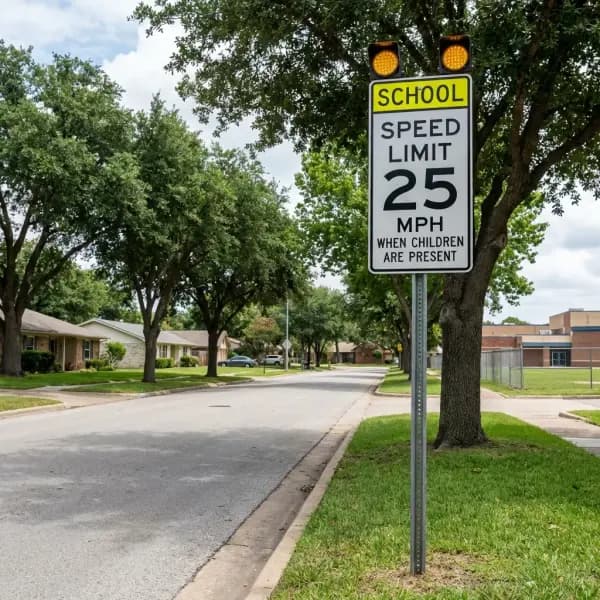
Texas school zones have a speed limit of 20 mph when children are present (or as posted). Fines for speeding in a school zone are doubled. Texas also prohibits using a handheld device (including cell phone calls) while driving in a school zone.
Texas School Bus Rules (§545.066)
- Flashing red lights + stop arm: ALL traffic in BOTH directions must stop at least 20 feet from the bus.
- Divided highway exception: If the road has a raised physical median, only traffic following the bus must stop.
- Texas penalty (1st offense): $500–$1,250 fine; 2nd offense: $1,000–$2,000; possible license suspension.
Texas Railroad Crossing Rules
When railroad signals activate in Texas, you must stop at least 15 feet from the nearest rail. School buses, passenger buses, and vehicles carrying hazardous materials must always stop at crossings, even if lights are not flashing. Never drive around or under lowered gates.
Texas Open Container Law
Texas Penal Code §49.031 prohibits possessing an open container of alcohol in the passenger area of a vehicle on a public highway. This applies even if you are parked. Violation is a Class C misdemeanor (up to $500 fine). Passengers may have open containers in Texas on some charter bus or limo-type vehicles.
Texas Seat Belt Laws
Texas requires all front-seat occupants and all passengers under 17 (regardless of seat position) to be buckled. The driver is responsible for all passengers under 17. Fines for seat belt violations are up to $200 for the occupant and up to $250 for child safety seat violations.
What Happens After a Ticket in Texas
Getting a Texas traffic ticket gives you several options. You generally must respond within 15–30 days of receipt (check your citation). Ignoring a ticket leads to a warrant and additional consequences.
Option 1: Pay the Fine
Paying is a plea of "no contest" or "guilty." The violation goes on your Texas driving record, points are added, your insurance may increase, and you may incur DRP surcharges for 3 years.
Option 2: Texas Defensive Driving Course
Texas allows eligible drivers to take an approved defensive driving course (DDC) to dismiss a traffic ticket and prevent points from being added — available once every 12 months for Class C traffic violations. Requirements:
- Request within specified time after citation
- Carry valid insurance at the time of the violation
- Pay the court fee (typically $10)
- Not have completed DDC dismissal within 12 months
- Complete a 6-hour approved course
Option 3: Contest the Ticket
- Trial by declaration: Submit a written statement — available in some Texas counties without appearing in court.
- In-person trial: Appear before a judge or magistrate. Request the citing officer appear; if they do not, the case may be dismissed.
- Deferred adjudication: First-time offenders may pay a fee and stay violation-free for a period (typically 90–180 days) to have the ticket dismissed without points.
Warning: Failure to Appear in Texas
If you ignore a Texas traffic citation, the court issues a Failure to Appear (FTA) warrant. Your license may be suspended, additional fines are added, and you risk arrest if stopped. The Texas DPS will not renew your license or vehicle registration while you have outstanding warrants or unpaid surcharges.
Texas Out-of-State Tickets
Texas participates in the Nonresident Violator Compact (NRVC) and Driver License Compact (DLC). Out-of-state violations are reported to Texas and treated like Texas violations — including points and insurance impact. Ignoring an out-of-state ticket can result in Texas license suspension.
Test Your Knowledge
These 25 questions are designed to mimic the style and difficulty of the actual Texas DPS knowledge test. Can you score the passing 70%?
What is the maximum speed limit on most highways unless otherwise posted?
Questions are created and maintained by the DMV Question Bank content team following a rigorous editorial process. Content is updated regularly to reflect the latest Texas Driver Handbook and traffic laws. Official sources include the Texas Transportation Code, Texas Penal Code §49, and TxDPS publications.
Frequently Asked Questions
What is the speed limit in Texas school zones?
What is Texas's highest speed limit?
How much is a speeding ticket in Texas?
What are the penalties for a first DWI in Texas?
What is the difference between DWI and DUI in Texas?
How does the Texas point and surcharge system work?
Can I take a defensive driving course to dismiss a Texas ticket?
What is the Texas implied consent law for DWI?
Ready for the Actual Exam?
Fines & limits is just one section. Get your Texas-specific premium study pack with a pass guarantee.